BPC-157: A Research Overview, Structure & Laboratory Interest
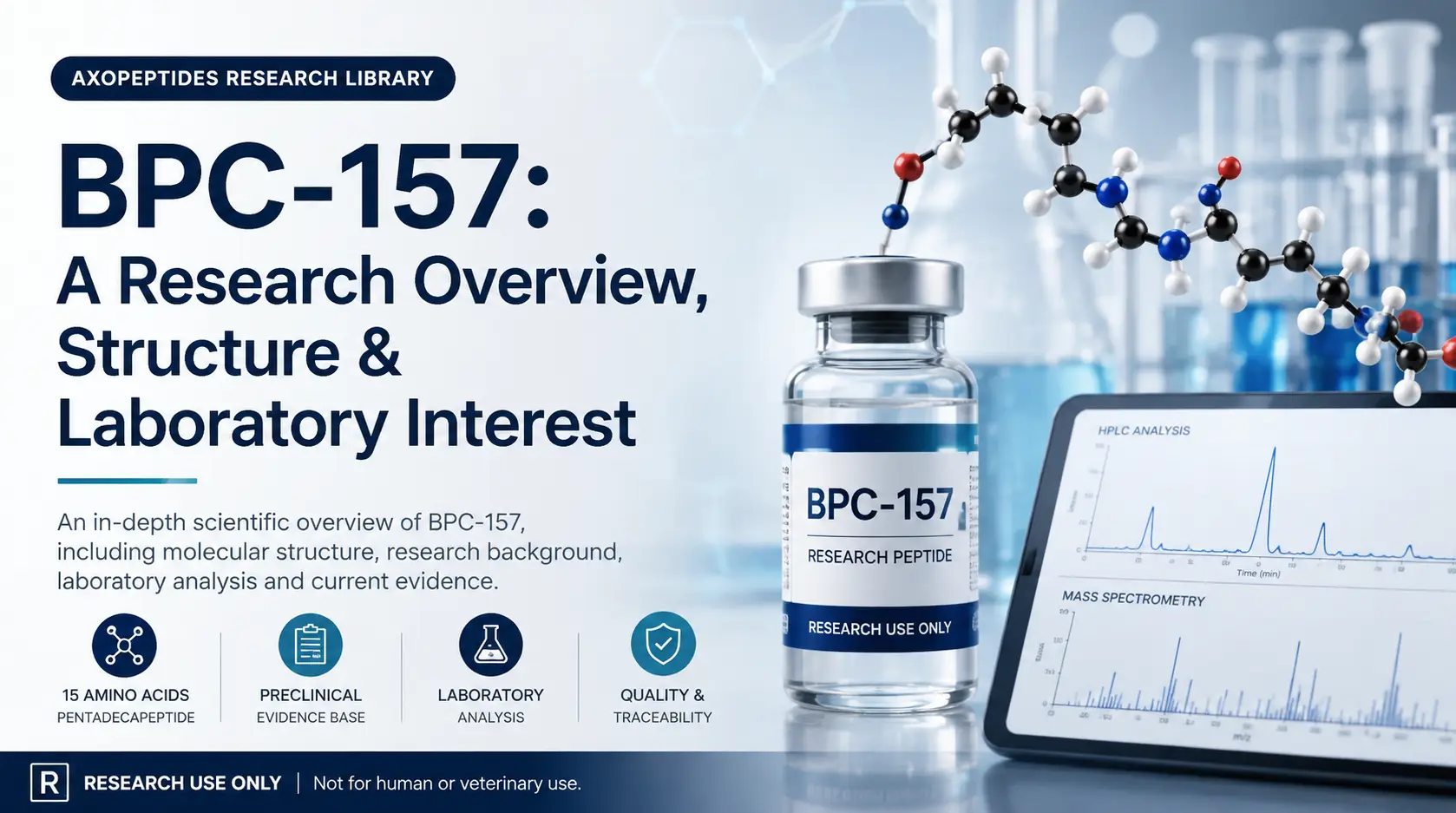
BPC-157 is a synthetic pentadecapeptide that has been investigated across a range of experimental and preclinical research models. This overview examines its molecular identity, scientific background, analytical characterisation and the limitations of the available evidence.
R
Research Use Only.
This article is provided for scientific and educational purposes. It does not provide medical advice, dosing information, reconstitution instructions, administration or injection guidance, treatment recommendations, or instructions for personal or veterinary use.
Peptide Length15 amino acids
CAS Number137525-51-0
Molecular Weight≈ 1419.5 g/mol
Evidence ProfilePredominantly preclinical
Scientific overview
What Is BPC-157?
BPC-157 is a synthetic peptide composed of 15 amino-acid residues. Scientific publications commonly describe it as a stable gastric pentadecapeptide, and the compound has appeared in experimental research literature for several decades.
Its commonly reported amino-acid sequence is GEPPPGKPADDAGLV.
The term pentadecapeptide refers to a peptide containing fifteen amino-acid residues. These residues are joined by peptide bonds, and their exact sequence forms an important part of the molecule's chemical identity.
Important evidence distinction:
BPC-157 has a substantially larger preclinical literature base than human clinical evidence. Experimental observations should therefore not be presented as established outcomes in people.
Molecular identity
Chemical & Molecular Characteristics
Standard chemical identifiers allow researchers to compare information across scientific databases, analytical reports and published literature without relying solely on abbreviations or informal terminology.
Common name
BPC-157 / BPC 157
Peptide length
15 amino-acid residues
Reported sequence
GEPPPGKPADDAGLV
Molecular formula
C62H98N16O22
Approximate molecular weight
1419.5 g/mol
CAS Registry Number
137525-51-0
PubChem CID
9941957
Research classification
Synthetic research peptide
Chemical identity, purity and quantity are separate analytical concepts. A single identifier or reported purity percentage should not be treated as a complete characterisation of a research sample.
Scientific literature
BPC-157 Research Background
BPC-157 has been discussed in scientific literature since the 1990s. Much of the research has involved laboratory experiments and animal models designed to investigate biological pathways, cellular responses and signalling systems.
Preclinical work can be valuable for hypothesis generation and mechanistic investigation. It does not, however, automatically establish clinical relevance.
Translational biomedical research typically progresses through several stages, including laboratory investigation, preclinical models and appropriately controlled clinical studies.
Experimental models
Areas Investigated in BPC-157 Research
Published experimental studies involving BPC-157 have examined a broad range of biological systems. These categories describe areas of scientific investigation rather than established clinical applications.
Neurological ModelsAnimal research exploring neurological and behavioural systems.
Cellular SignallingStudies investigating molecular and cellular signalling pathways.
These research categories should not be interpreted as claims of therapeutic effectiveness, personal benefit or recommended use.
Evidence quality
Understanding the BPC-157 Evidence Base
Not all scientific evidence has the same meaning. Correctly identifying the type of experimental model is essential when interpreting BPC-157 literature.
Current evidence profile
In vitro
Experimental
Laboratory studies performed outside a complete living organism, including cell-based and isolated biological-system investigations.
Animal models
Preclinical
A substantial portion of the published literature involves animal models used to investigate biological mechanisms and experimental responses.
Human studies
Very limited
Published human evidence remains extremely limited compared with the volume of preclinical research.
Clinical evidence
What Human Evidence Exists?
The amount of published human research involving BPC-157 remains very small relative to the level of public attention surrounding the compound.
A 2025 publication reported an IRB-approved safety pilot involving only two participants. An investigation of that size cannot establish clinical effectiveness or provide a comprehensive assessment of safety.
A 2026 review of BPC-157 development also highlighted substantial translational and biopharmaceutical gaps and described the human evidence base as limited.
Scientific interpretation:
findings should be described according to the experimental model in which they were observed. Laboratory or animal observations cannot automatically be converted into claims about outcomes in humans.
Analytical chemistry
Laboratory Analysis of BPC-157
Biological research and analytical chemistry answer different questions. Biological experiments investigate responses within experimental systems, while analytical techniques can help assess characteristics such as identity and chromatographic composition.
High-Performance Liquid Chromatography
HPLC is commonly used in peptide analysis. Components within a sample can be separated under defined chromatographic conditions, producing a chromatogram containing detected peaks.
When performed using an appropriate analytical method, HPLC data can contribute to assessment of chromatographic purity and sample consistency.
Mass Spectrometry
Mass spectrometry examines mass-to-charge characteristics and can provide information that supports assessment of molecular identity.
For peptide analysis, measured mass information can be compared with the expected molecular characteristics of the target compound.
HPLC and mass spectrometry provide complementary analytical information. Chromatographic purity alone should not automatically be interpreted as complete proof of molecular identity.
Quality documentation
Purity, COAs & Analytical Identity
A Certificate of Analysis, commonly abbreviated to COA, records analytical information associated with a particular sample or production batch.
Useful analytical documentation may include:
sample or batch identifier;
name of the submitted material;
analytical method used;
chromatographic purity where applicable;
mass or identity-related analytical information;
test date; and
testing laboratory details.
Researchers should distinguish between purity, identity and quantity. These represent different analytical questions and should not be treated as interchangeable measurements.
Laboratory Reports & Batch Documentation
View available AxoPeptides batch-linked Certificates of Analysis and laboratory documentation.
Reproducibility is a fundamental scientific principle. Researchers comparing experimental work need to know which material was analysed and whether separate experiments involved the same or different batches.
Linking analytical documentation to a defined batch creates a clearer audit trail between a research material and its corresponding analytical information.
Batch identifiers can therefore form part of broader laboratory documentation alongside analytical reports, experimental records and supplier information.
Scientific caution
Current Limitations of BPC-157 Research
Public discussion surrounding BPC-157 is substantially greater than the strength of its available human evidence base.
Much of the published literature is preclinical.
Published human research remains extremely limited.
Some reported human investigations involve very small participant numbers.
Independent replication is limited for parts of the literature.
Translation from experimental models to humans remains uncertain.
Controlled clinical evidence is insufficient for established clinical conclusions.
Responsible scientific communication requires experimental findings to remain described as experimental findings rather than being converted into claims about personal outcomes.
United Kingdom
BPC-157 in the UK Research Context
UK organisations working with experimental compounds should maintain a clear distinction between scientific information and medicinal claims.
The Medicines and Healthcare products Regulatory Agency (MHRA) considers factors including presentation, intended purpose, product claims and pharmacological characteristics when assessing whether a product may fall within medicines legislation.
Research-only positioning should therefore be reflected consistently across product information, imagery, educational content and relevant purchasing interfaces rather than relying solely on a disclaimer.
For this reason, this article contains no dosing, reconstitution, administration or injection guidance and does not present BPC-157 as a treatment or as providing a personal health benefit.
Explore the AxoPeptides Research Catalogue
Browse research materials and associated laboratory information available through the AxoPeptides research catalogue.
BPC-157 is a synthetic peptide consisting of fifteen amino-acid residues. It has primarily been investigated through laboratory and preclinical research.
What is the amino-acid sequence of BPC-157?
The sequence commonly reported in scientific databases and publications is GEPPPGKPADDAGLV.
What is the molecular formula of BPC-157?
PubChem lists the molecular formula as C62H98N16O22.
What is the CAS number for BPC-157?
The CAS Registry Number commonly associated with BPC-157 is 137525-51-0.
What does BPC-157 purity mean?
In an analytical context, purity generally describes the proportion of detected sample attributed to a target component under a defined analytical method. Purity is not the same as identity, quantity or complete sample characterisation.
How can BPC-157 be analysed in a laboratory?
Analytical approaches used for peptide characterisation can include high-performance liquid chromatography and mass spectrometry. The appropriate method depends on the analytical question being investigated.
Does preclinical BPC-157 research establish effects in humans?
No. Findings from laboratory and animal research cannot by themselves establish clinical effects in humans. Published human evidence involving BPC-157 remains very limited.
Where can researchers view peptide laboratory documentation?
AxoPeptides provides a dedicated
COA and Laboratory Reports
section for available batch-linked analytical documentation.
Sources
Scientific & Regulatory References
The following sources provide chemical, scientific or regulatory background relevant to this overview.
National Center for Biotechnology Information.
PubChem Compound Summary for CID 9941957, BPC-157.
View PubChem record
Sikiric P, et al. Stable gastric pentadecapeptide BPC 157: novel therapy in gastrointestinal tract.
Current Pharmaceutical Design. 2011;17(16):1612-1632. PMID: 21548867.
View PubMed record
Lee E, Burgess K. Safety of Intravenous Infusion of BPC157 in Humans: A Pilot Study.
Alternative Therapies in Health and Medicine. 2025;31(5):20-24. PMID: 40131143.
View PubMed record
BPC-157 translational-development review. BPC-157 as an Investigational Peptide Therapeutic: Biopharmaceutical Challenges, Formulation Strategies, and Translational Development Barriers.
2026. PMID: 42198317.
View PubMed record
Medicines and Healthcare products Regulatory Agency (MHRA).
Borderline products: how to tell if your product is a medicine.
View GOV.UK guidance
Medicines and Healthcare products Regulatory Agency (MHRA).
Advertising medicines and medicinal-product guidance.
View GOV.UK guidance