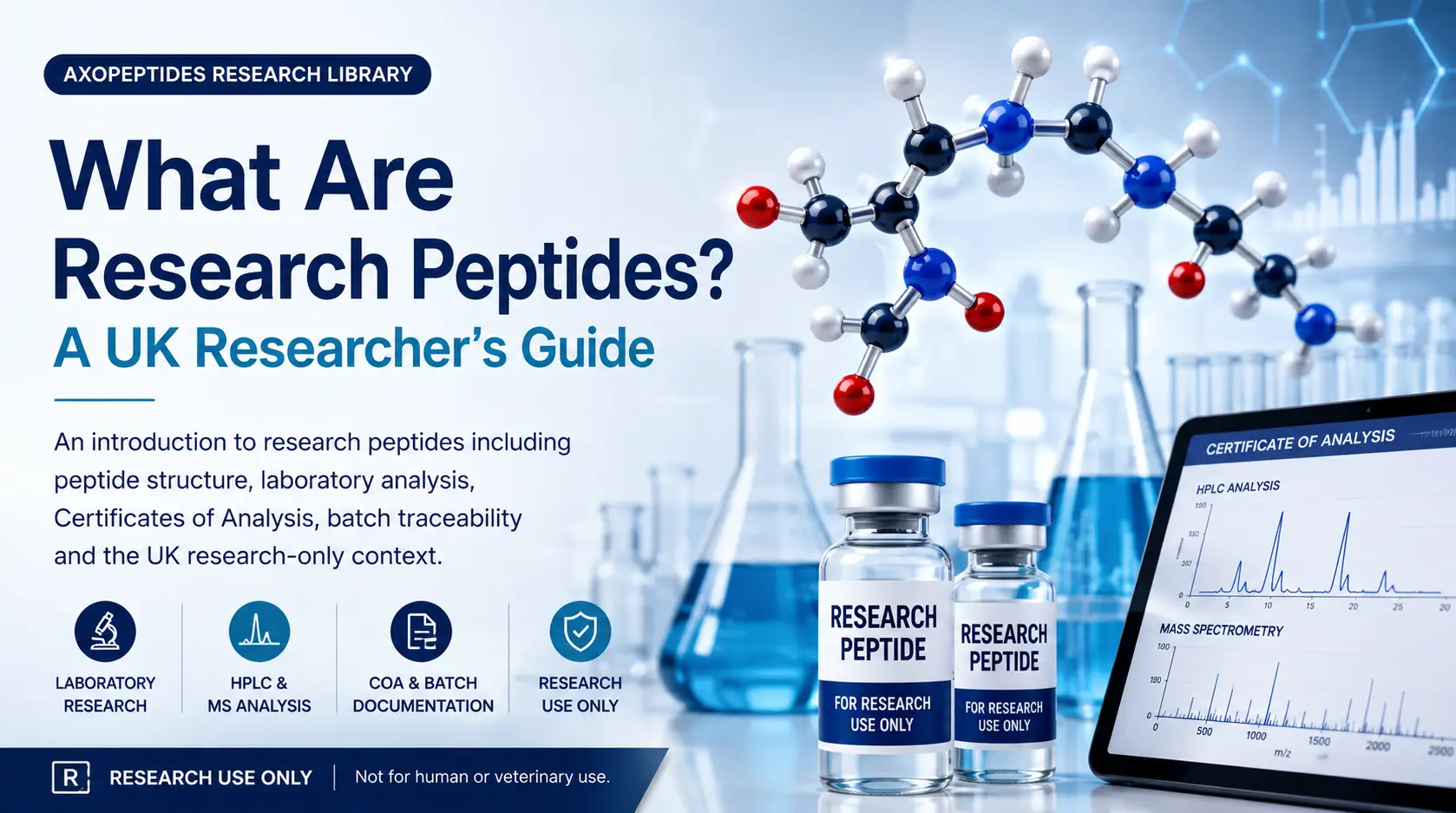
What Are Research Peptides? A UK Researcher’s Guide
Research peptides are peptide materials examined in scientific, analytical and experimental settings. This guide explains peptide structure, laboratory characterisation, analytical documentation, Certificates of Analysis, batch traceability and the UK research-only context.
R
Research Use Only
This article is provided for scientific and educational purposes. It does not provide medical advice, dosing information, reconstitution instructions, administration or injection guidance, treatment recommendations or instructions for personal or veterinary use.
Building BlocksAmino acids
Core LinkagePeptide bonds
Common AnalysisHPLC & MS
DocumentationCOA & batch data
Peptide fundamentals
What Is a Peptide?
Peptides are molecules built from amino-acid residues connected through peptide bonds. The exact sequence of those amino acids is a fundamental part of a peptide's chemical identity.
Amino acids can be arranged in many different sequences. Changing the order of residues can produce a chemically different peptide even when the total number of amino acids remains the same.
AA1
AA2
AA3
AA4
AA5
Sequence matters
The order of amino-acid residues forms part of a peptide's primary chemical identity and can influence its physical and biochemical characteristics.
Research terminology
What Are Research Peptides?
The term research peptide is commonly used to describe peptide material intended for laboratory, analytical or experimental investigation.
The phrase itself does not establish the chemical identity, purity or quality of a sample. Those characteristics require supporting analytical information.
Researchers evaluating peptide material may therefore consider several separate questions rather than relying on a product name or research-use statement alone.
Identity
What compound is represented by the sample?
Sequence
What amino-acid sequence is associated with the target peptide?
Purity
What does the analytical method report about sample composition?
Batch
Which defined production or sample batch is being examined?
Analysis
Which analytical methods were used to characterise the sample?
Traceability
Can the analytical documentation be linked to the specific material?
Molecular structure
How Are Peptides Structured?
Peptide chains are formed when amino-acid residues are joined through covalent peptide bonds. A peptide can therefore be represented as an ordered sequence of connected amino-acid residues.
Scientists may represent amino acids using full names, three-letter abbreviations or one-letter codes. Sequence notation makes it possible to communicate a peptide's residue order efficiently.
Characteristic
Scientific Relevance
Amino-acid sequence
Identifies the order of residues within the peptide chain.
Peptide bonds
Form the covalent connections between neighbouring amino-acid residues.
Molecular formula
Describes the elemental composition associated with a defined molecule.
Molecular mass
Provides an analytical characteristic that can be compared with experimentally measured mass information.
Conformation
Describes the three-dimensional arrangement a peptide may adopt under particular conditions.
Origins & synthesis
Natural, Synthetic & Modified Peptides
Peptide molecules occur throughout biological systems. Researchers can also produce defined peptide sequences through laboratory synthesis.
A synthetic peptide may reproduce a naturally occurring sequence or may contain deliberately designed modifications. Such changes can alter molecular characteristics and therefore need to be reflected accurately in analytical documentation.
Naturally Occurring Peptides
Naturally occurring peptide sequences can be isolated, identified or studied to investigate biological and biochemical systems.
Synthetic Peptides
Laboratory synthesis allows researchers to produce defined peptide sequences for analytical characterisation and experimental investigation.
Experimental research
Why Do Laboratories Study Peptides?
Peptides can be useful experimental molecules because their sequence, composition and molecular characteristics can be defined and investigated.
Peptide research occurs across many scientific disciplines. The purpose of an experiment depends on the question being investigated and should not automatically be interpreted as a clinical application.
Analytical Chemistry
Characterising molecular and chromatographic properties.
Biochemistry
Investigating molecular interactions and biochemical systems.
Assay Development
Developing experimental systems for controlled measurements.
Structural Research
Examining sequence, conformation and molecular interactions.
Chromatography
Investigating separation behaviour under defined conditions.
Mass Spectrometry
Studying mass-to-charge characteristics and molecular identity.
An experimental research topic should not be converted into a claim of therapeutic benefit or a recommendation for personal use.
Analytical chemistry
How Are Research Peptides Analysed?
No single analytical technique necessarily answers every question about a peptide sample. Different methods can provide complementary information.
High-Performance Liquid Chromatography
HPLC separates detected sample components under defined chromatographic conditions. The resulting chromatogram can provide information about sample composition and chromatographic purity.
Mass Spectrometry
Mass spectrometry measures mass-to-charge characteristics. Experimental mass information can be compared with expected characteristics of a target peptide.
01Sample
→
02Analysis
→
03Data
→
04Interpretation
Analytical interpretation
Peptide Purity vs Molecular Identity
Purity and identity are related analytical concepts, but they are not the same measurement.
PURITY
What proportion is detected as the target component?
Chromatographic analysis can report the relative proportion of detected components under a defined analytical method.
IDENTITY
Is the material consistent with the expected molecule?
Identity assessment can involve molecular characteristics such as expected mass and other appropriate analytical data.
Important distinction
A high reported chromatographic purity percentage should not automatically be interpreted as complete proof of molecular identity.
Research documentation
What Is a Peptide Certificate of Analysis?
A Certificate of Analysis, commonly abbreviated to COA, records analytical information associated with a defined sample or batch.
Depending on the scope of testing, useful analytical documentation may include:
sample or batch identification;
submitted material name;
analytical method;
chromatographic purity where applicable;
mass-related or identity-related information;
analysis date; and
testing laboratory information.
AxoPeptides COA & Laboratory Reports
View available batch-linked analytical documentation and Certificates of Analysis.
Research reproducibility depends partly on being able to identify the materials associated with an experiment.
If separate experiments use different batches, accurate batch records make it easier to investigate whether differences in analytical or experimental observations may be associated with the material used.
STEP 1
Research Material
→
STEP 2
Batch Number
→
STEP 3
Laboratory Report
→
STEP 4
Research Record
Scientific literacy
How Should Peptide Research Evidence Be Evaluated?
Scientific findings need to be interpreted according to the experimental system in which they were produced.
Laboratory experiments, animal studies and controlled human investigations answer different questions and represent different stages of evidence.
In vitro
Laboratory experiments outside a complete living organism.
Preclinical
Experimental research that may include animal models and other non-clinical systems.
Human research
Studies involving human participants under defined research protocols.
An observation from one category should not automatically be presented as a conclusion belonging to another.
United Kingdom
Research Peptides in the UK Context
The words Research Use Only can communicate a stated research-only purpose, but they do not by themselves determine whether a product falls within UK medicines legislation.
The Medicines and Healthcare products Regulatory Agency (MHRA) determines whether products fall within the definition of a medicinal product and considers the circumstances and characteristics of the product when making that assessment.
Product claims and presentation are therefore important. Research-only positioning should remain consistent across educational information, product descriptions, imagery and relevant purchasing interfaces.
Scientific wording
Describe laboratory research without turning experimental observations into personal-benefit claims.
Research imagery
Use laboratory, analytical and molecular imagery rather than imagery suggesting personal administration or use.
Consistent presentation
Research-use statements should not contradict surrounding product or promotional content.
This AxoPeptides research guide deliberately excludes:
dosing instructions;
reconstitution instructions;
injection or administration guidance;
treatment recommendations;
personal benefit claims;
customer outcome testimonials; and
bodybuilding or biohacking-style promotion.
Explore the AxoPeptides Research Catalogue
Browse research materials and associated laboratory information available through the AxoPeptides catalogue.
Frequently Asked Questions About Research Peptides
What are research peptides?
The term generally describes peptide materials intended for laboratory, analytical or experimental investigation. Analytical characteristics should be established through appropriate documentation rather than inferred from the phrase alone.
What are peptides made from?
Peptides consist of amino-acid residues linked through peptide bonds. Their amino-acid sequence forms an important part of their molecular identity.
What is a peptide bond?
A peptide bond is the covalent amide linkage connecting neighbouring amino-acid residues within a peptide or polypeptide chain.
Are peptides and proteins the same?
Peptides and proteins are closely related because both are constructed from amino-acid chains joined by peptide bonds. Scientific terminology may distinguish them according to size, structure and context rather than a single universal boundary.
What does HPLC measure in peptide analysis?
HPLC separates detected components under specified chromatographic conditions and can provide information about chromatographic composition and purity.
Does 99% peptide purity prove identity?
No. A chromatographic purity result and molecular identity represent different analytical questions. Additional analytical information may be used when identity assessment is required.
What is a peptide COA?
A Certificate of Analysis records analytical information associated with a particular sample or batch, which may include the analytical method, reported results, testing date and laboratory details.
Why are batch numbers important?
Batch identifiers help connect research materials with their corresponding analytical documentation and research records.
Does “Research Use Only” automatically determine UK legal status?
No. The MHRA can consider the wider characteristics, claims and presentation of a product when determining whether it falls within the definition of a medicinal product.
Where can researchers view AxoPeptides laboratory reports?