AxoPeptides Research Library · Article 21
CJC-1295 with DAC: GHRH Analogue Structure, Drug Affinity Complex & Laboratory Research Overview
Modified GHRH Analogue · Drug Affinity Complex · Analytical Research
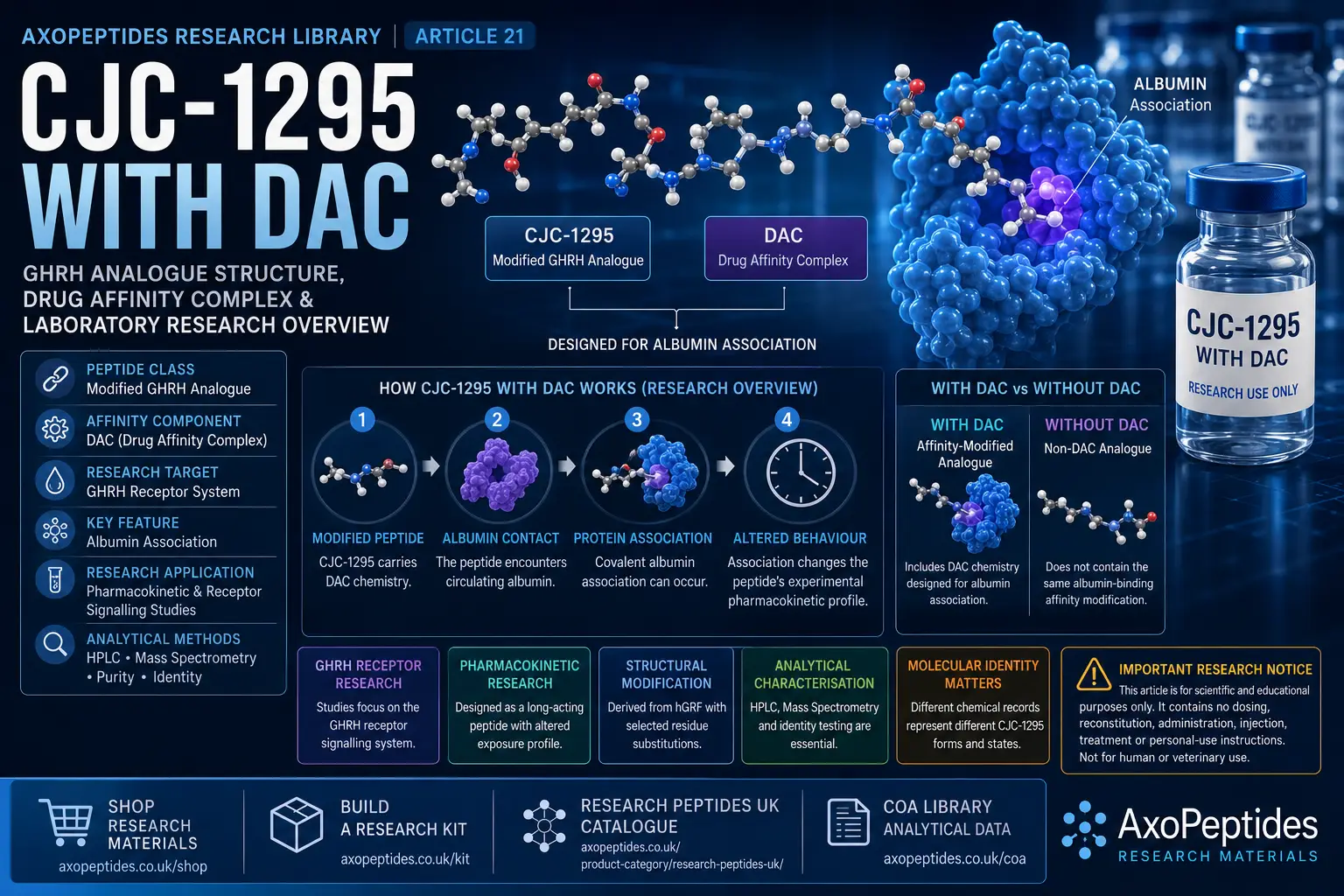
CJC-1295 with DAC is a synthetic peptide analogue derived from
growth-hormone-releasing hormone research. Its molecular design
combines a modified GHRH peptide backbone with a Drug Affinity
Complex, commonly abbreviated DAC.
The DAC component was designed to react with circulating albumin,
creating a peptide–protein association that substantially changes
the pharmacokinetic behaviour of the modified peptide compared
with a corresponding non-DAC analogue.
Researchers exploring related materials can browse the
Research Peptides UK catalogue
,
visit the
AxoPeptides Shop
or
build a research kit
.
Research information notice:
This article is provided for scientific and educational reference
only. It contains no dosing, reconstitution, administration,
injection, treatment or personal-use instructions.
Research Profile
Compound
CJC-1295
Analogue Class
Modified GHRH Analogue
Affinity Component
DAC
DAC Meaning
Drug Affinity Complex
Research Target
GHRH Receptor System
Key Feature
Albumin Association
Molecular Overview
What Is CJC-1295 with DAC?
CJC-1295 is a synthetic analogue developed from the shorter
active region of human growth-hormone-releasing factor.
The molecule was engineered through selected residue substitutions
and addition of an affinity-modifying chemical group.
In the DAC form, a reactive linker is incorporated into the peptide.
This feature was designed to form an association with albumin,
one of the major proteins present in circulating plasma.
The result is a useful example of how peptide chemistry can be
modified to investigate the relationship between molecular structure,
protein association and pharmacokinetic behaviour.
Peptide Analogue Research
Relationship to GHRH
Growth-hormone-releasing hormone, commonly abbreviated GHRH,
is a naturally occurring peptide involved in signalling through
the GHRH receptor system.
CJC-1295 was developed as a modified analogue of the active
hGRF(1-29) region rather than as an unrelated peptide.
Chemical substitutions were introduced to alter properties
such as enzymatic susceptibility and molecular persistence.
01
Reference Peptide
Human growth-hormone-releasing factor provides the
underlying peptide framework.
02
Residue Modification
Selected substitutions distinguish CJC-1295 from the
unmodified reference sequence.
03
Affinity Modification
The DAC component adds an additional protein-binding
chemistry element.
Drug Affinity Complex
What Does DAC Mean?
DAC stands for Drug Affinity Complex. In CJC-1295 research,
it refers to a reactive chemical component incorporated into
the peptide design.
The purpose of this design is to permit covalent association
with albumin after exposure to biological environments containing
suitable reactive protein groups.
STEP 01
Modified Peptide
CJC-1295 carries the DAC chemistry.
STEP 02
Albumin Contact
The peptide encounters circulating albumin.
STEP 03
Protein Association
Covalent albumin association can occur.
STEP 04
Altered Behaviour
Protein association changes the peptide’s experimental
pharmacokinetic profile.
Protein Association Research
Why Is Albumin Important in CJC-1295 Research?
Albumin is a highly abundant plasma protein and has a much larger
molecular size than a short peptide analogue.
Linking a peptide to albumin therefore creates a substantially
different molecular system from the free peptide alone.
This principle is relevant to research involving distribution,
degradation and persistence of modified peptide compounds.
Important distinction:
CJC-1295 with DAC and CJC-1295 without DAC should not be treated
as analytically interchangeable. The affinity-modifying chemistry
changes the compound being studied.
Molecular Comparison
CJC-1295 with DAC vs Without DAC
The terms “with DAC” and “without DAC” describe different
molecular designs. They should not be used as though they
refer to one identical chemical compound.
CJC-1295 with DAC
Affinity-Modified Analogue
Includes Drug Affinity Complex chemistry designed for
albumin association.
Without DAC
Non-DAC Analogue
Does not contain the same albumin-binding affinity
modification used in the DAC form.
Receptor Pharmacology
GHRH Receptor Research
Because CJC-1295 was developed from GHRH-related peptide chemistry,
receptor research has focused on the GHRH receptor signalling system.
Laboratory studies can examine receptor interaction using biochemical
or cellular systems and can compare how molecular modifications
influence activity relative to reference GHRH sequences.
04
Experimental Measurement
Pharmacokinetic Research
Long-Acting Peptide Design
One of the defining research features of CJC-1295 is its use
as a model for prolonged peptide exposure compared with
short-lived GHRH-related molecules.
Pharmacokinetic experiments can measure the disappearance
of a compound from circulation, exposure over time and the
consequences of albumin association on the observed profile.
01
Free Compound
Unbound peptide species can be investigated.
02
Albumin-Associated Form
Protein-bound peptide represents a different molecular state.
03
Time-Course Analysis
Concentration-related measurements can be compared over time.
Chemical Representation
Why CJC-1295 Chemical Records Can Look Different
CJC-1295 terminology is unusually important when reviewing
molecular databases because records may represent different
peptide forms, affinity modifications or associated counterions.
A molecular formula or molecular weight should therefore never
be copied without confirming exactly which CJC-1295 chemical
representation the source is describing.
FORM 01
DAC-Containing Record
Represents affinity-modified CJC-1295 chemistry.
FORM 02
Acetate Record
Includes acetate within the chemical representation.
FORM 03
Without-DAC Record
Chemically distinct from the affinity-modified DAC form.
Analytical Science
Laboratory Characterisation of CJC-1295
Characterising an affinity-modified peptide requires confirming
more than a general product name. Sequence, modification state,
chromatographic behaviour and molecular identity are separate
analytical considerations.
Available analytical documentation for AxoPeptides research
materials can also be reviewed through the
COA Library
.
01
Structural Reference
Expected peptide backbone and DAC modification should be defined.
02
HPLC
Chromatography can investigate relative sample composition.
03
Mass Spectrometry
Mass-related measurements can contribute to molecular identity assessment.
Analytical Interpretation
Purity, Identity & Modification State Are Different Questions
PURITY
Sample Composition
Relative chromatographic composition under the selected method.
IDENTITY
Which Molecule?
Addresses whether analytical evidence corresponds with
the expected CJC-1295 species.
MODIFICATION
With DAC or Without?
The affinity modification forms part of the molecular identity.
Scientific Caution
Important Limitations When Reading CJC-1295 Research
✓ CJC-1295 is a modified GHRH analogue rather than unmodified native GHRH.
✓ The DAC component forms part of the affinity-modified molecular design.
✓ CJC-1295 with DAC and without DAC should not be treated as chemically identical.
✓ Albumin-associated and unbound peptide species represent different molecular states.
✓ Receptor-signalling measurements should remain tied to the experimental system used.
✓ Different PubChem records may represent different CJC-1295 chemical forms.
✓ HPLC purity alone does not establish complete molecular identity or DAC status.
United Kingdom
CJC-1295 in the UK Research Context
Scientific discussion of research compounds should remain clearly
separated from medicinal presentation and personal-use instructions.
MHRA borderline-product guidance explains that classification can
consider product claims, pharmacological properties, intended purpose
and the overall way a product is presented.
Research terminology should therefore remain consistent across
product descriptions, advertising, website content and other
surrounding presentation.
This article intentionally provides no:
Dosing
Reconstitution
Injection Guidance
Administration
Treatment Claims
Personal-Use Guidance
Performance Claims
Testimonials
AxoPeptides Research Catalogue
Explore Research Materials
Browse available research materials individually or select
multiple compounds using the AxoPeptides Research Kit Builder.
Scientific FAQ
Frequently Asked Research Questions About CJC-1295
What is CJC-1295?
CJC-1295 is a synthetic modified analogue developed from
human growth-hormone-releasing factor research.
What does DAC mean in CJC-1295?
DAC stands for Drug Affinity Complex.
Why is albumin studied with CJC-1295?
The DAC chemistry was designed to permit covalent
association between the modified peptide and albumin.
Is CJC-1295 a GHRH analogue?
Yes. CJC-1295 was developed from modified human
growth-hormone-releasing factor peptide chemistry.
Are CJC-1295 with DAC and without DAC the same compound?
No. The DAC affinity modification changes the molecular
structure and experimental behaviour of the compound.
Why do different sources show different CJC-1295 formulas?
Database records can represent different DAC, non-DAC,
parent or acetate-associated chemical forms.
What receptor system is associated with CJC-1295 research?
Research focuses on the GHRH receptor signalling system.
Does HPLC purity prove CJC-1295 DAC identity?
No. Chromatographic purity, peptide identity and affinity
modification state are separate analytical questions.
Scientific Sources
References & Further Reading
Primary scientific publications and chemical databases should
be reviewed in their original context when evaluating CJC-1295 research.
PubChem — CJC-1295
Molecular structure and chemical reference information
for a CJC-1295 record.
View PubChem ↗
PubChem — DAC:GRF Acetate
Separate chemical record associated with CJC-1295 acetate / DAC:GRF.
View PubChem ↗
Jetté L, et al. — 2005
Original structural and pharmacological research describing
CJC-1295 as a tetrasubstituted hGRF analogue with affinity-modifying chemistry.
View PubMed ↗
Teichman SL, et al. — 2006
Pharmacokinetic research examining CJC-1295 as a
long-acting GHRH analogue.
View PubMed ↗
MHRA — Borderline Products Guidance
UK guidance concerning claims, pharmacological properties,
intended purpose and product presentation.
View GOV.UK Guidance ↗
Continue Exploring
Explore AxoPeptides Research Resources
Browse research materials, build a multi-product research kit,
explore the peptide catalogue or review available analytical documentation.
Research Catalogue
Shop Research Materials
Browse the complete AxoPeptides research catalogue.
Visit Shop →
Research Kit Builder
Build a Research Kit
Select multiple research materials in one kit.
Build a Research Kit →
Analytical Records
COA Library
Review available laboratory and analytical documentation.
View COA Library →
Scientific & Laboratory Research Information
This page is intended for scientific, laboratory and educational
information. It provides no dosing, reconstitution, administration,
injection, treatment or personal-use guidance.