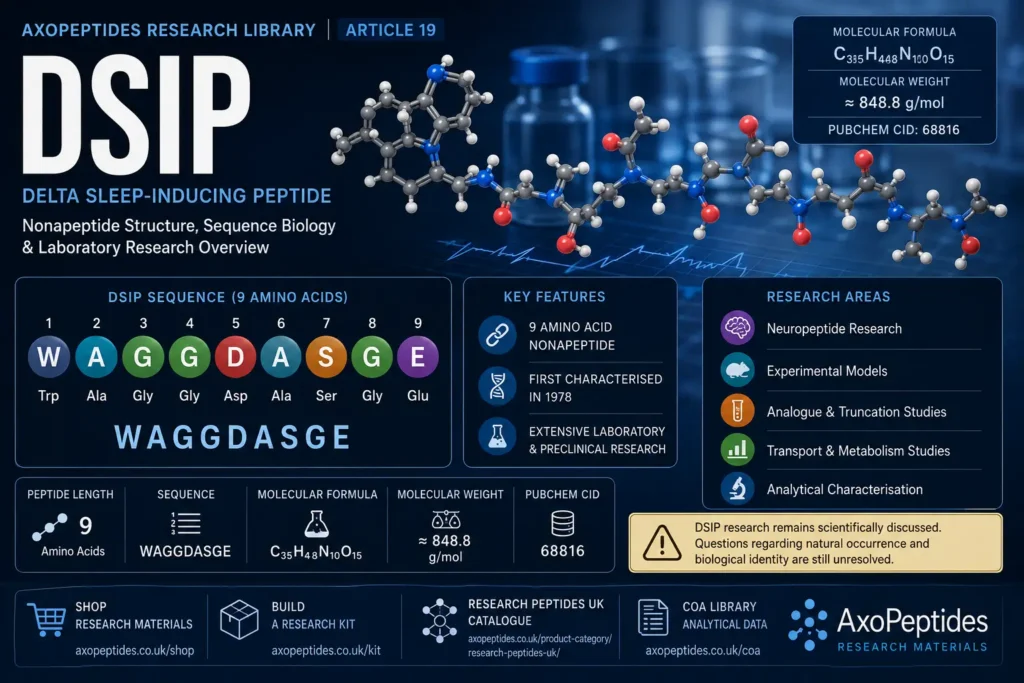
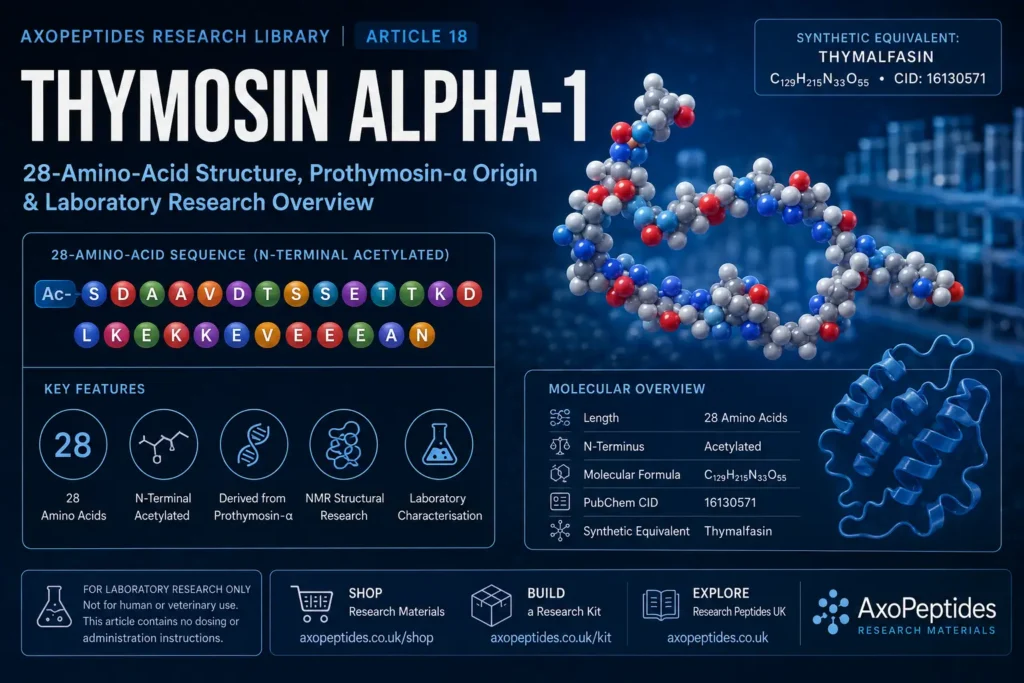
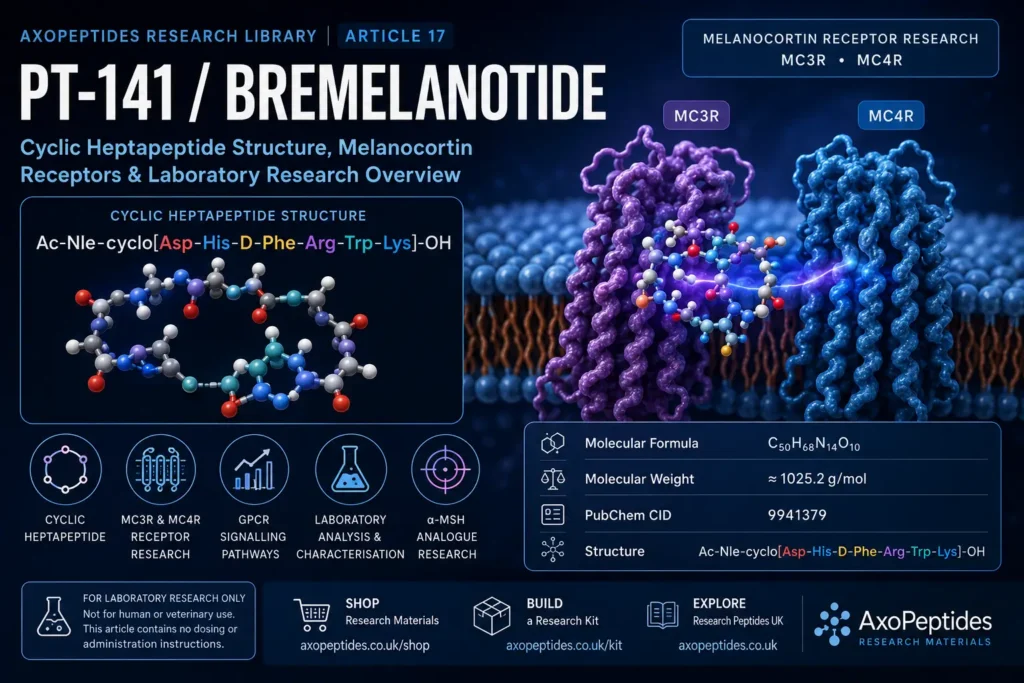
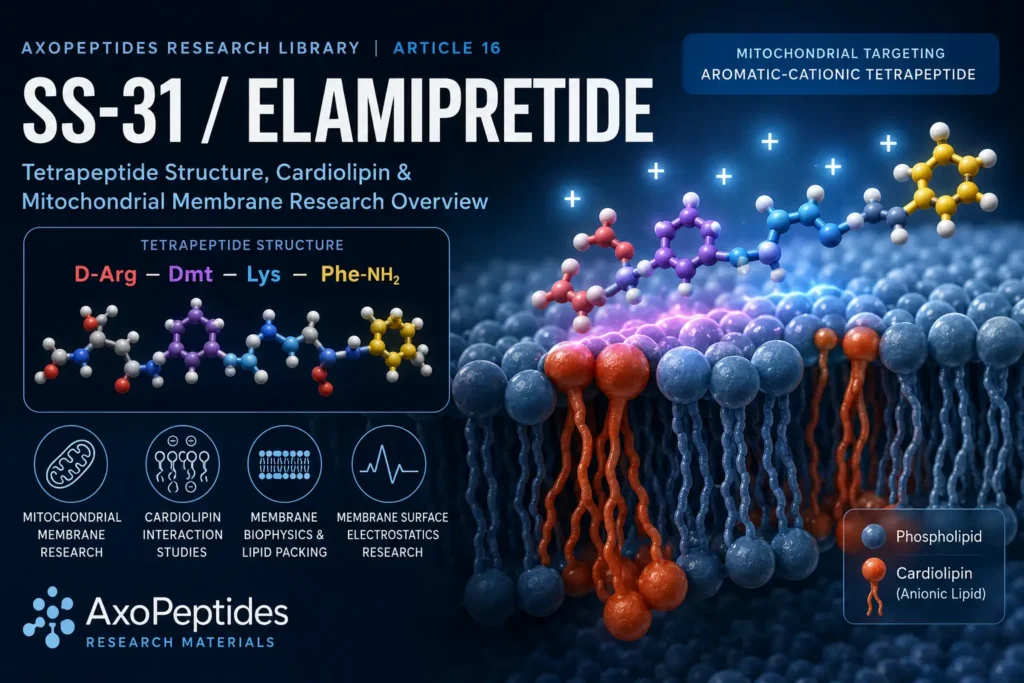
AxoPeptides Research Library · Article 23
KPV: Lys-Pro-Val Tripeptide Structure, α-MSH Fragment Research & Laboratory Overview
Lys-Pro-Val · α-MSH Fragment · Transport & Cellular Research
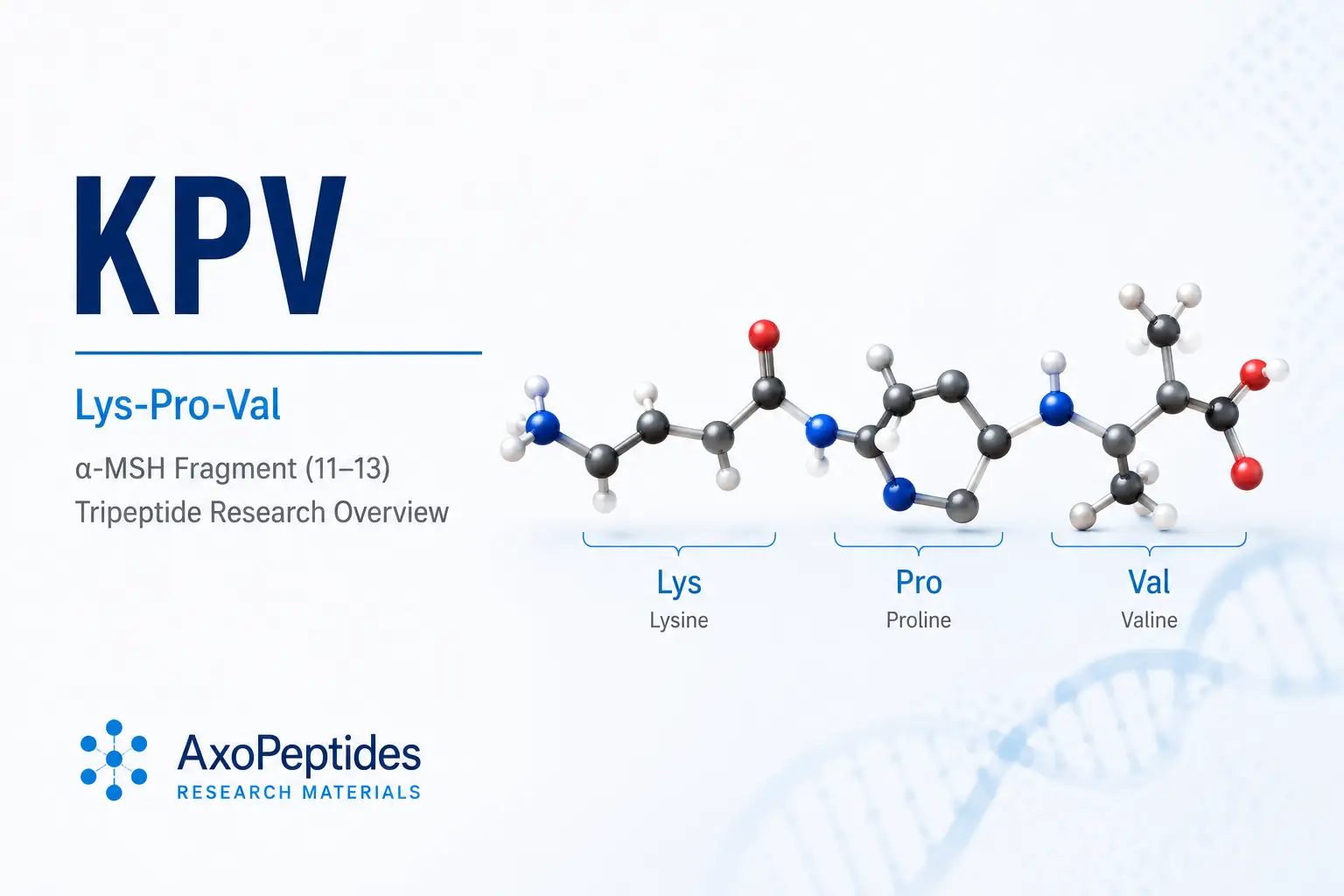
KPV is a short tripeptide composed of lysine, proline and valine.
It corresponds to the C-terminal three-residue region of
α-melanocyte-stimulating hormone, commonly abbreviated α-MSH.
Research involving KPV has examined peptide structure,
α-MSH fragment biology, epithelial transport, PepT1-mediated
uptake, intracellular signalling and analytical characterisation.
Researchers exploring related materials can browse the
Research Peptides UK catalogue
,
visit the
AxoPeptides Shop
or
build a research kit
.
Research information notice:
This article is provided for scientific and educational
reference only. It contains no dosing, reconstitution,
administration, injection, treatment or personal-use instructions.
Research Profile
Compound
KPV
Full Sequence
Lys-Pro-Val
Peptide Length
3 Amino Acids
Parent Peptide
α-MSH
Fragment
MSH 11–13
Molecular Formula
C16H30N4O4
Molecular Weight
342.43 g/mol
PubChem CID
125672
Molecular Overview
What Is the KPV Peptide?
KPV is a chemically defined tripeptide made from three standard
L-amino-acid residues: lysine, proline and valine.
Its sequence can be written using either three-letter or one-letter notation:
Tripeptide Sequence
KPV
Lys – Pro – Val
Tripeptide Architecture
The Three Amino Acids of KPV
Despite its small size, each residue contributes a different
chemical feature to the tripeptide.
01
K
Lysine
Basic amino-acid residue
02
P
Proline
Cyclic secondary-amino-acid residue
03
V
Valine
Branched-chain hydrophobic residue
Peptide Fragment Biology
KPV as the C-Terminal Fragment of α-MSH
KPV corresponds to amino-acid residues 11–13 at the C terminus
of α-melanocyte-stimulating hormone.
This relationship is important because KPV research often compares
the short fragment with the longer α-MSH peptide to determine which
molecular observations depend on the complete parent sequence
and which remain detectable in the shorter tripeptide.
Parent Peptide
α-MSH
Longer melanocortin peptide
C-Terminal Fragment
MSH 11–13
Lys-Pro-Val · KPV
Structure–Activity Research
Why Compare KPV with α-MSH?
Fragment research helps determine which parts of a larger peptide
are necessary for a particular experimental observation.
If a short fragment produces a measurable response under controlled
conditions, researchers can then examine whether the fragment
operates through the same molecular mechanism as the parent peptide
or through a distinct pathway.
01
Parent Sequence
Full α-MSH peptide
02
Minimal Fragment
KPV · residues 11–13
03
Experimental Comparison
Molecular endpoints can be compared.
Transport Research
KPV & PepT1 Transport Research
One experimentally well-described area of KPV research concerns
the peptide transporter PepT1.
PepT1 transports dipeptides and tripeptides across cellular membranes.
Laboratory studies have used epithelial and intestinal model systems
to investigate whether KPV can be transported through this pathway.
STEP 04
Experimental Measurement
Cellular Research
KPV & Intracellular Signalling Research
KPV has been investigated in epithelial and other cellular models
using molecular readouts such as transcription-factor activation,
chemokine signalling and related biochemical endpoints.
These experiments are useful for identifying candidate pathways,
but the mechanism of KPV should not be reduced to one receptor
or one signalling cascade without considering the model used.
Scientific caution:
studies comparing KPV with α-MSH have reported mechanistic
differences. A measurable KPV effect does not automatically prove
that KPV uses the same MC1R/cAMP pathway associated with full α-MSH.
Experimental Science
How Is KPV Studied Experimentally?
Different experimental systems answer different questions
about the peptide.
01
Chemical
Sequence & molecular identity
02
Transport
PepT1-mediated uptake
03
Cellular
Intracellular signalling models
04
Preclinical
Controlled animal research
Analogue Chemistry
KPV & Modified Tripeptide Analogues
Researchers have also investigated structural derivatives of KPV,
including peptides containing altered stereochemistry or modified
residue chemistry.
Analogue studies can help identify which structural features
influence transport, stability or experimentally measured
cellular responses.
REFERENCE
Lys-Pro-Val
Standard all-L KPV peptide
VARIABLE
Stereochemistry
D-amino-acid substitutions can be studied.
MEASUREMENT
Structure–Activity
Modified peptides can be compared experimentally.
Chemical Representation
Parent KPV & Acetate Records
Chemical databases can contain separate records for the parent
Lys-Pro-Val tripeptide and acetate-associated forms.
Parent KPV
C16H30N4O4
Molecular weight 342.43 g/mol
Acetate Representation
KPV Acetate
Includes acetate in the chemical record
Analytical Science
Laboratory Characterisation of KPV
Even a peptide containing only three residues requires
appropriate analytical confirmation of molecular identity.
Available analytical documentation for AxoPeptides research
materials can also be reviewed through the
COA Library
.
01
Sequence Reference
Lys-Pro-Val defines the expected residue order.
02
HPLC
Chromatography can investigate relative sample composition.
03
Mass Spectrometry
Molecular mass-related data can support identity assessment.
Analytical Interpretation
Purity, Identity & Chemical Form Are Different Questions
PURITY
Sample Composition
Relative chromatographic composition under the analytical method used.
IDENTITY
Which Molecule?
Addresses whether analytical evidence corresponds with Lys-Pro-Val.
FORM
Parent or Acetate?
Counterion representation should be identified when comparing records.
Scientific Caution
Important Limitations When Reading KPV Research
✓ KPV is the defined Lys-Pro-Val tripeptide and corresponds to α-MSH residues 11–13.
✓ KPV is not chemically identical to full-length α-MSH.
✓ A shared experimental effect does not prove identical signalling mechanisms.
✓ PepT1 transport observations are specific to transporter-containing experimental models.
✓ Cellular signalling findings should remain identified as cellular evidence.
✓ Animal-model observations should remain labelled as preclinical.
✓ HPLC purity alone does not establish complete molecular identity.
United Kingdom
KPV in the UK Research Context
Scientific discussion of research compounds should remain clearly
separated from medicinal presentation and personal-use instructions.
MHRA guidance explains that the classification of borderline
products can involve product claims, pharmacological properties,
intended purpose and overall presentation.
Research-only terminology should therefore remain consistent
across product descriptions, advertising, website content and
other surrounding presentation.
This article intentionally provides no:
Dosing
Reconstitution
Injection Guidance
Administration
Treatment Claims
Personal-Use Guidance
Therapeutic Claims
Testimonials
AxoPeptides Research Catalogue
Explore Research Materials
Browse available research materials individually or select
multiple compounds using the AxoPeptides Research Kit Builder.
Scientific FAQ
Frequently Asked Research Questions About KPV
What is KPV?
KPV is a tripeptide composed of lysine, proline and valine.
What is the KPV sequence?
The sequence is Lys-Pro-Val, abbreviated KPV.
How many amino acids are in KPV?
KPV contains three amino-acid residues and is therefore a tripeptide.
Is KPV derived from α-MSH?
Yes. KPV corresponds to the C-terminal residues 11–13 of α-MSH.
What is MSH 11–13?
MSH 11–13 is another name used for the Lys-Pro-Val KPV fragment.
What is PepT1?
PepT1 is a transporter capable of carrying selected dipeptides
and tripeptides across cellular membranes and has been investigated
experimentally in relation to KPV.
What is the molecular weight of KPV?
PubChem lists the parent Lys-Pro-Val tripeptide at 342.43 g/mol.
Does HPLC purity prove KPV identity?
No. Chromatographic purity and complete molecular identity are
separate analytical questions.
Scientific Sources
References & Further Reading
Primary research and independent chemical databases should be
reviewed in their full context when evaluating KPV research.
PubChem — MSH (11–13) / KPV
Molecular formula, molecular weight and chemical identifiers
for Lys-Pro-Val.
View PubChem ↗
Dalmasso G, et al. — 2008
Experimental research examining PepT1-mediated uptake of the
Lys-Pro-Val tripeptide in intestinal models.
View PubMed ↗
Elliott RJ, et al. — 2004
Cellular signalling research comparing α-MSH and its
KPV C-terminal fragment.
View PubMed ↗
Brzoska T, et al. — 2008
Review of α-MSH-related peptide chemistry and research involving KPV.
View PubMed ↗
MHRA — Borderline Products Guidance
UK guidance concerning product claims, pharmacological
properties, intended purpose and presentation.
View GOV.UK Guidance ↗
Continue Exploring
Explore AxoPeptides Research Resources
Browse research materials, build a multi-product research kit,
explore the peptide catalogue or review available analytical documentation.
Research Catalogue
Shop Research Materials
Browse the complete AxoPeptides research catalogue.
Visit Shop →
Research Kit Builder
Build a Research Kit
Select multiple research materials in one kit.
Build a Research Kit →
Analytical Records
COA Library
Review available laboratory and analytical documentation.
View COA Library →
Scientific & Laboratory Research Information
This page is intended for scientific, laboratory and educational
information. It provides no dosing, reconstitution, administration,
injection, treatment or personal-use guidance.