AxoPeptides Research Library · Article 20
Epitalon: AEDG Tetrapeptide Structure, Pineal Peptide Research & Laboratory Overview
AEDG Sequence · Tetrapeptide Chemistry · Experimental Research
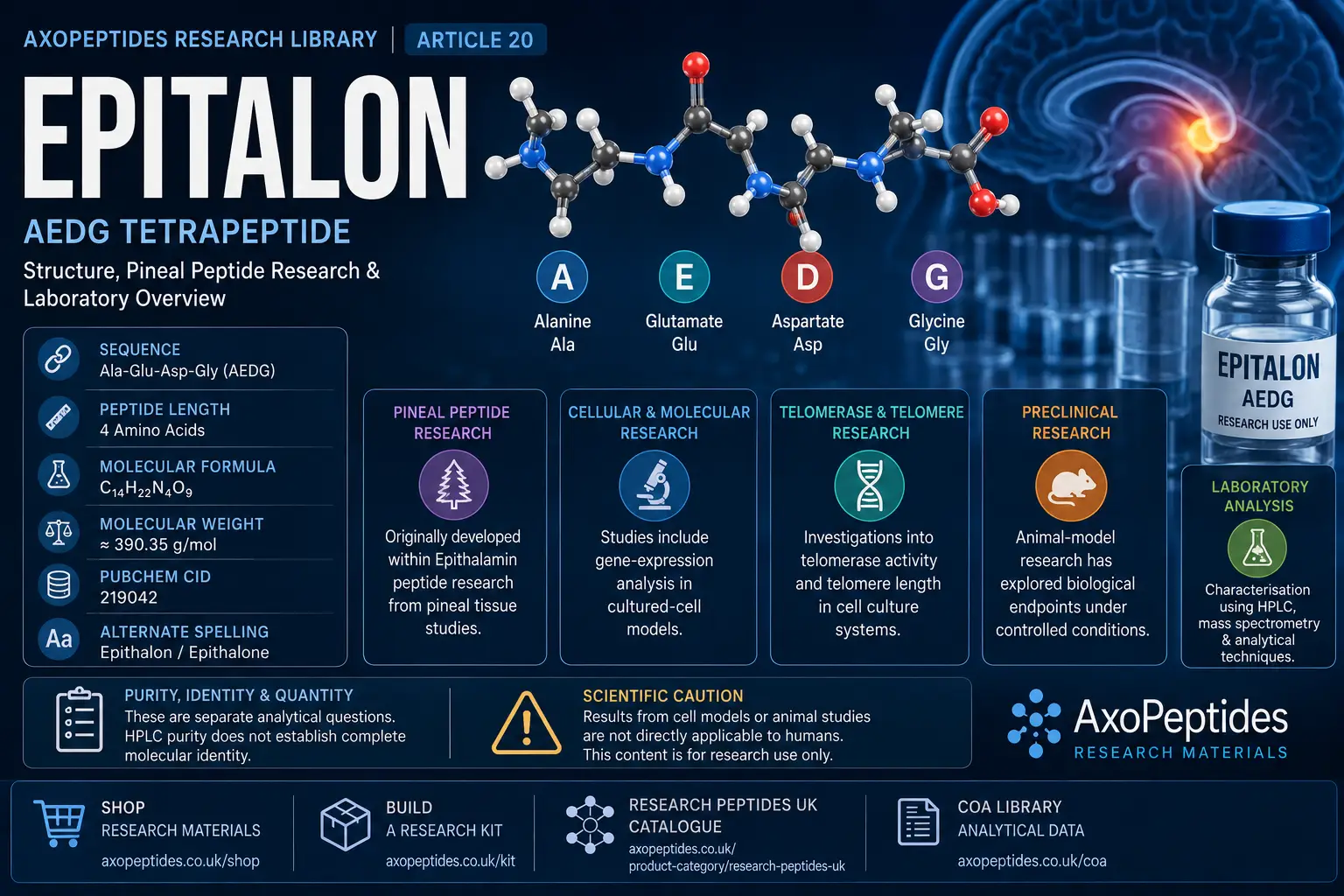
Epitalon, also encountered in scientific literature as Epithalon
or Epithalone, is a short synthetic peptide composed of four
amino-acid residues: alanine, glutamate, aspartate and glycine.
The peptide is commonly represented by the sequence
Ala-Glu-Asp-Gly, abbreviated AEDG. Research involving Epitalon
has included molecular characterisation, gene-expression studies,
cellular models, animal experiments and analytical peptide science.
Researchers exploring related materials can browse the
Research Peptides UK catalogue
,
visit the
AxoPeptides Shop
or
build a research kit
.
Research information notice:
This article is provided for scientific and educational reference
only. It contains no dosing, reconstitution, administration,
injection, treatment or personal-use instructions.
Research Profile
Compound
Epitalon
Alternative Spelling
Epithalon
Peptide Length
4 Amino Acids
Sequence
AEDG
Molecular Formula
C14H22N4O9
Molecular Weight
≈ 390.35 g/mol
PubChem CID
219042
Molecular Overview
What Is Epitalon?
Epitalon is a chemically defined tetrapeptide containing four
amino-acid residues. Its short sequence makes it considerably
smaller than many peptide hormones and signalling peptides studied
in molecular biology.
The standard sequence is:
Four-Residue Sequence
AEDG
Ala – Glu – Asp – Gly
Tetrapeptide Architecture
The Four Amino Acids of Epitalon
The term tetrapeptide means that the molecular backbone contains
four amino-acid residues connected through peptide bonds.
Compound Reference
Epitalon Molecular Characteristics
Standard chemical identifiers provide a reference for distinguishing
the parent AEDG peptide from modified or salt-associated forms.
Common Name
Epitalon
Sequence
Ala-Glu-Asp-Gly
Short Sequence
AEDG
Peptide Length
4 Residues
Molecular Formula
C14H22N4O9
Molecular Weight
≈ 390.35 g/mol
PubChem CID
219042
Historical Research Context
Epitalon & Epithalamin Research
Epitalon was developed within research involving peptide
components associated with pineal tissue extracts historically
referred to as Epithalamin.
It is important to distinguish a chemically defined synthetic
tetrapeptide from a complex biological extract. AEDG provides a
defined molecular sequence that can be synthesised, characterised
and investigated independently.
Historical Material
Epithalamin
Biological peptide-extract research context
Defined Tetrapeptide
Epitalon
Ala-Glu-Asp-Gly · AEDG
Short-Peptide Science
Why Study a Four-Residue Peptide?
Very short peptides provide relatively simple molecular systems
for investigating sequence-specific biochemical interactions.
01
Defined Sequence
AEDG provides a short and precisely defined amino-acid order.
02
Synthetic Accessibility
A short tetrapeptide can be produced and compared across controlled experiments.
03
Molecular Comparison
Sequence variants can be studied to investigate structure-dependent effects.
Cellular Molecular Research
AEDG & Gene-Expression Research
Laboratory studies have investigated whether exposure to AEDG
correlates with measurable changes in gene-expression patterns
within selected cellular models.
Such experiments may use quantitative molecular methods to compare
messenger-RNA or protein-marker measurements between experimental
groups under controlled conditions.
01
Cell Model
Defined cultured-cell systems
02
AEDG Exposure
Defined experimental peptide condition
03
Molecular Measurement
Gene or protein-expression analysis
Evidence interpretation:
A change in a molecular marker within a cell model remains a
cell-model observation and should not automatically be extrapolated
beyond the experimental conditions.
Cell-Biology Research
Epitalon, Telomerase & Telomere Research
Some laboratory studies have investigated Epitalon in cultured
cell systems while measuring telomerase-related activity and
telomere-associated molecular endpoints.
This area is best understood as experimental cell biology.
Telomerase measurements, telomere-length measurements and
cell-population behaviour are separate endpoints and should
not be treated as interchangeable.
ENDPOINT 01
Telomerase Activity
Enzyme-associated measurement
ENDPOINT 02
Telomere Length
Chromosomal molecular measurement
MODEL
Cultured Cells
In-vitro experimental systems
Scientific caution:
Results involving cultured cells should remain described as
in-vitro evidence. They do not independently establish outcomes
outside the cell systems investigated.
Preclinical Research
Animal-Model Research & Experimental Limitations
Epitalon has also been investigated in animal models using
defined experimental protocols and measured biological endpoints.
Animal experiments can provide useful preclinical information,
but they should remain identified as animal-model evidence and
should not be treated as equivalent to other evidence levels.
01
Chemical
Structure and identity
02
Biochemical
Molecular assays
03
Cellular
Cultured-cell research
04
Preclinical
Animal research models
Chemical Representation
Epitalon Parent Compound & Acetate Form
Chemical databases may contain separate entries for the parent
tetrapeptide and an acetate-associated representation.
Parent Compound
Epitalon
C14H22N4O9 · PubChem CID 219042
Salt Representation
Epitalon Acetate
Separate chemical database representation
When comparing molecular formula, molecular weight or analytical
documentation, the chemical form being referenced should be stated clearly.
Analytical Science
Laboratory Characterisation of Epitalon
A synthetic Epitalon sample can be investigated using complementary
analytical techniques addressing sequence, chromatographic
composition and molecular identity.
Available analytical documentation for AxoPeptides research
materials can also be reviewed through the
COA Library
.
01
Sequence Reference
AEDG defines the expected four-residue peptide.
02
HPLC
Chromatography can examine relative sample composition.
03
Mass Spectrometry
Molecular mass-related data can contribute to identity assessment.
Analytical Interpretation
Purity, Identity & Quantity Are Different Questions
PURITY
Sample Composition
Relative chromatographic composition under the analytical method used.
IDENTITY
Which Molecule?
Addresses whether analytical evidence is consistent with AEDG.
QUANTITY
How Much Material?
Requires an appropriate quantitative analytical method.
Scientific Caution
Important Limitations When Reading Epitalon Research
✓ Epitalon is the defined four-residue AEDG peptide and should be distinguished from complex pineal peptide extracts.
✓ Results from cultured cells remain in-vitro experimental evidence.
✓ Telomerase activity and telomere length are separate molecular endpoints.
✓ Gene-expression measurements do not independently establish all downstream biological consequences.
✓ Animal-model findings should remain clearly identified as preclinical.
✓ Parent Epitalon and acetate-associated records should be distinguished when comparing analytical data.
✓ HPLC purity alone does not establish complete molecular identity.
United Kingdom
Epitalon in the UK Research Context
Scientific discussion of research compounds should remain clearly
separated from medicinal presentation and personal-use instructions.
Current MHRA guidance explains that assessment of borderline
products can consider explicit and implicit claims, pharmacological,
metabolic or immunological properties, intended purpose and overall
public presentation.
Research-only terminology should therefore remain consistent across
product descriptions, advertising, packaging, website content,
social media and other surrounding presentation.
This article intentionally provides no:
Dosing
Reconstitution
Injection Guidance
Administration
Treatment Claims
Personal-Use Guidance
Longevity Claims
Testimonials
AxoPeptides Research Catalogue
Explore Research Materials
Browse available research materials individually or select
multiple compounds using the AxoPeptides Research Kit Builder.
Scientific FAQ
Frequently Asked Research Questions About Epitalon
What is Epitalon?
Epitalon is a synthetic tetrapeptide containing four amino-acid residues.
What is the Epitalon sequence?
The sequence is Ala-Glu-Asp-Gly, abbreviated AEDG.
How many amino acids are in Epitalon?
Epitalon contains four residues and is therefore a tetrapeptide.
What is another spelling of Epitalon?
Epithalon and Epithalone are alternative spellings encountered in scientific literature.
What is the molecular formula of Epitalon?
PubChem lists C14H22N4O9 for the parent Epitalon compound.
What is the molecular weight of Epitalon?
The parent compound has a molecular mass of approximately 390.35 g/mol.
Has Epitalon been studied in cell models?
Yes. Published experimental literature includes cultured-cell
studies examining molecular endpoints such as gene expression
and telomere-associated measurements.
Does HPLC purity prove Epitalon identity?
No. Chromatographic purity and complete molecular identity
are separate analytical questions.
Scientific Sources
References & Further Reading
Original research papers and independent chemical databases
should be reviewed in full when evaluating Epitalon research.
PubChem — Epitalon
Molecular formula, chemical structure and compound identifiers.
View PubChem ↗
Khavinson VK, et al. — 2003
Experimental cell-culture research examining telomerase
activity and telomere-associated measurements.
View PubMed ↗
Khavinson V, et al. — 2020
AEDG peptide research involving gene-expression and
protein-marker measurements in cultured cells.
View PubMed ↗
Araj SK, et al. — 2025
Contemporary review of Epitalon chemistry and experimental literature.
View PubMed ↗
MHRA — Borderline Products Guidance
UK guidance concerning product claims, intended purpose,
pharmacological properties and public presentation.
View GOV.UK Guidance ↗
Continue Exploring
Explore AxoPeptides Research Resources
Browse available research materials, build a multi-product research
kit, explore the peptide catalogue or review available analytical
documentation.
Research Catalogue
Shop Research Materials
Browse the complete AxoPeptides research catalogue.
Visit Shop →
Research Kit Builder
Build a Research Kit
Select multiple research materials in one kit.
Build a Research Kit →
Analytical Records
COA Library
Review available laboratory and analytical documentation.
View COA Library →
Scientific & Laboratory Research Information
This page is intended for scientific, laboratory and educational
information. It provides no dosing, reconstitution, administration,
injection, treatment or personal-use guidance.