AxoPeptides Research Library · Article 24
LL-37: Human Cathelicidin Structure, Membrane Interaction & Laboratory Research Overview
37-Residue Peptide · Human Cathelicidin · Membrane Research
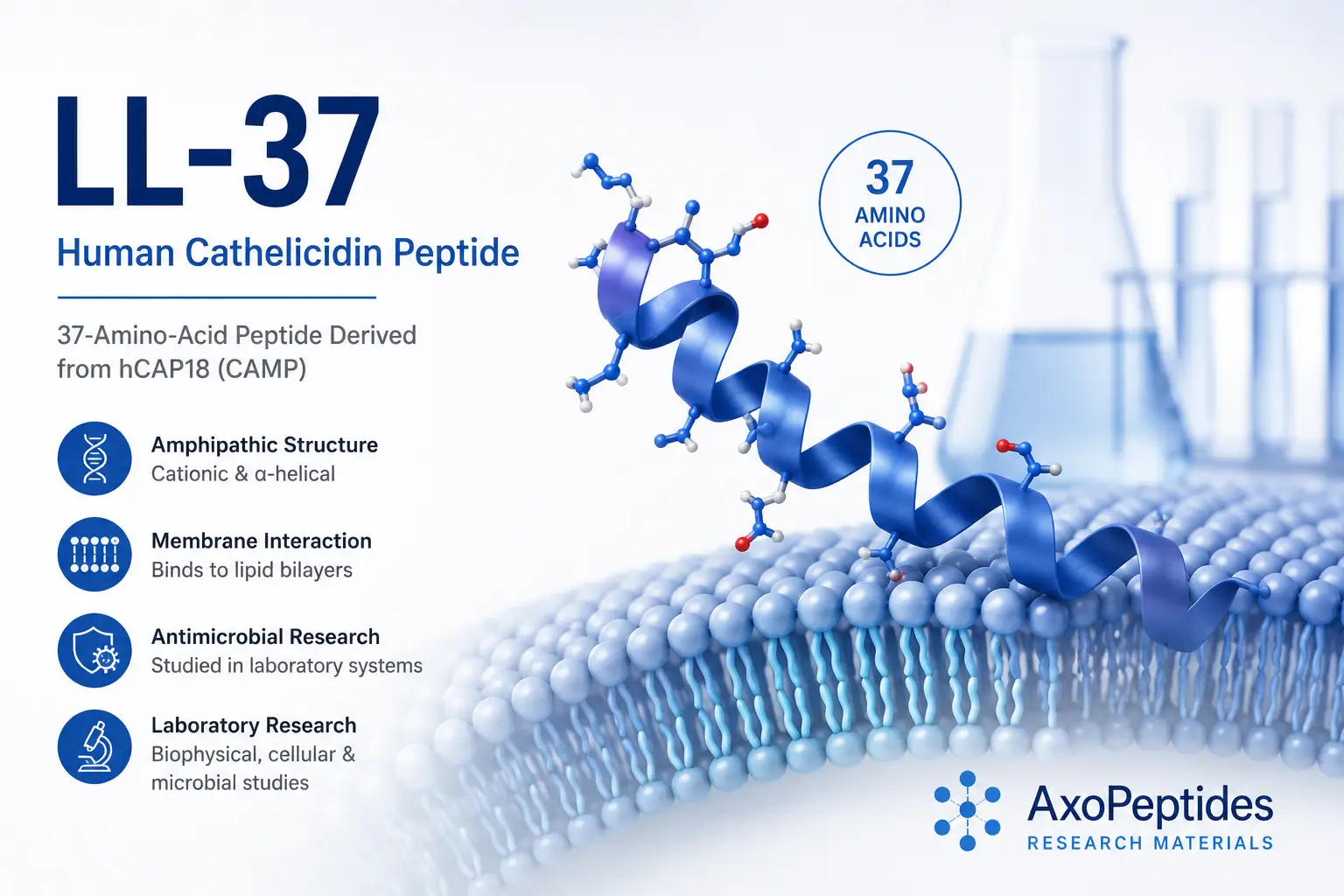
LL-37 is a 37-amino-acid peptide generated from the human
cathelicidin precursor protein hCAP18, encoded by the CAMP gene.
It is the best-characterised mature human cathelicidin peptide
and has been widely investigated in peptide and membrane biology.
Experimental LL-37 research includes peptide structure,
precursor processing, amphipathic helix formation, membrane
association, lipid interaction, self-assembly and antimicrobial
activity in controlled laboratory systems.
Researchers exploring related materials can browse the
Research Peptides UK catalogue
,
visit the
AxoPeptides Shop
or
build a research kit
.
Research information notice:
This article is provided for scientific and educational reference only.
It contains no dosing, reconstitution, administration, injection,
treatment or personal-use instructions.
Research Profile
Compound
LL-37
Peptide Family
Cathelicidin
Precursor
hCAP18 / CAMP
Peptide Length
37 Amino Acids
Structural Character
Cationic / Amphipathic
Molecular Formula
C205H340N60O53
Molecular Weight
≈ 4493 g/mol
PubChem CID
16198951
Molecular Overview
What Is LL-37?
LL-37 is a mature peptide produced through proteolytic processing
of the larger human cathelicidin precursor hCAP18.
The name LL-37 reflects the two leucine residues at its N terminus
and its total length of 37 amino acids.
Its combination of charged and hydrophobic residues gives the peptide
amphipathic characteristics that are particularly relevant in
membrane-interaction experiments.
Precursor Biology
From CAMP / hCAP18 to LL-37
LL-37 is not initially produced as an isolated 37-residue peptide.
The CAMP gene encodes a larger precursor protein commonly referred
to as hCAP18.
STEP 03
Proteolytic Processing
Structural Biology
Amphipathic & α-Helical Structure
LL-37 is frequently described as an amphipathic peptide because
its sequence contains both hydrophobic and positively charged
regions.
Under membrane-like or other suitable experimental conditions,
substantial portions of LL-37 can adopt α-helical conformations.
Structural behaviour can vary with solvent composition, ionic
conditions and lipid environment.
01
Positive Charge
Multiple basic residues contribute cationic character.
02
Hydrophobic Regions
Non-polar residues contribute membrane-facing chemistry.
03
α-Helical Conformation
Helical structure can develop under defined experimental conditions.
Membrane Biophysics
LL-37 & Lipid Membrane Research
A major area of LL-37 research concerns interactions between
the peptide and lipid membranes.
Model bilayer systems allow researchers to investigate peptide
adsorption, membrane insertion, surface charge, lipid organisation
and membrane permeability under controlled laboratory conditions.
VARIABLE
Lipid Composition
MEASUREMENT
Membrane Interaction
Antimicrobial Peptide Research
LL-37 in Experimental Antimicrobial Research
LL-37 has been extensively studied in vitro against a range of
microbial systems. Experimental assays can examine growth inhibition,
membrane disruption and peptide–microbe interactions.
These observations depend strongly on factors such as salt
concentration, peptide concentration, microbial species,
membrane composition and assay methodology.
Evidence interpretation:
antimicrobial activity reported in laboratory assays is an experimental
result. It should not be converted into claims regarding product use
or treatment.
Supramolecular Research
LL-37 Self-Assembly & Oligomerisation
LL-37 can form higher-order peptide assemblies under selected
experimental conditions.
Researchers use spectroscopy, microscopy and structural methods
to investigate whether LL-37 exists as monomers, oligomers or
larger assemblies and how those states influence membrane behaviour.
Experimental Science
How Is LL-37 Studied Experimentally?
01
Chemical
Sequence and molecular identity
02
Biophysical
Membrane and lipid interaction
03
Cellular
Cell-based signalling experiments
04
Microbial
Controlled antimicrobial assays
Analytical Science
Laboratory Characterisation of LL-37
Analytical characterisation should distinguish the intended
full-length 37-residue peptide from truncated fragments,
modified analogues or salt-associated chemical forms.
Available analytical documentation for AxoPeptides research materials
can also be reviewed through the
COA Library
.
01
Sequence Reference
Full 37-residue peptide identity should be defined.
02
HPLC
Chromatography can examine relative sample composition.
03
Mass Spectrometry
Molecular mass-related evidence can contribute to identity assessment.
Analytical Interpretation
Purity, Identity & Peptide Form Are Different Questions
PURITY
Sample Composition
Relative chromatographic composition under the selected method.
IDENTITY
Which Molecule?
Addresses whether evidence is consistent with full-length LL-37.
FORM
Parent, Fragment or Salt?
Chemical form should be identified when comparing analytical records.
Scientific Caution
Important Limitations When Reading LL-37 Research
✓ LL-37 is a 37-residue mature peptide derived from the larger hCAP18 precursor.
✓ Structural conformation depends on experimental environment.
✓ Membrane effects vary with lipid composition and ionic conditions.
✓ Antimicrobial assays are highly dependent on methodology and test conditions.
✓ Full-length LL-37 and shorter LL-37-derived fragments are not chemically identical.
✓ Cellular and microbial experiments represent different evidence levels.
✓ HPLC purity alone does not establish complete molecular identity.
United Kingdom
LL-37 in the UK Research Context
Scientific discussion of LL-37 should remain clearly separated
from medicinal presentation and personal-use instructions.
Current MHRA borderline-products guidance explains that classification
can take account of claims, pharmacological properties, intended purpose
and overall presentation.
This is particularly relevant for compounds with extensively published
biological activity, because the overall wording and presentation matter,
not only the phrase “research use only.”
This article intentionally provides no:
Dosing
Reconstitution
Injection Guidance
Administration
Treatment Claims
Personal-Use Guidance
Infection Claims
Testimonials
AxoPeptides Research Catalogue
Explore Research Materials
Browse available research materials individually or select
multiple compounds using the AxoPeptides Research Kit Builder.
Scientific FAQ
Frequently Asked Research Questions About LL-37
What is LL-37?
LL-37 is a 37-amino-acid human cathelicidin peptide derived from hCAP18.
Why is it called LL-37?
The mature peptide begins with two leucine residues and contains 37 residues in total.
What precursor produces LL-37?
LL-37 is generated from the human cathelicidin precursor hCAP18, encoded by CAMP.
Is LL-37 amphipathic?
Yes. Its sequence contains both charged and hydrophobic regions,
giving the peptide amphipathic structural characteristics.
What is the molecular formula of LL-37?
PubChem lists C205H340N60O53 for LL-37.
What is the molecular weight of LL-37?
PubChem reports a molecular weight of approximately 4493 g/mol.
Why is LL-37 studied with lipid membranes?
Its cationic and amphipathic structure makes peptide–membrane
interaction an important area of biophysical research.
Does HPLC purity prove LL-37 identity?
No. Chromatographic purity and complete molecular identity
are separate analytical questions.
Scientific Sources
References & Further Reading
Original scientific publications and independent databases should
be reviewed in full when evaluating LL-37 research.
PubChem — LL-37Molecular formula, molecular weight and chemical identifiers.View PubChem ↗
UniProt — Human CAMPHuman cathelicidin precursor and post-secretory peptide-processing information.
View UniProt ↗
Dürr UHN, et al. — 2006Structural review of LL-37 as a 37-residue amphipathic
human cathelicidin peptide.View PubMed ↗
Tjabringa GS, et al. — 2005Research review covering the human cathelicidin LL-37
and its diverse laboratory-observed biological activitiesView PubMed ↗
MHRA — Borderline Products GuidanceUK guidance concerning claims, intended purpose,
pharmacological properties and overall presentation.View GOV.UK Guidance ↗
Continue Exploring
Explore AxoPeptides Research Resources
Browse research materials, build a multi-product research kit,
explore the peptide catalogue or review available analytical documentation.
Research Catalogue
Shop Research Materials
Browse the complete AxoPeptides research catalogue.
Visit Shop →
Research Kit Builder
Build a Research Kit
Select multiple research materials in one kit.
Build a Research Kit →
Analytical Records
COA Library
Review available laboratory and analytical documentation.
View COA Library →
Scientific & Laboratory Research Information
This page is intended for scientific, laboratory and educational
information. It provides no dosing, reconstitution, administration,
injection, treatment or personal-use guidance.