AxoPeptides Research Library · Article 22
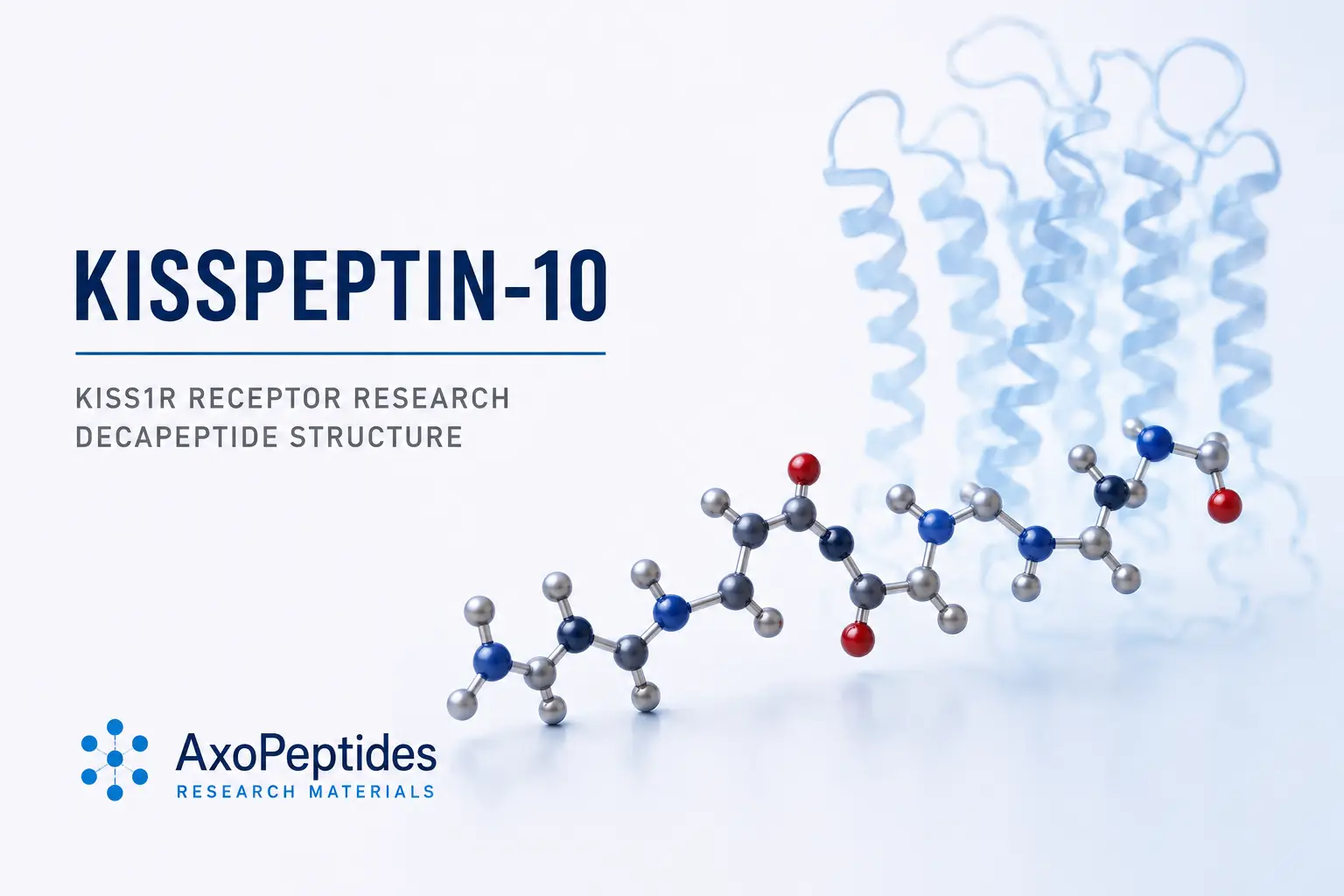
Kisspeptin-10: Decapeptide Structure, KISS1R/GPR54 Signalling & Laboratory Research Overview
10-Residue Peptide · KISS1R Receptor · GPCR Signalling
Kisspeptin-10, commonly abbreviated KP-10 or Kp-10, is a
ten-amino-acid peptide derived from the larger KISS1 precursor.
It represents the shortest naturally occurring kisspeptin fragment
that retains strong activity at the kisspeptin receptor.
Research involving Kisspeptin-10 has examined peptide sequence,
precursor processing, KISS1R/GPR54 receptor binding, GPCR signalling,
structure–activity relationships and laboratory characterisation.
Researchers exploring related materials can browse the
Research Peptides UK catalogue
,
visit the
AxoPeptides Shop
or
build a research kit
.
Research information notice:
This article is provided for scientific and educational reference only.
It contains no dosing, reconstitution, administration, injection,
treatment or personal-use instructions.
Research Profile
Compound
Kisspeptin-10
Abbreviation
KP-10 / Kp-10
Peptide Length
10 Amino Acids
Precursor
KISS1
Receptor
KISS1R / GPR54
Molecular Formula
C63H83N17O14
Molecular Weight
≈ 1302.4 g/mol
PubChem CID
25240297
Molecular Overview
What Is Kisspeptin-10?
Kisspeptin-10 is a short peptide fragment produced from the
KISS1-encoded peptide precursor. It corresponds to the conserved
C-terminal region shared by biologically active kisspeptins.
Other kisspeptin forms described in the literature include longer
fragments such as Kisspeptin-54, Kisspeptin-14 and Kisspeptin-13.
These peptides are related through a common precursor and share
the receptor-active C-terminal region.
Kisspeptin-10 is particularly useful in receptor research because
it is compact while retaining high affinity for KISS1R.
Peptide Architecture
A 10-Residue RF-Amide Peptide
Human Kisspeptin-10 is a decapeptide containing ten amino-acid
residues and a C-terminal amide group. The terminal Arg-Phe-amide
motif places kisspeptins within the broader RF-amide peptide family.
01
10 Residues
The complete KP-10 molecule contains ten amino-acid residues.
02
C-Terminal Region
The receptor-active region is located at the conserved C terminus.
03
RF-Amide Motif
The molecule terminates with an Arg-Phe-amide structural motif.
Precursor Biology
Relationship to the KISS1 Precursor
The human KISS1 gene encodes a larger precursor polypeptide.
Proteolytic processing can generate several shorter kisspeptin
fragments from this precursor.
Kisspeptin-10 represents the shortest well-characterised
endogenous member of this peptide family.
STEP 01
KISS1 Gene
Encodes the kisspeptin precursor.
STEP 02
Precursor Peptide
A larger polypeptide is produced.
STEP 03
Proteolytic Processing
Shorter kisspeptin fragments can be generated.
STEP 04
Kisspeptin-10
Ten-residue receptor-active peptide.
Peptide Family
Kisspeptin-10 & Longer Kisspeptins
Kisspeptin does not refer to only one peptide length. Several
related cleavage products derived from KISS1 have been described.
Receptor Pharmacology
What Is KISS1R / GPR54?
KISS1R is the recognised receptor for kisspeptin peptides.
Earlier literature frequently refers to the same receptor as GPR54.
KISS1R belongs to the G-protein-coupled receptor family.
Kisspeptin-10 can therefore be investigated using receptor-binding,
second-messenger and intracellular signalling assays.
NAME
KISS1R
Current kisspeptin receptor nomenclature.
HISTORICAL NAME
GPR54
Name widely used in earlier receptor literature.
RECEPTOR CLASS
GPCR
G-protein-coupled receptor signalling system.
Cellular Signalling
KISS1R & Gq/11 Signalling Research
Experimental receptor studies indicate that KISS1R can couple
to Gq/11-associated signalling pathways.
This can be investigated through phospholipase-C-associated
signalling, phosphoinositide turnover and intracellular
calcium-mobilisation experiments.
Scientific interpretation:
receptor signalling measurements describe molecular and cellular
events within experimental systems. They should not automatically
be converted into claims beyond those systems.
Structure–Activity Research
Why Kisspeptin-10 Is Useful in Analogue Research
Kisspeptin-10 contains the core C-terminal sequence required
for strong KISS1R interaction, making it useful for comparing
receptor activity across modified peptide analogues.
Researchers can systematically alter residue identity,
terminal chemistry or peptide stability and then compare
receptor binding or signalling measurements.
REFERENCE
Kisspeptin-10
Defined receptor-active reference peptide.
VARIABLE
Residue Substitution
Individual residues can be changed experimentally.
MEASUREMENT
KISS1R Activity
Receptor affinity or cellular signalling can then be compared.
Experimental Science
How Is Kisspeptin-10 Studied?
Kisspeptin-10 research can span several experimental levels.
Each level addresses different scientific questions.
01
Chemical
Sequence and molecular identity
02
Receptor
KISS1R affinity and activation
03
Cellular
Intracellular signalling experiments
04
Preclinical
Controlled animal research models
Analytical Science
Laboratory Characterisation of Kisspeptin-10
A synthetic Kisspeptin-10 sample can be evaluated using
complementary analytical techniques addressing sequence,
chromatographic composition and molecular identity.
Available analytical documentation for AxoPeptides research
materials can also be reviewed through the
COA Library
.
01
Sequence Reference
The expected ten-residue peptide and terminal amidation should be defined.
02
HPLC
Chromatography can investigate relative sample composition.
03
Mass Spectrometry
Molecular mass-related measurements can contribute to identity assessment.
Analytical Interpretation
Purity, Identity & Peptide Form Are Different Questions
PURITY
Sample Composition
Relative chromatographic composition under the analytical method used.
IDENTITY
Which Molecule?
Addresses whether evidence corresponds with Kisspeptin-10.
FORM
Terminal Chemistry
C-terminal amidation forms part of the expected peptide identity.
Scientific Caution
Important Limitations When Reading Kisspeptin-10 Research
✓ Kisspeptin-10 is one member of a family of KISS1-derived peptides.
✓ KP-10 and KP-54 differ in peptide length despite sharing a common receptor-active region.
✓ KISS1R and GPR54 refer to the same receptor under different nomenclature conventions.
✓ Receptor binding and intracellular signalling are separate experimental measurements.
✓ Cellular findings should remain identified as cellular evidence.
✓ Animal-model observations should remain identified as preclinical evidence.
✓ HPLC purity alone does not establish complete molecular identity.
United Kingdom
Kisspeptin-10 in the UK Research Context
Scientific discussion of research compounds should remain clearly
separated from medicinal presentation and personal-use instructions.
Current MHRA borderline-product guidance explains that classification
can consider explicit and implicit claims, pharmacological properties,
intended purpose and overall product presentation. citeturn372872search7turn372872search15
Research terminology should therefore remain consistent across
product descriptions, advertising, website content and other
surrounding presentation.
This article intentionally provides no:
Dosing
Reconstitution
Injection Guidance
Administration
Treatment Claims
Personal-Use Guidance
Hormonal Advice
Testimonials
AxoPeptides Research Catalogue
Explore Research Materials
Browse available research materials individually or select
multiple compounds using the AxoPeptides Research Kit Builder.
Scientific FAQ
Frequently Asked Research Questions About Kisspeptin-10
What is Kisspeptin-10?
Kisspeptin-10 is a ten-residue peptide derived from the KISS1 peptide precursor.
How many amino acids are in Kisspeptin-10?
The peptide contains ten amino-acid residues and is therefore a decapeptide.
What gene is Kisspeptin-10 derived from?
Kisspeptin peptides are generated from a precursor encoded by the KISS1 gene.
What receptor does Kisspeptin-10 bind?
Kisspeptin-10 binds the KISS1 receptor, historically called GPR54.
Is KISS1R the same receptor as GPR54?
Yes. GPR54 is the historical receptor name; KISS1R is the current nomenclature.
What is the molecular formula of Kisspeptin-10?
PubChem lists C63H83N17O14 for human Kisspeptin-10.
What is the molecular weight of Kisspeptin-10?
PubChem reports a molecular weight of approximately 1302.4 g/mol.
Does HPLC purity prove Kisspeptin-10 identity?
No. Chromatographic purity and complete molecular identity are separate analytical questions.
Scientific Sources
References & Further Reading
Original scientific publications and independent databases
should be reviewed in full when evaluating Kisspeptin-10 research.
PubChem — Kisspeptin-10
Molecular formula, molecular weight, synonyms and compound identifiers.
View PubChem ↗
Bilban M, et al. — 2004
Research identifying Kisspeptin-10 as a decapeptide derived from the KISS1 precursor.
View PubMed ↗
Gutiérrez-Pascual E, et al. — 2009
Structure–activity research comparing kisspeptin peptides and KISS1R receptor activity.
View PubMed ↗
UniProt — Human KISS1
Protein reference information describing kisspeptin processing and KISS1R signalling.
View UniProt ↗
MHRA — Borderline Products Guidance
UK guidance concerning claims, intended purpose, pharmacological properties and product presentation.
View GOV.UK Guidance ↗
Continue Exploring
Explore AxoPeptides Research Resources
Browse research materials, build a multi-product research kit,
explore the peptide catalogue or review available analytical documentation.
Research Catalogue
Shop Research Materials
Browse the complete AxoPeptides research catalogue.
Visit Shop →
Research Kit Builder
Build a Research Kit
Select multiple research materials in one kit.
Build a Research Kit →
Analytical Records
COA Library
Review available laboratory and analytical documentation.
View COA Library →
Scientific & Laboratory Research Information
This page is intended for scientific, laboratory and educational
information. It provides no dosing, reconstitution, administration,
injection, treatment or personal-use guidance.