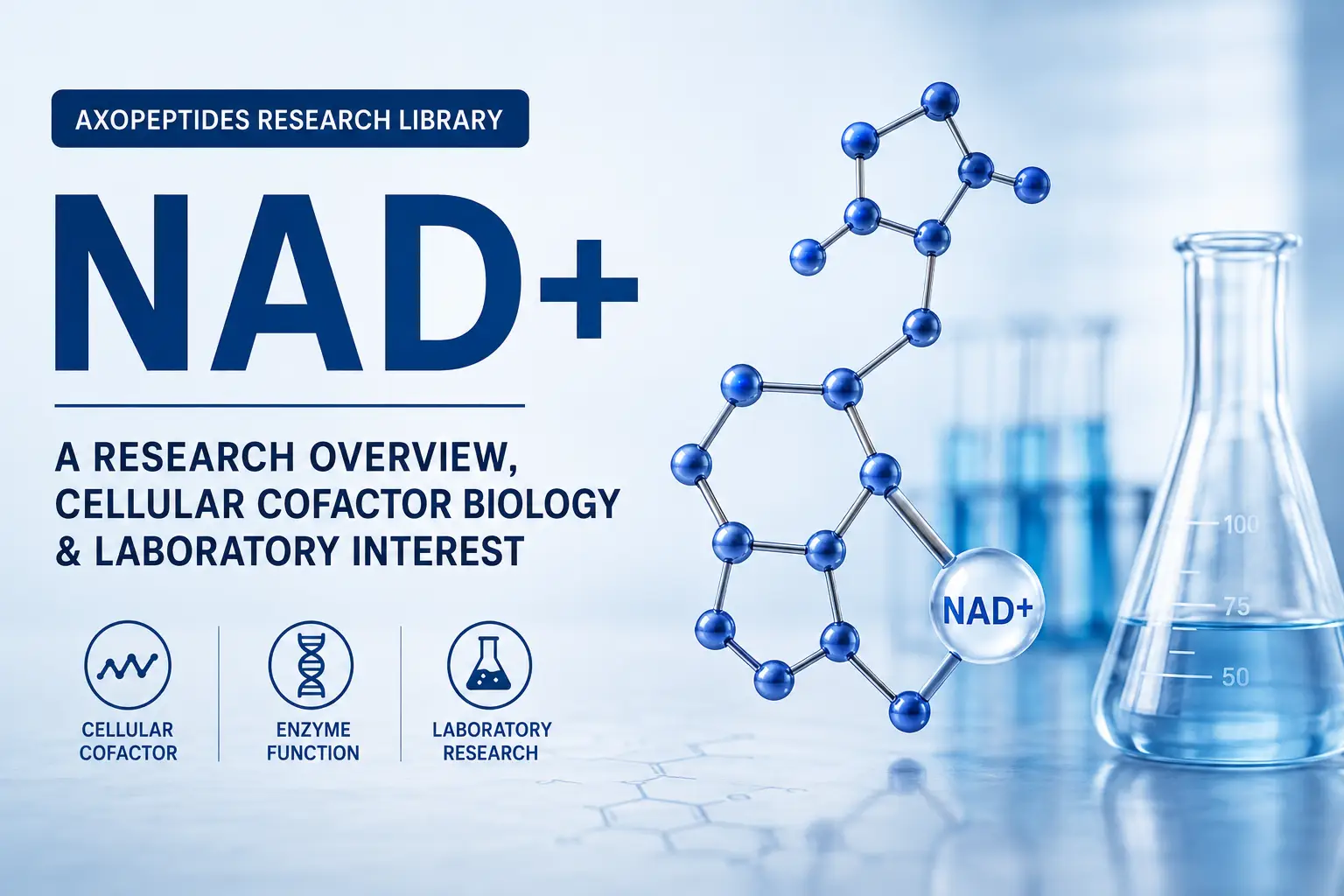
NAD+: A Research Overview, Cellular Cofactor Biology & Laboratory Interest
Nicotinamide adenine dinucleotide, commonly abbreviated NAD+, is a
fundamental cellular coenzyme involved in redox chemistry and numerous
enzyme-dependent processes. This scientific overview examines its
molecular identity, cellular roles, metabolism, analytical
characterisation and limitations of the current evidence.
R
Research & Educational Information
This article is provided for scientific and educational purposes.
It contains no dosing, administration, injection, treatment,
supplementation or personal-use instructions.
COMPOUNDNAD+
FULL NAMENicotinamide Adenine Dinucleotide
MOLECULAR WEIGHT≈ 663.4 g/mol
PRIMARY ROLECellular coenzyme
MOLECULAR IDENTITY
What Is NAD+?
NAD+ stands for nicotinamide adenine dinucleotide.
It is a naturally occurring cellular molecule that acts as an
important coenzyme in numerous biochemical reactions.
One of its best-established functions is participation in
oxidation–reduction reactions. In these reactions, NAD+ can accept
reducing equivalents and be converted to its reduced form,
NADH.
NAD+ also participates in non-redox cellular processes by serving
as a substrate for several enzyme families.
Key scientific point
NAD+ is not merely an energy-related molecule. Its biology also
includes enzyme-dependent processes involving signalling,
DNA-associated pathways and cellular regulation.
CHEMICAL CLASSIFICATION
Is NAD+ a Peptide?
No. NAD+ is not a peptide.
Peptides are composed of amino-acid residues linked through peptide
bonds. NAD+ instead belongs to a different chemical class and is
constructed from nucleotide-derived components.
PEPTIDE
Amino-Acid Chain
Composed of amino-acid residues joined through peptide bonds.
NAD+
Dinucleotide Coenzyme
Built from nucleotide-related components and functions as
a cellular coenzyme.
Keeping this distinction clear improves scientific accuracy,
particularly on websites that catalogue both peptides and other
research compounds.
MOLECULAR STRUCTURE
NAD+ Molecular Characteristics
NAD+ is composed of two nucleotide-related units connected through
a pyrophosphate linkage.
One part contains adenine, while the other contains nicotinamide.
These structural features are central to the molecule's role in
biochemical reactions.
Common abbreviationNAD+
Full nameNicotinamide adenine dinucleotide
Oxidation stateOxidised form
Molecular formulaC21H27N7O14P2
Approximate molecular weight663.4 g/mol
Chemical classDinucleotide coenzyme
REDOX BIOCHEMISTRY
NAD+ in Oxidation–Reduction Reactions
NAD+ is widely studied as an electron-carrying coenzyme in cellular
redox reactions.
In simplified terms, NAD+ can accept reducing equivalents during an
enzymatic reaction and become NADH.
OXIDISED FORM
NAD+
⇄
REDOX TRANSFER
Electron / hydride chemistry
⇄
REDUCED FORM
NADH
This diagram represents a simplified biochemical relationship rather
than a complete metabolic pathway.
NAD+/NADH cycling is involved in numerous metabolic reactions,
including pathways associated with glycolysis, the citric-acid cycle
and mitochondrial oxidative metabolism.
COENZYME PAIR
What Is the Difference Between NAD+ and NADH?
NAD+ and NADH are two redox states of the same coenzyme system.
NAD+
Oxidised Form
Can participate as an electron or hydride acceptor in
appropriate enzyme-catalysed reactions.
NADH
Reduced Form
Carries reducing equivalents that can participate in subsequent
biochemical reactions.
Researchers frequently examine the NAD+/NADH relationship because
it can provide information about cellular redox state and metabolism.
ENZYME BIOLOGY
NAD+-Dependent Enzymes
NAD+ is not used exclusively in classical redox reactions.
Several enzyme families consume NAD+ as part of their catalytic activity.
Sirtuins
NAD+-dependent enzymes investigated in relation to protein
deacylation and cellular regulation.
PARPs
Poly(ADP-ribose) polymerases use NAD+ in reactions associated
with ADP-ribosylation and DNA-related cellular processes.
CD38
An NAD+-consuming enzyme extensively investigated in cellular
signalling and NAD metabolism.
Important distinction
These molecular roles describe established biochemical pathways.
They should not be converted directly into claims that increasing
NAD+ produces a particular outcome in a person.
CELLULAR METABOLISM
How Is NAD+ Maintained in Cells?
Cells maintain NAD+ through interconnected biosynthetic and recycling
pathways.
Nicotinamide and other vitamin-B3-related precursors participate
in pathways that can contribute to NAD biosynthesis.
01Biosynthesis
Cells can generate NAD+ through biochemical pathways involving
precursor molecules.
02Salvage Pathways
Cellular recycling pathways regenerate NAD+ from metabolites
produced during NAD-consuming reactions.
03Consumption
Enzymes including sirtuins, PARPs and CD38 consume NAD+ during
specific catalytic processes.
04Redox Cycling
NAD+ and NADH continuously interconvert through numerous
enzyme-mediated metabolic reactions.
SCIENTIFIC RESEARCH
Areas Investigated in NAD+ Research
NAD+ is studied across a very broad range of biochemical and
cellular research fields.
The areas below represent scientific research topics, not claims
of treatment or personal benefit.
Energy Metabolism
Research into redox reactions and metabolic energy pathways.
Mitochondrial Biology
Experimental investigation of NAD-dependent metabolism within
mitochondrial systems.
DNA-Associated Processes
Research involving NAD-consuming enzymes such as PARPs.
Cell Signalling
Studies examining NAD-dependent signalling pathways and
enzyme activity.
Cellular Senescence
Experimental research examining relationships between NAD
metabolism and cellular ageing models.
Immune Cell Biology
Research into enzymes such as CD38 and their relationship
with NAD metabolism.
Research topic ≠ clinical claim
The fact that NAD+ participates in a biological pathway does not
establish that externally supplied NAD+ produces a particular
health outcome.
EVIDENCE INTERPRETATION
Understanding NAD+ Research Evidence
NAD+ research includes fundamental biochemistry, cell studies,
animal experiments and human studies involving different interventions.
These categories should not be treated as interchangeable evidence.
01Biochemical Evidence
Enzyme reactions, molecular structures and redox chemistry.
02Cellular Research
Experiments involving cultured cells and defined cellular systems.
03Animal Models
Preclinical investigation of NAD metabolism in whole organisms.
04Human Research
Studies may investigate NAD metabolism, NAD precursors or
other interventions, each requiring separate interpretation.
ANALYTICAL CHEMISTRY
Laboratory Analysis of NAD+
Analytical methods can be used to identify and quantify NAD-related
compounds in research samples.
01Chromatography
HPLC and related methods can separate NAD+, NADH and other
sample components under defined conditions.
02Mass Spectrometry
Mass-spectrometric analysis can provide data supporting
molecular identification.
03Spectroscopic Methods
NADH has characteristic absorbance properties that can be used
in biochemical assays.
04Quantitative Assays
Enzymatic or analytical assays may be used to quantify NAD-related
metabolites depending on the research question.
Chromatographic Analysis
Chromatography can separate NAD+ from related compounds and degradation
products under specified analytical conditions.
Mass Spectrometry
Mass spectrometry provides molecular mass-related data that can
contribute to compound identification.
ANALYTICAL INTERPRETATION
Purity, Identity & Quantity
These analytical terms describe different properties of a research sample.
PURITY
Sample Composition
Describes relative composition detected under a specific
analytical method.
IDENTITY
Molecular Confirmation
Addresses whether the detected material is consistent with
the expected compound.
QUANTITY
Measured Amount
Determines how much of the compound is present using an
appropriate quantitative method.
Do not confuse purity with content.
A chromatographic purity percentage does not by itself establish
the absolute amount of NAD+ present in a research sample.
ANALYTICAL DOCUMENTATION
What Should an NAD+ Certificate of Analysis Show?
A useful COA should make clear which material was tested, which
analytical method was used and which batch the results represent.
Material or compound name
Batch or sample identifier
Analytical method
Testing date
Chromatographic result where applicable
Identity-related data where tested
Quantitative data where applicable
Testing laboratory details
Clear link between test sample and represented batch
COA & Laboratory Reports
View available AxoPeptides batch-linked Certificates of Analysis
and analytical documentation.
Laboratory data should be traceable to the actual research material
represented by the report.
01
Research Material
→
02
Batch ID
→
03
Test Sample
→
04
Laboratory Analysis
→
05
COA
This improves documentation and helps researchers distinguish
one research batch from another.
SCIENTIFIC LIMITATIONS
Important Limitations in NAD+ Research
NAD+ has fundamental cellular roles, but this does not establish
that externally supplied NAD+ reproduces every intracellular function.
Biochemical pathway involvement should not be converted directly
into claims of human benefit.
Studies involving NAD+ precursors are not automatically equivalent
to studies involving NAD+ itself.
Cellular and animal observations require separate validation
before conclusions can be drawn about humans.
Research involving NAD metabolism can differ substantially in
study design, compound, route and measured endpoint.
Commercial “anti-ageing” or “energy” language may go beyond what
individual scientific studies actually demonstrate.
Analytical purity and absolute quantity remain separate measurements.
UNITED KINGDOM
NAD+ in the UK Research Context
NAD+ is chemically different from the peptide compounds discussed
elsewhere in the AxoPeptides research library, but the same principle
of careful product presentation applies.
MHRA guidance states that whether a product may fall within the
definition of a medicinal product depends on factors including
its claims, intended purpose and overall presentation. :contentReference[oaicite:2]{index=2}
Research-only wording should therefore remain consistent with
surrounding content rather than being contradicted by medicinal,
treatment or personal-benefit claims.
NAD+ stands for nicotinamide adenine dinucleotide.
Is NAD+ a peptide?
No. NAD+ is a dinucleotide-derived coenzyme rather than an
amino-acid peptide.
What is the difference between NAD+ and NADH?
NAD+ is the oxidised form of the coenzyme, while NADH is its
reduced form. They participate together in cellular redox reactions.
What is NAD+ used for in cells?
NAD+ participates in redox reactions and is also consumed by
several enzyme families including sirtuins, PARPs and CD38.
What is the molecular weight of NAD+?
PubChem lists beta-NAD+ at approximately 663.4 g/mol.
What is the molecular formula of NAD+?
PubChem lists the molecular formula C21H27N7O14P2 for beta-NAD+.
What enzymes use NAD+?
In addition to redox enzymes, NAD+ is used by enzymes including
sirtuins, poly(ADP-ribose) polymerases and CD38.
Does NAD+ research prove anti-ageing effects?
No. NAD+ is extensively studied in cellular ageing biology, but
participation in those pathways should not be interpreted as proof
that an NAD+ product produces an anti-ageing effect in people.
How can NAD+ be analysed in a laboratory?
Depending on the research question, analytical approaches can
include chromatography, mass spectrometry, spectroscopic methods
and biochemical quantitative assays.
Does a high purity result show how much NAD+ is present?
Not necessarily. Purity and absolute quantity are separate
analytical measurements.
SCIENTIFIC & REGULATORY SOURCES
References
PubChem.
beta-Nicotinamide adenine dinucleotide — chemical identifiers
and molecular properties.
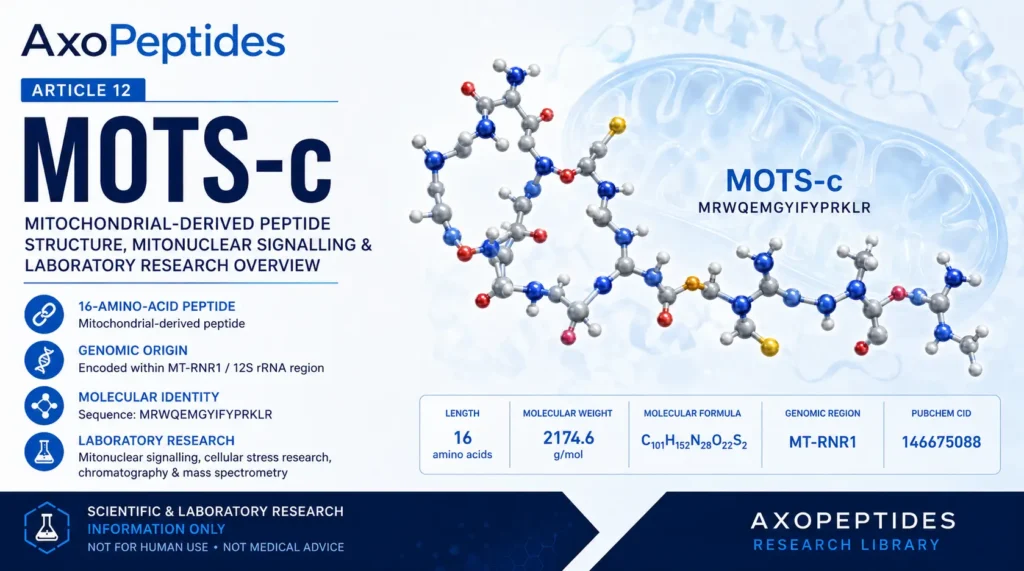
A scientific overview of MOTS-c covering its 16-amino-acid sequence, mitochondrial genomic origin, stress-associated nuclear translocation, mitonuclear signalling and laboratory characterisation.
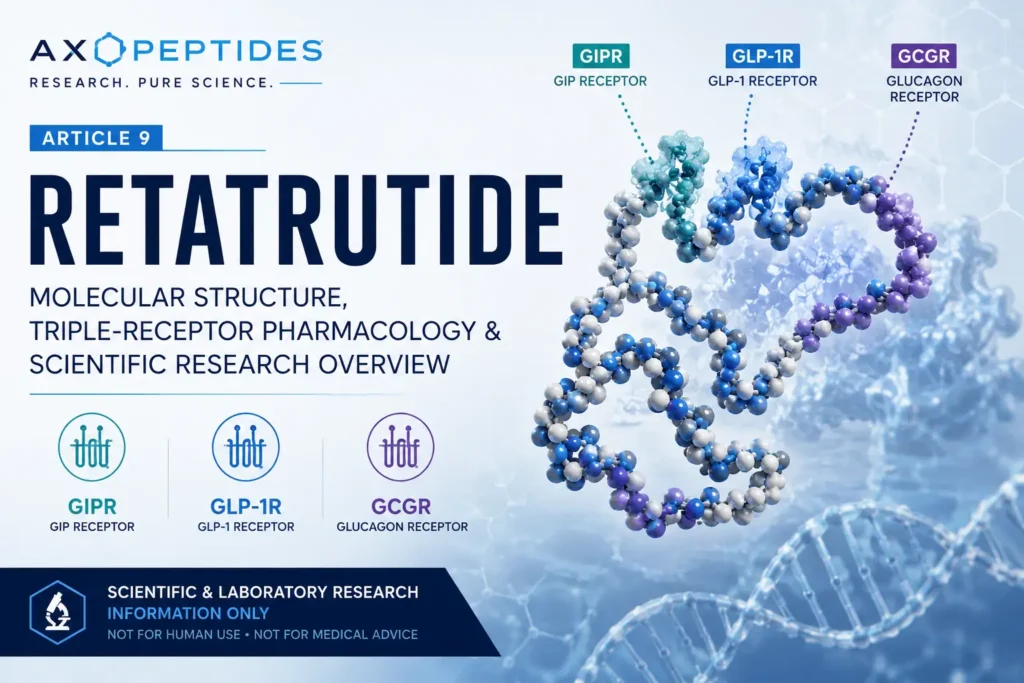
A scientific overview of retatrutide covering its peptide architecture, triple-receptor pharmacology, structural biology, laboratory analysis and research limitations.