AOD-9604: hGH-Derived Peptide Structure,
Fragment Biology & Laboratory Research Overview
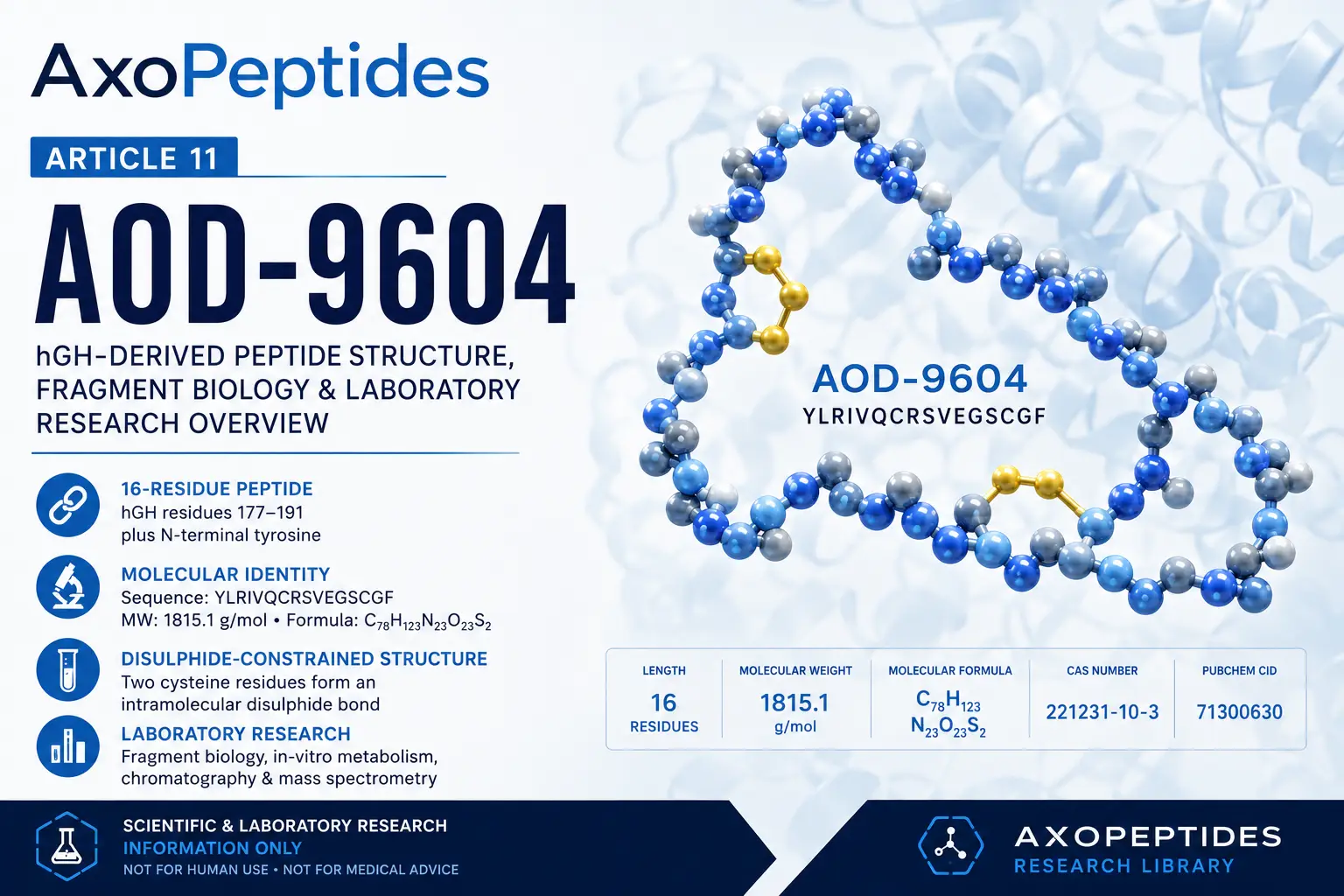
AOD-9604 is a synthetic 16-residue peptide derived from a
C-terminal region of human growth hormone. This scientific
overview examines its amino-acid sequence, molecular architecture,
relationship to the parent protein, fragment-based peptide research,
experimental literature and analytical characterisation.
R
Scientific & Laboratory Research Information
This article is intended for scientific and educational
information only. It contains no dosing, reconstitution,
administration, injection, treatment or personal-use
instructions.
PEPTIDEAOD-9604
LENGTH16 residues
SEQUENCEYLRIVQCRSVEGSCGF
MOLECULAR WEIGHT≈ 1815.1 g/mol
MOLECULAR OVERVIEW
What Is AOD-9604?
AOD-9604 is a synthetic peptide derived from a short region
located close to the C-terminus of human growth hormone.
Scientific literature describes AOD-9604 as a peptide containing
the human growth hormone sequence corresponding to residues
177–191 together with an additional N-terminal tyrosine residue.
The result is a 16-amino-acid peptide, also described chemically
as a hexadecapeptide.
PEPTIDE IDENTITY
AOD-960416-amino-acid synthetic hGH-derived peptide fragment
Because AOD-9604 represents only a small portion of the much
larger growth-hormone protein, its molecular properties should
not automatically be assumed to be identical to those of
full-length growth hormone.
PARENT PROTEIN
Relationship to Human Growth Hormone
Human growth hormone is a substantially larger protein containing
multiple structural regions.
AOD-9604 represents only a short sequence associated with the
C-terminal portion of that protein.
PARENT PROTEIN
Human Growth Hormone
↓
SELECTED C-TERMINAL REGION
AOD-960416-residue synthetic peptide
Simplified conceptual diagram showing the relationship between
a parent protein and a derived peptide fragment.
PEPTIDE SCIENCE
What Is a Peptide Fragment?
A peptide fragment is a shorter amino-acid sequence corresponding
to part of a larger peptide or protein.
Researchers frequently study fragments to investigate whether a
particular region of a larger molecule contributes to specific
structural, biochemical or receptor-related observations.
01Parent Molecule
A larger protein contains many connected amino-acid
residues and structural regions.
02Selected Region
Researchers identify a shorter sequence for independent
experimental investigation.
03Synthetic Fragment
The selected peptide can then be chemically synthesised
and characterised separately.
Important scientific distinction
A fragment derived from a protein should not automatically
be assumed to reproduce every structural or biological
property of the complete parent molecule.
AMINO-ACID SEQUENCE
What Is the Sequence of AOD-9604?
PubChem lists the AOD-9604 amino-acid sequence as:
YLRIVQCRSVEGSCGF
In three-letter amino-acid notation, this corresponds to:
Tyr – Leu – Arg – Ile – Val – Gln – Cys – Arg –
Ser – Val – Glu – Gly – Ser – Cys – Gly – Phe
1
YTyr
2
LLeu
3
RArg
4
IIle
5
VVal
6
QGln
7
CCys
8
RArg
9
SSer
10
VVal
11
EGlu
12
GGly
13
SSer
14
CCys
15
GGly
16
FPhe
CHEMICAL CHARACTERISTICS
AOD-9604 Molecular Characteristics
Standardised molecular identifiers make it easier to distinguish
AOD-9604 from similarly named growth-hormone-derived fragments.
Common nameAOD-9604
Peptide length16 residues
SequenceYLRIVQCRSVEGSCGF
Molecular formulaC78H123N23O23S2
Molecular weight1815.1 g/mol
CAS number221231-10-3
PubChem CID71300630
Molecular originhGH C-terminal-derived fragment
STRUCTURAL CHEMISTRY
AOD-9604 Contains Two Cysteine Residues
The AOD-9604 sequence contains cysteine residues at positions
7 and 14.
These sulfur-containing residues participate in the
disulphide-constrained molecular structure represented for
AOD-9604 in chemical databases.
RESIDUE 7
Cys
S — S
RESIDUE 14
Cys
Disulphide bonding can impose a local structural constraint on a
peptide, meaning that molecular identity involves more than simply
confirming the order of amino acids.
EXPERIMENTAL PEPTIDE RESEARCH
Why Study a Growth-Hormone-Derived Fragment?
Fragment-based research can help scientists investigate whether
particular regions of a larger protein retain measurable
biochemical characteristics when studied independently.
AOD-9604 has therefore appeared in experimental literature
investigating the properties of a defined C-terminal-derived
growth-hormone fragment.
Sequence–Activity Research
Examines whether particular peptide sequences are
associated with measurable experimental observations.
Fragment Biology
Investigates the properties of a short peptide separately
from its larger parent protein.
Structure–Activity Relationships
Compares molecular structure with biochemical behaviour
in controlled experimental systems.
Peptide Metabolism
Examines how peptide molecules can be transformed or
degraded in defined laboratory systems.
Research findings must stay within their experimental context.
Observations involving isolated cells, biochemical assays or
animal models should not be converted into claims concerning
personal outcomes.
EVIDENCE LEVELS
Experimental Models Used in AOD-9604 Research
Published research concerning AOD-9604 spans different
experimental levels.
01Chemical
Structure & sequence
02In Vitro
Controlled laboratory systems
03Metabolism
Peptide transformation
04Preclinical
Experimental animal models
These forms of evidence answer different scientific questions
and should not be treated as interchangeable.
PEPTIDE METABOLISM
In-Vitro Metabolism Research
One useful area of AOD-9604 research concerns the analytical
investigation of peptide metabolism.
A 2015 study examined detection and in-vitro metabolism of
AOD-9604 using analytical mass-spectrometric techniques.
Research of this type can help identify molecular fragments or
transformation products generated when a peptide is exposed to
defined experimental conditions.
STARTING MATERIAL
AOD-9604
→
EXPERIMENTAL SYSTEM
In-vitro metabolism
→
ANALYTICAL QUESTION
Detected peptide species
Conceptual research workflow only; this is not a preparation or
use protocol.
ANALYTICAL SCIENCE
How Can AOD-9604 Be Detected Analytically?
Peptide identification commonly relies on multiple analytical
characteristics rather than a single measurement.
01Retention Behaviour
Chromatographic separation provides information about
how sample components behave under defined conditions.
02Molecular Mass
Mass-spectrometric measurements can be compared with
expected molecular characteristics.
03Fragment Ions
Tandem mass spectrometry can generate fragment-ion
information useful for sequence-related identification.
04Sequence Information
The expected amino-acid sequence provides a molecular
reference against which analytical data can be compared.
CHROMATOGRAPHY
HPLC in AOD-9604 Research
High-performance liquid chromatography can separate components
within a peptide sample according to their interaction with the
chromatographic system.
The resulting chromatogram can provide information about detected
components and relative chromatographic composition.
Simplified chromatogram illustration — not experimental data.
HPLC does not answer every analytical question.
A chromatographic purity percentage should not be treated
as automatic confirmation of sequence, molecular mass or
absolute quantity.
MASS SPECTROMETRY
Mass Spectrometry & Molecular Identity
Mass spectrometry measures ions according to their
mass-to-charge ratio.
For peptide research, mass-spectrometric information can help
determine whether detected molecular species are consistent with
the expected peptide.
PEPTIDEAOD-9604
→
IONISATIONMass analyser
→
DATAm/z information
→
INTERPRETATIONMolecular evidence
ANALYTICAL INTERPRETATION
Purity, Identity & Quantity Are Different
These three concepts answer different laboratory questions.
PURITY
Sample composition
Describes relative composition detected under a
specified analytical method.
IDENTITY
Which molecule?
Evaluates whether analytical evidence is consistent
with the expected peptide.
QUANTITY
How much material?
Requires an appropriate quantitative analytical
measurement.
A high purity result is not complete molecular characterisation.
Researchers should consider sequence, molecular mass and
other relevant analytical information alongside chromatography.
SCIENTIFIC CAUTION
Important Limitations When Reading AOD-9604 Research
AOD-9604 is a short peptide fragment and should not be treated
as equivalent to full-length human growth hormone.
Results observed with a parent protein cannot automatically
be attributed to a derived peptide fragment.
Results from biochemical assays should remain identified
as biochemical findings.
In-vitro metabolism studies answer different questions from
whole-organism experiments.
Observations from animal models should remain identified
as preclinical.
Amino-acid sequence alone does not provide complete
analytical characterisation.
Chromatographic purity does not automatically confirm
molecular identity.
Online descriptions can remove historical research findings
from their original experimental context.
UNITED KINGDOM
AOD-9604 in the UK Research Context
Scientific discussion of a peptide should remain clearly
separated from medicinal presentation or personal-use guidance.
Current MHRA guidance explains that regulatory classification
can take account of explicit and implicit claims, pharmacological
or metabolic properties, intended purpose and the overall way
a product is presented.
This includes presentation through websites, labelling,
packaging, promotional literature, advertising, social media
and customer reviews.
Research-only terminology therefore needs to remain consistent
with the surrounding content rather than being contradicted by
consumer-oriented instructions or medicinal claims.
Frequently Asked Research Questions About AOD-9604
What is AOD-9604?
AOD-9604 is a synthetic 16-residue peptide derived from
a C-terminal region of human growth hormone.
Is AOD-9604 a peptide?
Yes. AOD-9604 is a hexadecapeptide, meaning it contains
16 amino-acid residues.
What is the amino-acid sequence of AOD-9604?
PubChem lists the sequence as YLRIVQCRSVEGSCGF.
Which part of growth hormone is AOD-9604 related to?
Scientific literature describes AOD-9604 as containing
human growth hormone residues 177–191 together with an
additional N-terminal tyrosine.
Is AOD-9604 the same molecule as human growth hormone?
No. Human growth hormone is a substantially larger protein.
AOD-9604 represents only a short derived peptide region.
How many amino acids are in AOD-9604?
AOD-9604 contains 16 amino-acid residues.
What is the molecular formula of AOD-9604?
PubChem lists the molecular formula as C78H123N23O23S2.
What is the molecular weight of AOD-9604?
PubChem lists a molecular weight of approximately
1815.1 g/mol.
What is the CAS number for AOD-9604?
The CAS Registry Number commonly associated with AOD-9604
is 221231-10-3.
What is the PubChem CID for AOD-9604?
PubChem lists AOD-9604 as compound CID 71300630.
Does AOD-9604 contain cysteine residues?
Yes. The peptide sequence contains cysteine at positions
7 and 14.
How can AOD-9604 be characterised in a laboratory?
Depending on the research question, peptide characterisation
can involve chromatography, mass spectrometry and comparison
with expected sequence and molecular characteristics.
Does an HPLC purity percentage prove AOD-9604 identity?
No. Chromatographic purity and molecular identity are
separate analytical questions.
SCIENTIFIC & REGULATORY SOURCES
References & Further Reading
PubChem — AOD-9604
Chemical structure, sequence, molecular formula,
molecular weight and compound identifiers.
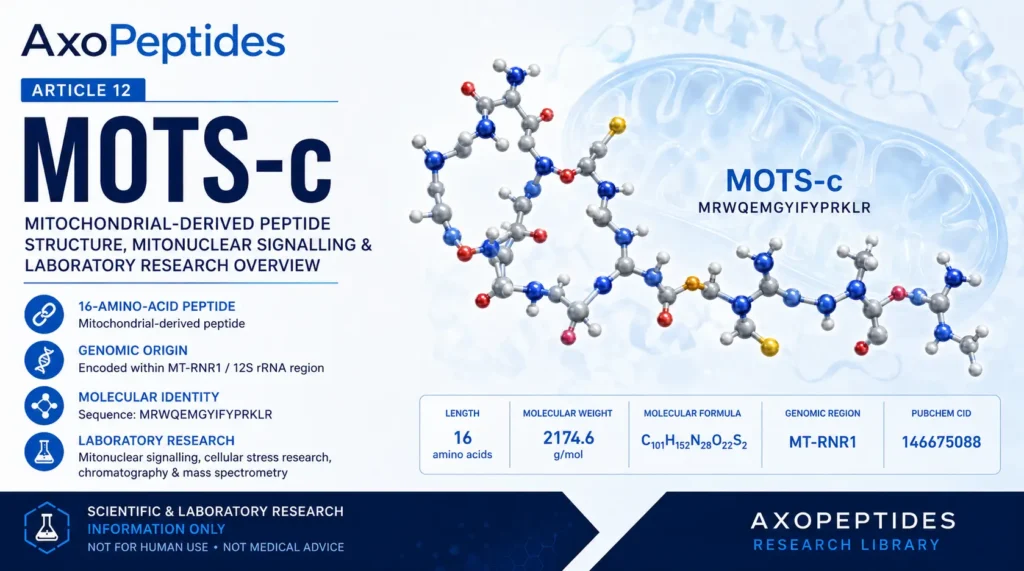
A scientific overview of MOTS-c covering its 16-amino-acid sequence, mitochondrial genomic origin, stress-associated nuclear translocation, mitonuclear signalling and laboratory characterisation.
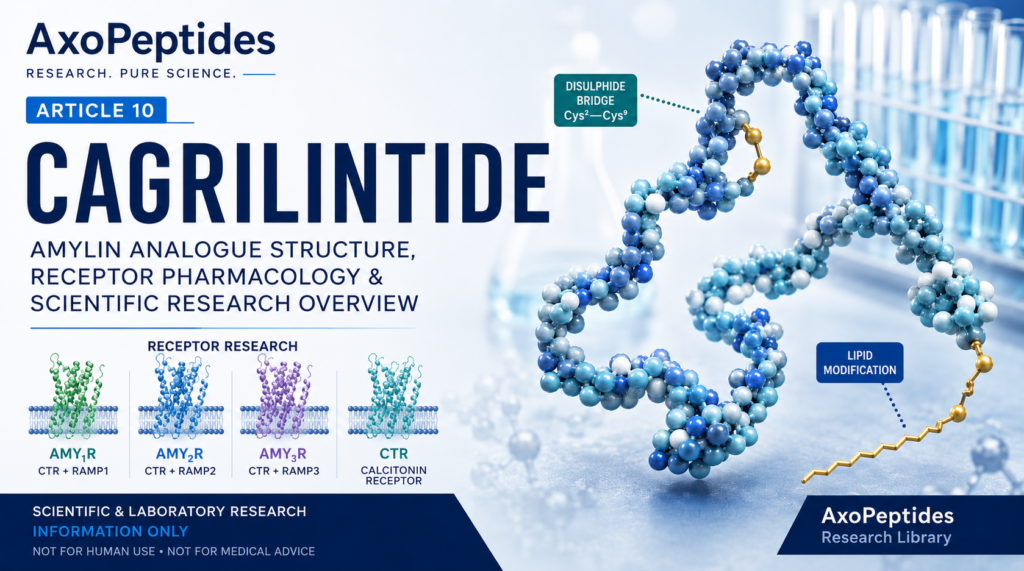
A scientific overview of cagrilintide covering its amylin-derived peptide architecture, lipid modification, calcitonin-family receptor interactions and structural research.
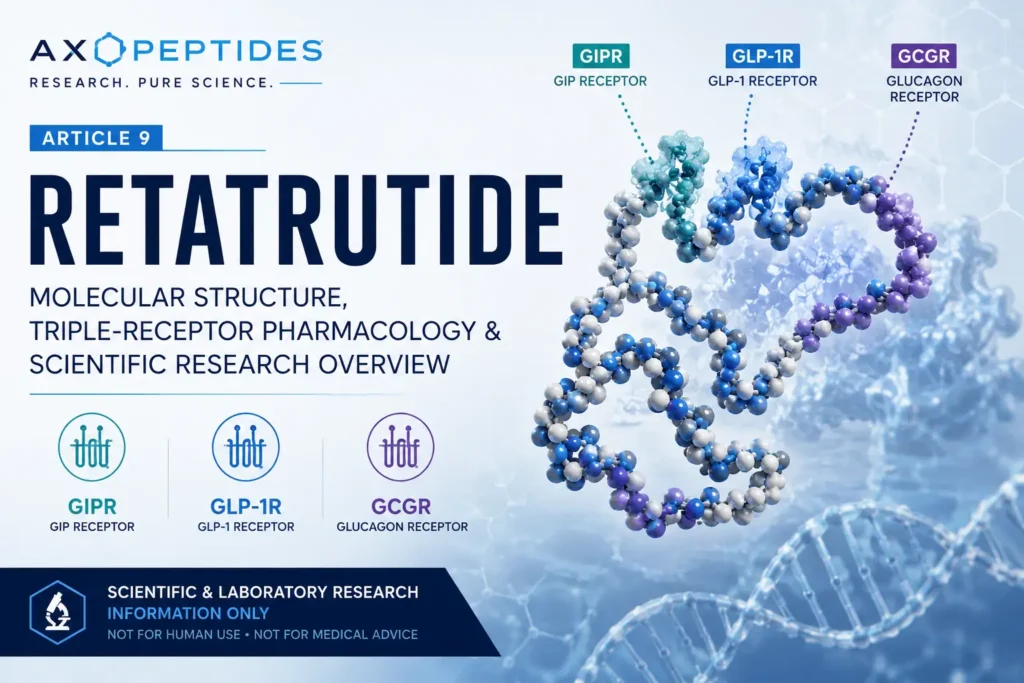
A scientific overview of retatrutide covering its peptide architecture, triple-receptor pharmacology, structural biology, laboratory analysis and research limitations.
A scientific overview of tirzepatide covering its 39-amino-acid peptide architecture, molecular characteristics, GIPR and GLP-1R interactions, structural biology and laboratory research.
A scientific overview of CJC-1295 No DAC covering molecular identity, its relationship to GHRH analogues, laboratory analysis and the distinction from DAC-modified CJC-1295.
A scientific overview of Ipamorelin covering its molecular identity, pentapeptide structure, receptor research, experimental evidence, laboratory analysis and research limitations.
A scientific overview of GHK-Cu covering its molecular identity, copper-binding characteristics, experimental literature, analytical testing and research limitations.