MOTS-c: Mitochondrial-Derived Peptide Structure,
Mitonuclear Signalling & Laboratory Research Overview
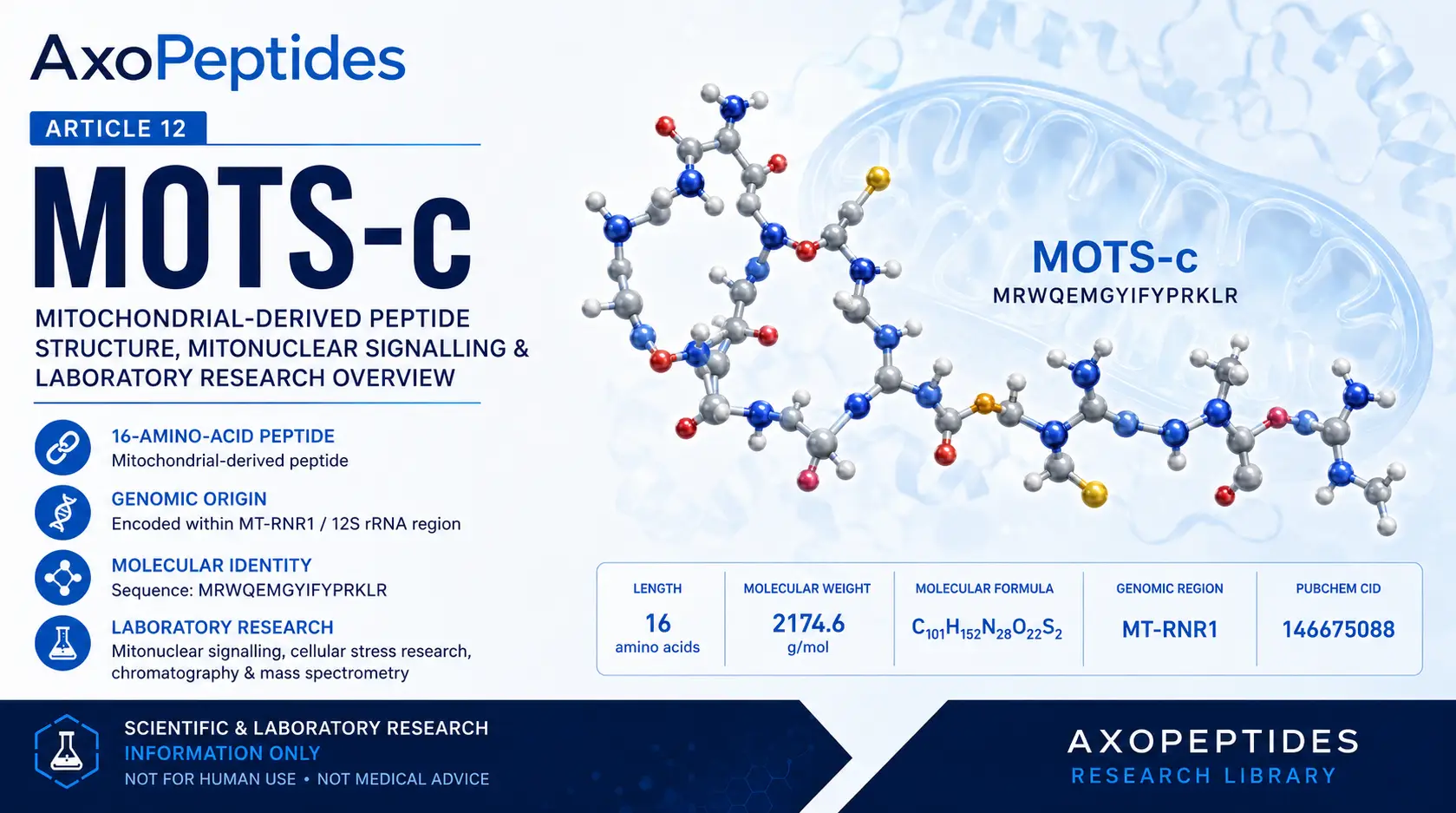
MOTS-c is a 16-amino-acid mitochondrial-derived peptide encoded
within the mitochondrial 12S rRNA region. This scientific
overview examines its sequence, mitochondrial genomic origin,
cellular localisation, stress-associated nuclear translocation,
AMPK-linked research, mitonuclear signalling and analytical
characterisation.
R
Scientific & Laboratory Research Information
This article is intended for scientific and educational
information only. It contains no dosing, reconstitution,
administration, injection, treatment, supplementation or
personal-use instructions.
PEPTIDEMOTS-c
LENGTH16 amino acids
GENOMIC REGIONMT-RNR1 / 12S rRNA
MOLECULAR WEIGHT≈ 2174.6 g/mol
MOLECULAR OVERVIEW
What Is MOTS-c?
MOTS-c is a short peptide containing 16 amino-acid residues.
It belongs to a research category commonly described as
mitochondrial-derived peptides, or MDPs.
Unlike conventional proteins encoded by nuclear DNA,
the genetic sequence associated with MOTS-c is located within
mitochondrial DNA.
The peptide was reported in 2015 during investigation of
previously unrecognised short open reading frames within the
mitochondrial genome.
MITOCHONDRIAL-DERIVED PEPTIDE
MOTS-c
16 amino acids • encoded within the mitochondrial
12S rRNA region
This discovery contributed to a broader research field examining
whether mitochondrial DNA contains short coding regions capable
of generating biologically active peptide signals.
RESEARCH TERMINOLOGY
What Does the Name MOTS-c Mean?
MOTS-c is derived from the phrase:
MMitochondrial
OOpen
RReading
FFrame
12S12S rRNA
cType-c
In scientific literature, the expanded terminology is commonly
written as mitochondrial open reading frame of the
12S rRNA type-c.
MITOCHONDRIAL GENETICS
What Is a Mitochondrial-Derived Peptide?
Mitochondria possess their own genome, separate from the
chromosomes located within the cell nucleus.
Historically, mitochondrial DNA was mainly discussed in relation
to established mitochondrial proteins, ribosomal RNAs and
transfer RNAs.
Research into mitochondrial-derived peptides expanded this view
by identifying short open reading frames located within regions
previously known primarily for mitochondrial RNA functions.
01Mitochondrial DNA
Contains a compact genetic system distinct from
nuclear chromosomes.
02Short Open Reading Frames
Small coding regions can potentially specify short
peptide sequences.
03MDP Research
Investigates peptide signals encoded within mitochondrial
genomic regions.
Important terminology
Saying that MOTS-c is mitochondrial-DNA encoded describes
its genetic origin. Questions concerning exactly where and
how mitochondrial-derived peptides are translated remain
an active area of molecular research.
GENOMIC ORIGIN
MOTS-c & the Mitochondrial 12S rRNA Region
MOTS-c is encoded within the mitochondrial gene region known
as MT-RNR1.
MT-RNR1 is conventionally associated with mitochondrial
12S ribosomal RNA.
The MOTS-c coding sequence therefore illustrates an important
concept in modern mitochondrial genetics: a genomic region
recognised for one function may contain an overlapping short
open reading frame relevant to peptide research.
MITOCHONDRIAL DNA
mtDNA
→
GENE REGION
MT-RNR1
→
12S rRNA REGION
Short ORF
→
PEPTIDE
MOTS-c
Simplified genomic relationship for educational purposes.
AMINO-ACID SEQUENCE
What Is the Amino-Acid Sequence of MOTS-c?
The human MOTS-c sequence reported in scientific literature is:
MRWQEMGYIFYPRKLR
In three-letter amino-acid notation:
Met – Arg – Trp – Gln – Glu – Met – Gly – Tyr –
Ile – Phe – Tyr – Pro – Arg – Lys – Leu – Arg
01
MMet
02
RArg
03
WTrp
04
QGln
05
EGlu
06
MMet
07
GGly
08
YTyr
09
IIle
10
FPhe
11
YTyr
12
PPro
13
RArg
14
KLys
15
LLeu
16
RArg
MOLECULAR CHARACTERISTICS
MOTS-c Molecular Information
Standard molecular identifiers provide a reference for
laboratory characterisation and database comparison.
Common nameMOTS-c
Peptide length16 amino acids
SequenceMRWQEMGYIFYPRKLR
Molecular formulaC101H152N28O22S2
Molecular weight2174.6 g/mol
PubChem CID146675088
Genomic regionMT-RNR1 / mitochondrial 12S rRNA
Research classificationMitochondrial-derived peptide
Molecular formula and calculated mass provide useful reference
information but should not be treated as substitutes for
analytical confirmation of an experimental sample.
MITONUCLEAR BIOLOGY
MOTS-c & Mitonuclear Communication
A major area of MOTS-c research concerns communication between
mitochondria and the nucleus.
These two cellular compartments each contain genetic material,
yet normal cellular function requires extensive coordination
between them.
Research published in 2018 reported that MOTS-c could relocate
to the nucleus in response to defined metabolic-stress conditions
in cellular models.
MITOCHONDRIAL GENOME
MOTS-c
⇢
CELLULAR STRESS MODEL
Dynamic localisation
⇢
NUCLEUS
Gene-regulation research
Simplified representation of a cellular research concept rather
than a complete signalling pathway.
CELLULAR LOCALISATION
Stress-Associated Nuclear Translocation Research
The intracellular location of a peptide can provide important
clues about the molecular processes in which it participates.
In cellular experiments, Kim and colleagues examined MOTS-c
localisation following several defined stress conditions,
including glucose restriction and other laboratory stress models.
Their results indicated dynamic movement of MOTS-c into the
nucleus under those experimental conditions.
Subcellular Fractionation
Laboratory fractions were used to examine the relative
localisation of MOTS-c within cellular compartments.
Immunofluorescence
Fluorescence microscopy was used to visualise peptide
localisation within experimental cells.
Stress Models
Defined cellular stresses were used to investigate
whether localisation patterns changed.
Nuclear Investigation
Researchers examined relationships between nuclear
MOTS-c and gene-regulatory processes.
CELLULAR SIGNALLING
MOTS-c & AMPK-Associated Research
AMP-activated protein kinase, commonly abbreviated
AMPK, is an extensively studied cellular
signalling enzyme involved in sensing changes in cellular
energetic state.
The original MOTS-c discovery work reported AMPK-associated
signalling in experimental systems.
The 2018 nuclear-translocation study further reported that
stress-associated MOTS-c movement into the nucleus was
AMPK-dependent under the conditions investigated.
EXPERIMENTAL CONDITION
Cellular stress
→
SIGNALLING RESEARCH
AMPK
→
OBSERVATION
Nuclear localisation
Mechanistic findings require context.
AMPK involvement reported in controlled experiments should
be described as an experimental signalling observation rather
than being converted into claims about personal outcomes.
STRESS-RESPONSE RESEARCH
MOTS-c, NRF2 & Nuclear Gene-Expression Research
The 2018 study also investigated whether nuclear MOTS-c was
associated with stress-responsive transcriptional machinery.
Experiments reported interactions involving
NRF2, a transcription factor associated with
antioxidant-response-element regulation.
The researchers also investigated MOTS-c-associated chromatin
interactions and changes in gene expression under defined
stress conditions.
01Nuclear Localisation
MOTS-c localisation was examined under controlled
stress conditions.
02NRF2 Interaction
Protein-interaction experiments investigated association
with stress-responsive transcription factors.
03Gene Expression
RNA-based analyses examined changes in nuclear gene
expression within the experimental system.
EVIDENCE INTERPRETATION
How Is MOTS-c Studied Experimentally?
MOTS-c research spans several experimental levels.
01Genomic
mtDNA & short ORFs
02Molecular
Sequence & peptide identity
03Cellular
Localisation & signalling
04Preclinical
Controlled biological models
Evidence generated at one level should not automatically be
treated as proof at another level.
For example:
Demonstrating nuclear localisation in cultured cells
establishes a cellular observation under those experimental
conditions. It does not by itself establish broader outcomes
outside that model.
ANALYTICAL SCIENCE
Laboratory Characterisation of MOTS-c
Synthetic MOTS-c research material can be examined using
complementary analytical methods.
01Peptide Sequence
The expected 16-residue sequence provides a primary
molecular reference.
02Chromatography
HPLC can separate detected sample components under
specified analytical conditions.
03Mass Spectrometry
Molecular mass-related data can contribute to
assessment of peptide identity.
04Database Comparison
Analytical results can be compared with established
sequence, formula and mass references.
CHROMATOGRAPHY
HPLC in MOTS-c Research
High-performance liquid chromatography separates compounds
according to their behaviour within a selected chromatographic
system.
For peptide materials, chromatographic data can provide
information about relative sample composition and detected
components under the specific method used.
Simplified chromatogram illustration — not laboratory data.
Chromatographic purity is method-dependent.
A purity percentage should always be interpreted in the
context of the analytical method that generated it.
MASS SPECTROMETRY
Mass Spectrometry & MOTS-c Identity
Mass spectrometry measures ions according to their
mass-to-charge ratio.
For a 16-residue peptide such as MOTS-c, mass-spectrometric
evidence can be compared with expected molecular characteristics
and, where appropriate, peptide-fragment information.
REFERENCE
MRWQEMGYIFYPRKLR
→
ANALYSIS
Mass spectrometry
→
DATA
m/z information
→
QUESTION
Identity evidence
ANALYTICAL INTERPRETATION
Purity, Identity & Quantity Are Separate Questions
PURITY
Sample composition
Describes the relative chromatographic composition
detected by a particular method.
IDENTITY
Which peptide?
Addresses whether analytical evidence corresponds
with the expected MOTS-c molecule.
QUANTITY
How much material?
Requires an appropriate quantitative analytical
measurement.
A high HPLC percentage does not prove all three.
Sequence, molecular identity and absolute quantity require
appropriate evidence beyond a chromatographic purity value.
SCIENTIFIC CAUTION
Important Limitations When Reading MOTS-c Research
MOTS-c is a relatively recently identified mitochondrial-derived
peptide compared with many classical mitochondrial proteins.
Its mitochondrial genomic origin should not be confused with
complete certainty about every step involved in peptide production.
Cellular localisation experiments answer different questions
from whole-organism research.
AMPK-associated findings should remain linked to the
experimental systems in which they were observed.
Nuclear-translocation research does not establish every
possible downstream biological consequence.
Results from cultured cells should remain identified as
cellular evidence.
Results from animal experiments should remain identified
as preclinical evidence.
Molecular mechanism should not be converted into unsupported
consumer claims.
HPLC purity alone does not confirm complete molecular identity.
UNITED KINGDOM
MOTS-c in the UK Research Context
Scientific discussion of a research peptide should remain
clearly separated from medicinal or personal-use presentation.
Current MHRA guidance explains that a product can fall within
medicines regulation according to factors including explicit
and implicit claims, pharmacological, metabolic or immunological
properties, intended purpose and the manner in which it is
presented.
The MHRA also considers presentation through labelling,
packaging, promotional literature, advertisements, websites,
social media and customer reviews.
Research-only wording should therefore remain consistent with
surrounding site content rather than being contradicted by
consumer-use instructions or medicinal claims.
MOTS-c is a 16-amino-acid mitochondrial-derived peptide
encoded within the mitochondrial 12S rRNA genomic region.
What does MOTS-c stand for?
The name refers to mitochondrial open reading frame of the
12S rRNA type-c.
Is MOTS-c a peptide?
Yes. MOTS-c is a short peptide composed of 16 amino-acid
residues.
What is the MOTS-c amino-acid sequence?
The human sequence reported in scientific literature is
MRWQEMGYIFYPRKLR.
How many amino acids are in MOTS-c?
MOTS-c contains 16 amino-acid residues.
Where is MOTS-c encoded?
Its coding region is located within MT-RNR1, the mitochondrial
genomic region associated with 12S ribosomal RNA.
What is a mitochondrial-derived peptide?
It is a research term for a short peptide associated with
a coding sequence located within mitochondrial DNA.
What is the molecular formula of MOTS-c?
PubChem lists the formula as C101H152N28O22S2.
What is the molecular weight of MOTS-c?
PubChem lists a molecular weight of approximately
2174.6 g/mol.
What is the PubChem CID for MOTS-c?
PubChem identifies MOTS-c as CID 146675088.
Can MOTS-c localise to the nucleus in experimental cells?
Published cellular research reported stress-associated
nuclear translocation of MOTS-c under defined experimental
conditions.
What is the connection between MOTS-c and AMPK research?
Experimental studies have investigated AMPK-associated
signalling, including evidence that stress-associated
nuclear translocation can be AMPK-dependent in cellular
models.
How can MOTS-c be analysed in a laboratory?
Depending on the analytical question, characterisation can
include chromatography, mass spectrometry and comparison
with expected sequence and molecular properties.
Does high HPLC purity prove MOTS-c identity?
No. Chromatographic purity and molecular identity are
separate analytical questions.
SCIENTIFIC & REGULATORY SOURCES
References & Further Reading
Lee C, et al. Cell Metabolism. 2015.
Original research describing the mitochondrial-derived
peptide MOTS-c and its mitochondrial genomic origin.
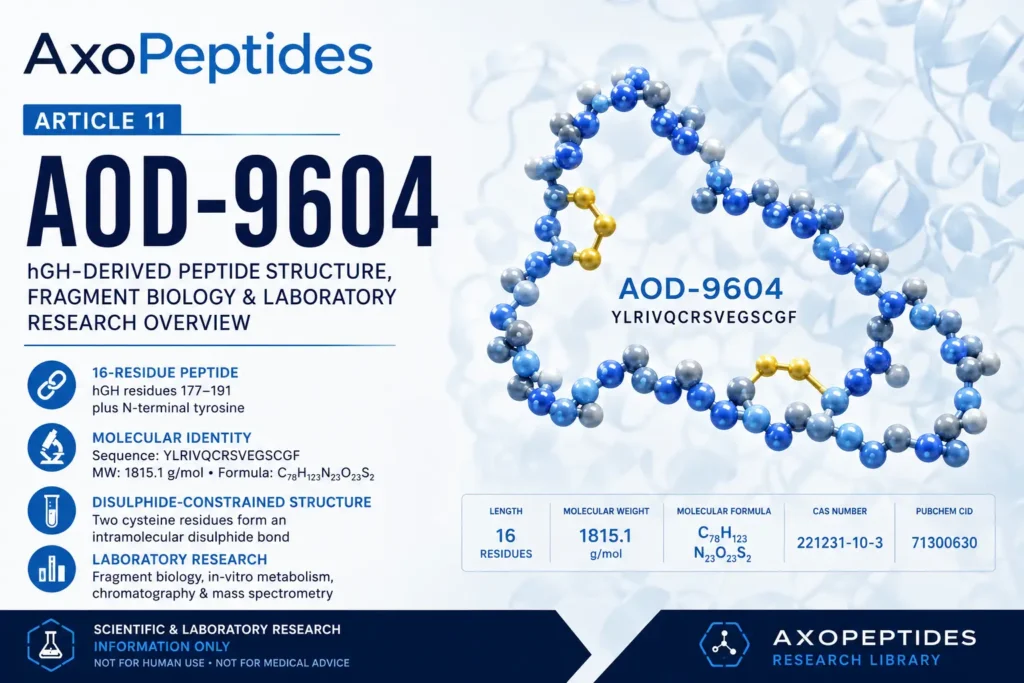
A scientific overview of AOD-9604 covering its 16-residue hGH-derived peptide architecture, amino-acid sequence, disulphide-constrained structure, experimental research and analytical characterisation.
A scientific overview of cagrilintide covering its amylin-derived peptide architecture, lipid modification, calcitonin-family receptor interactions and structural research.
A scientific overview of retatrutide covering its peptide architecture, triple-receptor pharmacology, structural biology, laboratory analysis and research limitations.
A scientific overview of tirzepatide covering its 39-amino-acid peptide architecture, molecular characteristics, GIPR and GLP-1R interactions, structural biology and laboratory research.
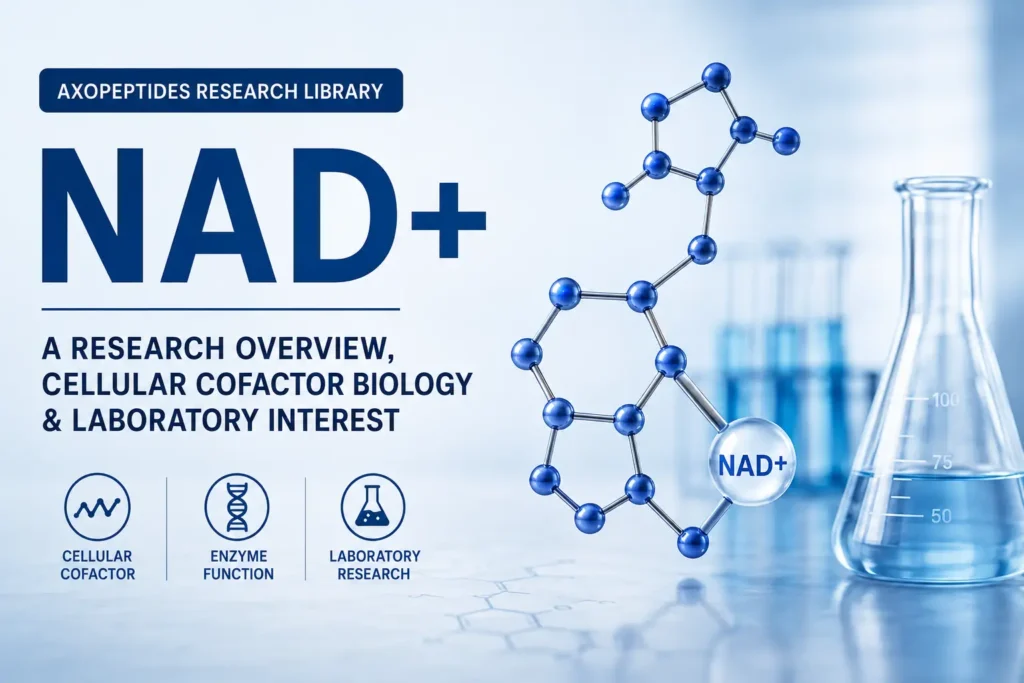
A scientific overview of NAD+ covering its role as a cellular cofactor, redox chemistry, NAD-dependent enzymes, laboratory analysis and research limitations.
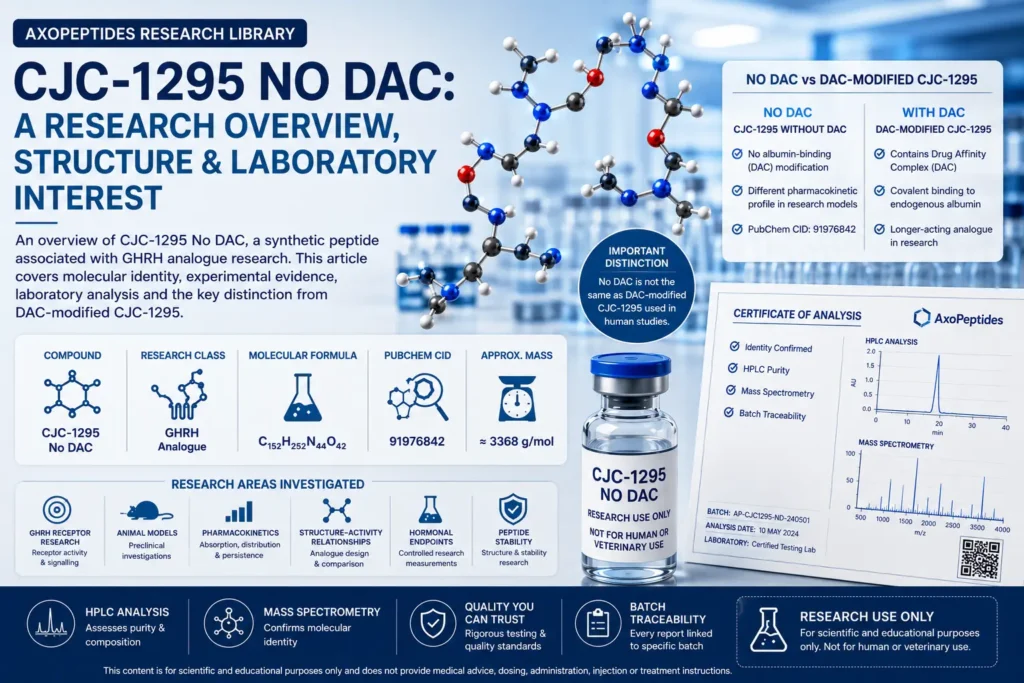
A scientific overview of CJC-1295 No DAC covering molecular identity, its relationship to GHRH analogues, laboratory analysis and the distinction from DAC-modified CJC-1295.
A scientific overview of Ipamorelin covering its molecular identity, pentapeptide structure, receptor research, experimental evidence, laboratory analysis and research limitations.
A scientific overview of GHK-Cu covering its molecular identity, copper-binding characteristics, experimental literature, analytical testing and research limitations.