CJC-1295 No DAC: A Research Overview, Structure & Laboratory Interest
CJC-1295 No DAC is a synthetic peptide discussed in research involving
growth-hormone-releasing-hormone analogue chemistry. This overview examines
its molecular identity, its distinction from DAC-modified CJC-1295,
experimental research, analytical characterisation and the limitations
of the available evidence.
R
Research Use Only
This article is provided for scientific and educational purposes.
It contains no dosing, reconstitution, administration, injection,
treatment or personal-use instructions.
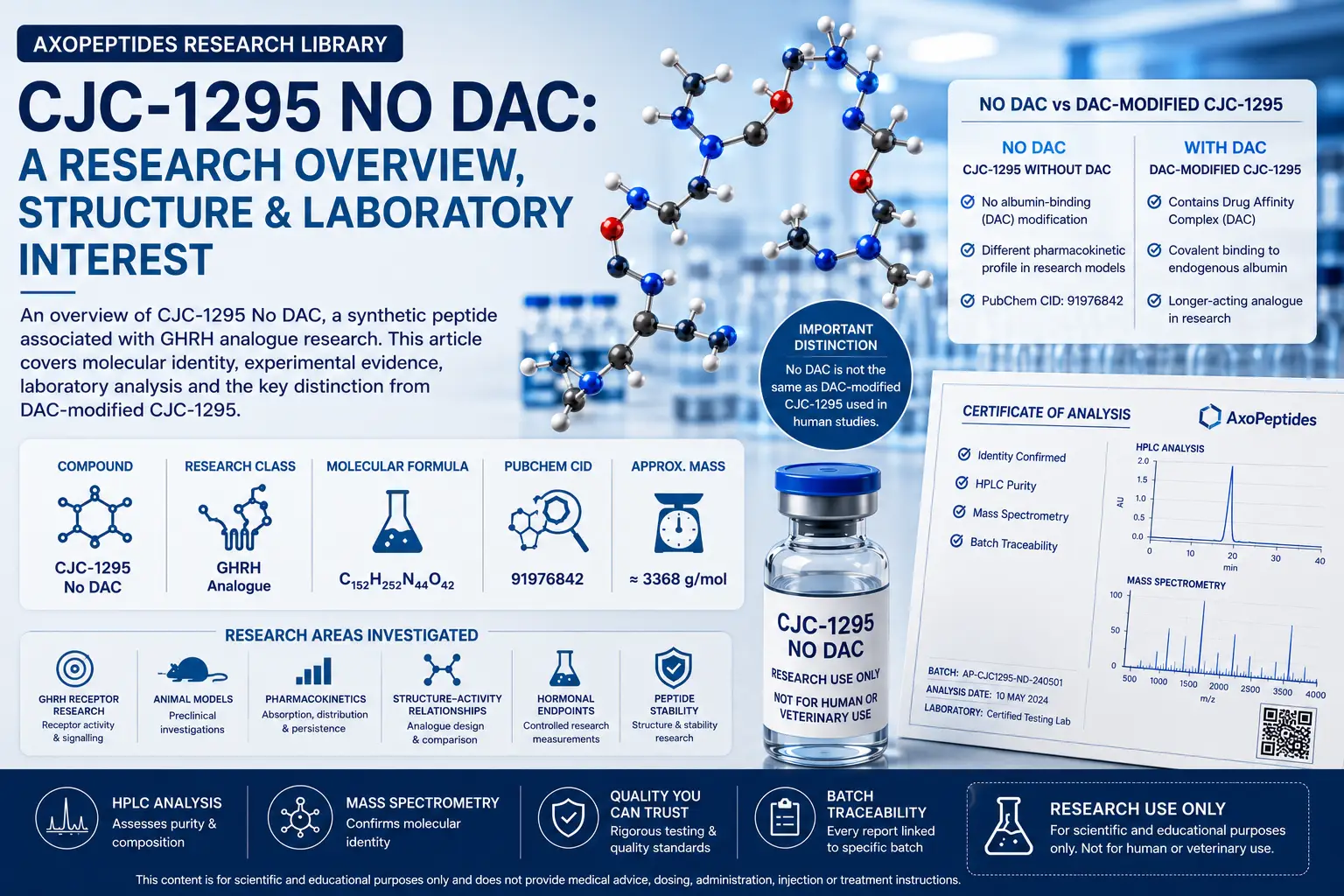
COMPOUNDCJC-1295 No DAC
PUBCHEM CID91976842
MOLECULAR FORMULAC152H252N44O42
RESEARCH CLASSGHRH analogue
MOLECULAR IDENTITY
What Is CJC-1295 No DAC?
CJC-1295 No DAC is a synthetic peptide associated with the broader
research field of growth-hormone-releasing-hormone analogues.
It is commonly discussed alongside CJC-1295, but the term
No DAC indicates an important structural distinction.
Research interpretation depends on identifying exactly which form
of the peptide was used. Findings involving DAC-modified CJC-1295
should not automatically be attributed to a non-DAC form.
Key distinction
“CJC-1295” is often used loosely online. Researchers should confirm
whether a publication, analytical report or research material refers
to the DAC-modified form or a non-DAC form.
RESEARCH TERMINOLOGY
What Does “DAC” Mean?
In the original CJC-1295 research programme, DAC refers to a
Drug Affinity Complex strategy.
The DAC-modified molecule incorporates chemistry designed to allow
covalent association with circulating albumin.
Albumin binding substantially changes the pharmacokinetic behaviour
of the research compound compared with a corresponding peptide
lacking that affinity-complex modification.
BASE PEPTIDE
Modified GRF analogue
+
DAC CHEMISTRY
Albumin-binding group
→
DAC FORM
Longer-acting analogue
This diagram describes structural research terminology and is not
an administration or treatment pathway.
COMPOUND COMPARISON
CJC-1295 No DAC vs CJC-1295 With DAC
The two terms should not be treated as interchangeable.
NO DAC
CJC-1295 Without DAC
Refers to a peptide form without the albumin-binding Drug Affinity
Complex modification.
PubChem maintains a distinct entry for CJC1295 Without DAC.
WITH DAC
DAC-Modified CJC-1295
Contains an affinity-complex modification designed to bind
endogenous albumin.
Much of the well-known human CJC-1295 literature examined
this long-acting form.
Why the distinction matters
Human data generated using DAC-modified CJC-1295 do not automatically
establish the same pharmacokinetic or pharmacodynamic evidence for
CJC-1295 No DAC.
PEPTIDE RESEARCH
Relationship to Growth-Hormone-Releasing Hormone Research
Growth-hormone-releasing hormone, commonly abbreviated
GHRH, is a peptide involved in physiological signalling
associated with growth-hormone secretion.
Researchers have developed synthetic GHRH analogues to investigate
how structural modifications alter receptor activity, stability and
pharmacokinetic properties.
CJC-1295 emerged from this area of peptide analogue research.
Peptide Analogue Design
Researchers modify peptide structure to study changes in molecular behaviour.
Receptor Research
Experimental models examine interactions with GHRH-related receptor systems.
Pharmacokinetic Research
Structural modifications can change persistence and distribution in experimental systems.
MOLECULAR CHARACTERISTICS
CJC-1295 No DAC Molecular Information
Chemical databases can help distinguish similarly named research
peptides by providing defined molecular identifiers.
Common nameCJC1295 Without DAC
PubChem CID91976842
Molecular formulaC152H252N44O42
Approximate calculated mass≈ 3368 g/mol
Research classGHRH-related peptide analogue
Molecular mass shown here is calculated from the elemental formula.
Exact analytical mass can depend on molecular representation,
counterions, salts and experimental conditions.
EXPERIMENTAL RESEARCH
Areas Investigated in CJC-1295 Research
Published research involving CJC-1295 and related GHRH analogues
has examined several experimental questions.
These categories describe research topics and should not be interpreted
as treatment indications or claims of benefit.
GHRH Receptor Research
Investigation of analogue activity in GHRH-related signalling systems.
Peptide Stability
Research examining how structural changes affect molecular persistence.
Albumin Binding
DAC-containing analogues have been investigated for covalent albumin association.
Hormonal Endpoints
Controlled experimental studies have measured defined endocrine variables.
Pharmacokinetics
Studies examine how molecular modifications alter experimental exposure profiles.
Structure–Activity Relationships
Comparative research investigates how peptide modifications affect observed activity.
EVIDENCE QUALITY
Understanding CJC-1295 Research Evidence
Evidence should be interpreted according to both the experimental model
and the exact molecular form investigated.
01Molecular Research
Structural studies examining peptide modification and analogue chemistry.
02In Vitro Research
Laboratory studies examining receptor activity or related molecular endpoints.
03Animal Research
Preclinical investigation of pharmacological and endocrine responses.
04Human Research
Human CJC-1295 studies must be checked carefully to determine
whether the DAC-modified form was used.
HUMAN RESEARCH
Has CJC-1295 Been Studied in Humans?
CJC-1295 has been studied in human research.
A frequently cited 2006 study examined a long-acting CJC-1295 analogue
designed to bind endogenous albumin and evaluated pharmacokinetic,
pharmacodynamic and safety endpoints in healthy adults.
A separate publication reported preservation of pulsatile growth-hormone
secretion during prolonged stimulation with the long-acting analogue.
Important compound-specific limitation
These well-known human studies concern DAC-modified, albumin-binding
CJC-1295. They should not automatically be described as human evidence
for CJC-1295 No DAC.
ANALYTICAL CHEMISTRY
Laboratory Analysis of CJC-1295 No DAC
Analytical testing can help establish whether a research material
is consistent with the molecular compound represented by its label
and documentation.
01Chromatographic Composition
HPLC can separate detected sample components under defined conditions.
02Molecular Mass
Mass spectrometry can provide data relevant to molecular identity.
03Compound Distinction
Analytical identity is particularly important where DAC and non-DAC forms exist.
04Batch Traceability
Documentation should identify which research batch was actually analysed.
High-Performance Liquid Chromatography
HPLC separates sample components according to their behaviour in a
defined chromatographic system. The resulting chromatogram can provide
information about relative sample composition.
Mass Spectrometry
Mass spectrometry provides mass-to-charge information that can be compared
with expected molecular characteristics. This can contribute to
assessment of molecular identity.
ANALYTICAL INTERPRETATION
Purity, Identity & Molecular Form
CJC-1295 is a useful example of why purity alone is not enough
to characterise a research peptide.
Purity
Describes relative chromatographic composition under the method used.
Identity
Addresses whether analytical evidence corresponds to the expected compound.
Molecular Form
Distinguishes structurally different versions such as DAC and non-DAC materials.
A high purity result cannot tell you whether the wrong analogue was tested.
Molecular identity and structural form require separate analytical
confirmation.
ANALYTICAL DOCUMENTATION
What Should a CJC-1295 No DAC COA Show?
A Certificate of Analysis should make the relationship between
the tested sample and the represented research material clear.
Full material name, including No DAC where applicable
Batch or sample identifier
Analytical method
Analysis date
Chromatographic purity where tested
Molecular mass or identity data where tested
Testing laboratory details
Clear link between the report and represented batch
COA & Laboratory Reports
View available AxoPeptides batch-linked Certificates of Analysis
and laboratory documentation.
When closely related peptide forms exist, batch traceability becomes
particularly important.
STEP 1
Material
→
STEP 2
Batch ID
→
STEP 3
Test Sample
→
STEP 4
Analysis
→
STEP 5
COA
The documentation should clearly distinguish a No DAC batch from
a DAC-modified material rather than relying on an abbreviated product name.
SCIENTIFIC CAUTION
Important Limitations in CJC-1295 Research
“CJC-1295” is sometimes used online without stating whether DAC is present.
DAC and non-DAC forms have meaningful structural differences.
Much of the well-known human literature concerns the DAC-modified form.
Human evidence for one molecular form should not automatically be attributed to another.
Results from animal models cannot automatically establish outcomes in humans.
Pharmacological activity does not by itself establish an authorised clinical use.
Chromatographic purity does not establish complete molecular identity.
UNITED KINGDOM
CJC-1295 No DAC in the UK Research Context
Research-only presentation should clearly distinguish scientific
information from medicinal or personal-use claims.
Current MHRA guidance states that product classification can involve
explicit and implicit claims, pharmacological properties, intended
purpose and presentation through websites, advertising, packaging,
social media and customer reviews.
A “Research Use Only” statement should therefore not contradict
surrounding content.
CJC-1295 No DAC is a synthetic peptide associated with research into
growth-hormone-releasing-hormone analogues and lacks the Drug Affinity
Complex modification associated with long-acting CJC-1295.
What does DAC stand for?
DAC refers to Drug Affinity Complex, a molecular strategy used in
the long-acting CJC-1295 research programme to enable albumin binding.
Is CJC-1295 No DAC identical to CJC-1295 with DAC?
No. The presence or absence of the affinity-complex modification
changes the molecular structure and associated pharmacokinetic characteristics.
What is the PubChem CID for CJC1295 Without DAC?
PubChem lists CJC1295 Without DAC as CID 91976842.
What is its molecular formula?
PubChem lists the molecular formula C152H252N44O42.
Has CJC-1295 been studied in humans?
Yes, but commonly cited human studies investigated the long-acting
DAC-modified CJC-1295 analogue. Those data should not automatically
be attributed to CJC-1295 No DAC.
Why is the DAC distinction important in scientific literature?
Because structural changes that alter albumin binding can substantially
affect the behaviour of a research compound.
How can CJC-1295 No DAC be analysed?
Depending on the analytical question, techniques can include
high-performance liquid chromatography and mass spectrometry.
Does high HPLC purity confirm that a sample is the No DAC form?
Not by itself. Purity and molecular identity are separate analytical
questions.
Why should the full compound name appear on a COA?
It helps prevent confusion between structurally different research
materials that may share the CJC-1295 name.
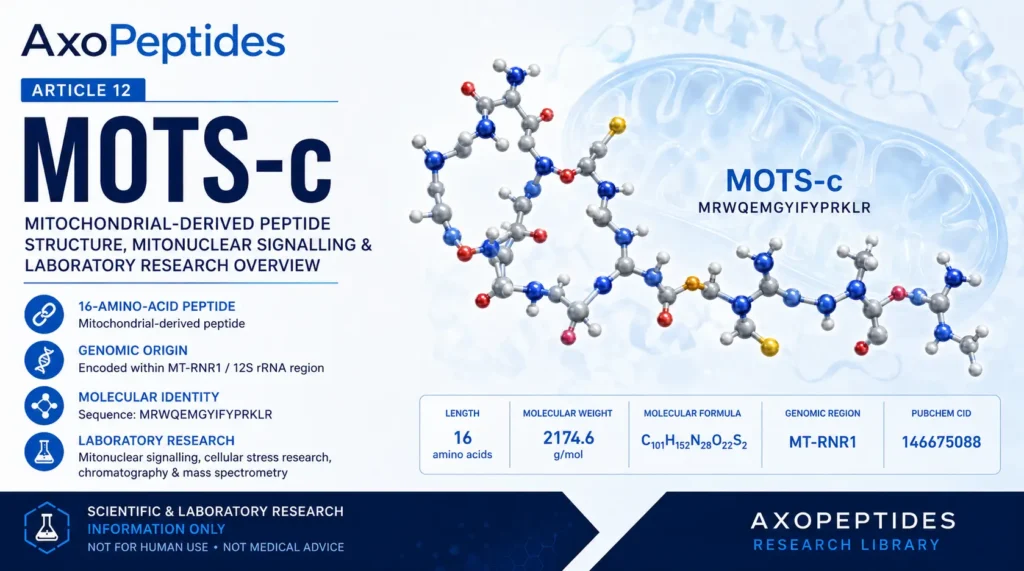
A scientific overview of MOTS-c covering its 16-amino-acid sequence, mitochondrial genomic origin, stress-associated nuclear translocation, mitonuclear signalling and laboratory characterisation.
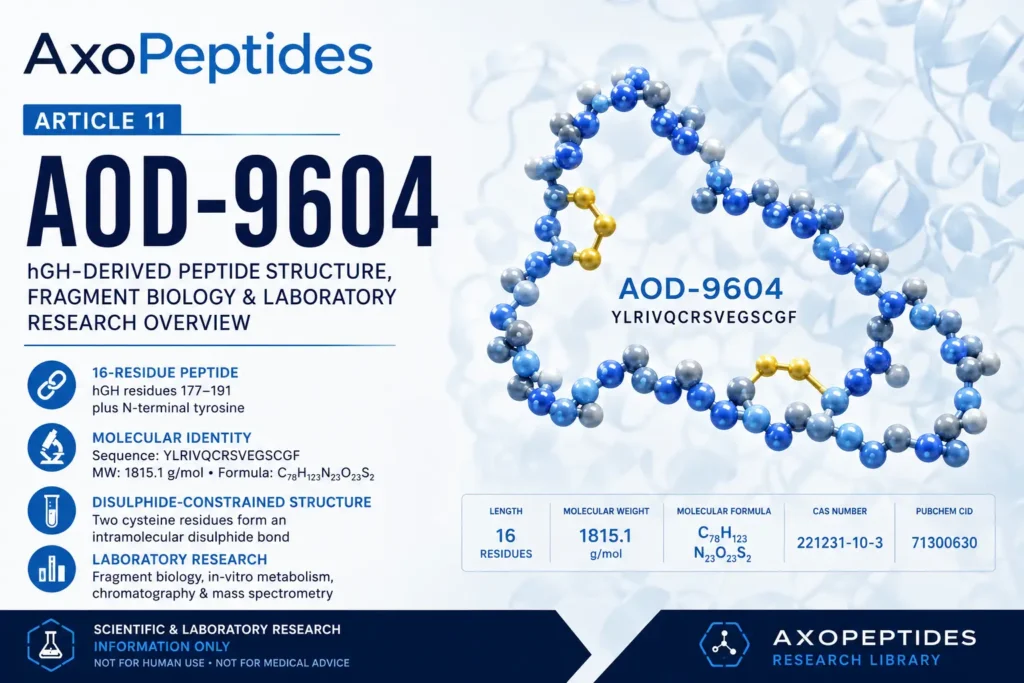
A scientific overview of AOD-9604 covering its 16-residue hGH-derived peptide architecture, amino-acid sequence, disulphide-constrained structure, experimental research and analytical characterisation.
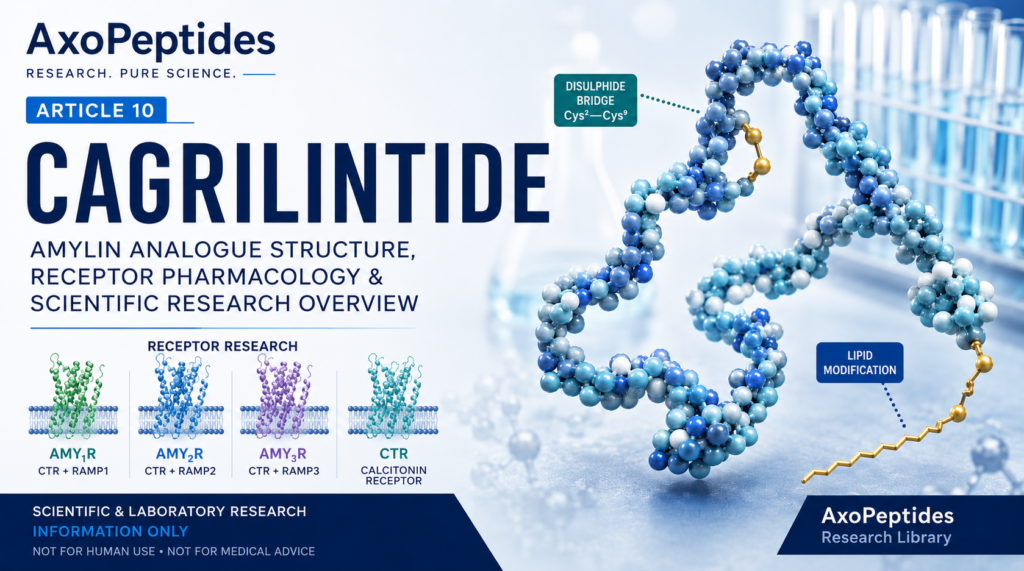
A scientific overview of cagrilintide covering its amylin-derived peptide architecture, lipid modification, calcitonin-family receptor interactions and structural research.
A scientific overview of retatrutide covering its peptide architecture, triple-receptor pharmacology, structural biology, laboratory analysis and research limitations.
A scientific overview of tirzepatide covering its 39-amino-acid peptide architecture, molecular characteristics, GIPR and GLP-1R interactions, structural biology and laboratory research.
A scientific overview of Ipamorelin covering its molecular identity, pentapeptide structure, receptor research, experimental evidence, laboratory analysis and research limitations.
A scientific overview of GHK-Cu covering its molecular identity, copper-binding characteristics, experimental literature, analytical testing and research limitations.