Tirzepatide: Molecular Structure, Dual-Receptor Pharmacology
& Scientific Research Overview
Tirzepatide is a synthetic 39-amino-acid peptide investigated
extensively in molecular pharmacology and structural biology.
This research overview examines its molecular architecture,
chemical modification, GIP and GLP-1 receptor interactions,
experimental research and analytical characterisation.
R
Scientific & Research Information
This article discusses molecular and laboratory research only.
It contains no dosing, reconstitution, administration,
injection or personal-use information.
MOLECULETirzepatide
PEPTIDE LENGTH39 amino acids
MOLECULAR WEIGHT≈ 4813 g/mol
RECEPTOR RESEARCHGIPR + GLP-1R
MOLECULAR OVERVIEW
What Is Tirzepatide?
Tirzepatide is a synthetic peptide molecule consisting of
39 amino-acid residues and additional structural modification.
From a molecular-pharmacology perspective, it is particularly
interesting because the same peptide has been engineered to
interact with two related class B G-protein-coupled receptors:
the glucose-dependent insulinotropic polypeptide receptor
(GIPR) and the glucagon-like peptide-1 receptor
(GLP-1R).
This dual-receptor architecture has made tirzepatide an important
model for studying how a single synthetic peptide can produce
different interactions across related receptor systems.
Research focus
This article examines tirzepatide as a molecular research
subject rather than providing guidance concerning its use.
PEPTIDE CHEMISTRY
Tirzepatide Molecular Structure
Tirzepatide contains a linear 39-amino-acid peptide component.
Its sequence was engineered using features associated with
naturally occurring incretin-peptide biology while incorporating
several deliberate molecular modifications.
PubChem currently reports the molecular formula of tirzepatide as
C225H348N48O68 and its molecular weight as
approximately 4813 g/mol.
TYPE
Synthetic peptide
LENGTH
39 amino acids
FORMULA
C225H348N48O68
MOLECULAR WEIGHT
≈ 4813 g/mol
Molecular formula and molecular weight provide useful reference
information, but they do not alone establish the identity or
purity of an experimental sample.
MOLECULAR ENGINEERING
Why Is Tirzepatide Structurally Modified?
Tirzepatide is not simply an unmodified naturally occurring
peptide sequence.
Its molecular design incorporates amino-acid substitutions and
a lipid-related structural modification. PubChem describes the
molecule as being conjugated to a C20 fatty diacid
moiety.
0139-residue peptide
+
02Sequence modifications
+
03C20 fatty diacid moiety
=
MOLECULETirzepatide
Simplified representation of structural design rather than
a complete chemical structure.
RECEPTOR PHARMACOLOGY
Why Is Tirzepatide Called a Dual-Receptor Agonist?
Tirzepatide has been characterised experimentally as an agonist
at both GIPR and GLP-1R.
These receptors belong to the class B family of
G-protein-coupled receptors, but they are distinct molecular
targets.
SYNTHETIC PEPTIDE
Tirzepatide
RECEPTOR 1
GIPR
RECEPTOR 2
GLP-1R
The scientific interest is therefore not simply that two
receptors are involved. Researchers also investigate whether
tirzepatide interacts with and activates those receptors in
identical or different ways.
RECEPTOR 01
Tirzepatide & GIP Receptor Research
The GIP receptor, abbreviated GIPR, is a class B
G-protein-coupled receptor activated naturally by
glucose-dependent insulinotropic polypeptide.
Tirzepatide's peptide sequence was designed with substantial
relationship to GIP-derived molecular architecture.
Experimental pharmacology has examined receptor binding,
receptor activation and downstream signalling associated with
tirzepatide-GIPR interactions.
LigandTirzepatide
→
Research targetGIPR
→
Research fieldGPCR signalling
RECEPTOR 02
Tirzepatide & GLP-1 Receptor Research
Tirzepatide also interacts with the GLP-1 receptor
(GLP-1R), another class B GPCR.
Experimental studies have reported that tirzepatide does not
necessarily behave identically at GIPR and GLP-1R.
This has generated research interest in concepts including
receptor selectivity, signalling bias, receptor internalisation
and differences in downstream signalling.
Important research distinction
“Dual receptor” does not mean that a molecule necessarily
interacts with two receptors with identical affinity,
potency or signalling behaviour.
STRUCTURAL BIOLOGY
What Has Structural Research Revealed?
Structural biology provides researchers with methods for
examining how peptide ligands interact with receptors at
extremely small scales.
Cryogenic electron microscopy
(cryo-EM) has been used to investigate
tirzepatide bound to both GIPR and GLP-1R.
01Peptide orientation
Structural models help investigate how tirzepatide is
positioned within receptor complexes.
02Residue interactions
Researchers can examine which peptide and receptor
residues contribute to molecular interactions.
03Receptor conformation
Structural studies can investigate conformational
changes associated with receptor activation.
Research published in Nature Communications reported
cryo-EM structures of tirzepatide-bound GIPR and GLP-1R
receptor complexes.
MOLECULAR PHARMACOLOGY
Receptor Signalling & Biased Agonism Research
GPCR activation is more complex than a simple receptor being
switched “on” or “off”.
Different ligands interacting with the same receptor can produce
different patterns of intracellular signalling.
Tirzepatide research has therefore examined concepts including
cAMP signalling,
β-arrestin recruitment and
receptor internalisation.
cAMP
A common intracellular second messenger investigated
downstream of class B GPCR activation.
β-Arrestin
Proteins involved in receptor regulation and signalling
that can be measured experimentally.
Internalisation
Research can examine how receptor populations change
following ligand activation.
Signalling Bias
Describes preferential activation of certain signalling
pathways relative to others.
EXPERIMENTAL SCIENCE
How Is Tirzepatide Studied Experimentally?
Tirzepatide appears across several different levels of scientific
investigation. Results from these levels should not be treated
as interchangeable.
01Molecular
Structure & binding
02Cellular
Receptor signalling
03Preclinical
Experimental models
04Clinical science
Separately controlled research
For a laboratory-focused article, the most relevant areas are
molecular structure, receptor pharmacology, cellular signalling
and analytical characterisation.
EVIDENCE INTERPRETATION
Why the Research Model Matters
A recurring problem in online discussions of research compounds
is the removal of findings from their experimental context.
MOLECULARWhat does it establish?
Molecular interaction, structural configuration
or biochemical properties under defined conditions.
IN VITROWhat does it establish?
Observations in controlled cellular or biochemical
experimental systems.
IN VIVOWhat does it establish?
Observations within the particular experimental
organism and study design investigated.
Evidence should remain in context.
Findings from receptor assays, cultured cells or experimental
models should not be rewritten as personal-use claims.
ANALYTICAL SCIENCE
Laboratory Analysis of Tirzepatide
Analytical characterisation of a synthetic peptide requires
answering several different questions about the material.
01Chromatography
HPLC and related chromatographic techniques can examine
sample composition under specified conditions.
02Mass Spectrometry
Molecular mass-related information can contribute to
assessment of molecular identity.
03Sequence Characterisation
Peptide sequence information is fundamental to defining
the molecular species being investigated.
04Structural Characterisation
Modified peptides require consideration of both the
peptide sequence and attached chemical groups.
ANALYTICAL INTERPRETATION
Purity Is Not the Same as Molecular Identity
A chromatographic purity result and molecular identification
answer different scientific questions.
PURITY
Sample composition
Relative chromatographic composition under the stated
analytical conditions.
IDENTITY
Which molecule?
Evidence that the analysed material corresponds to
the expected molecular species.
QUANTITY
How much material?
A separate quantitative analytical question requiring
an appropriate measurement method.
This distinction becomes particularly important for chemically
modified peptides, where both the peptide component and structural
modifications contribute to molecular identity.
SCIENTIFIC CAUTION
Important Limitations When Reading Tirzepatide Research
Receptor-binding experiments answer different questions
from whole-organism experiments.
Cellular signalling results depend on the experimental
system and assay design.
GIPR and GLP-1R activation should not be assumed to occur
with identical pharmacological characteristics.
Molecular structure alone does not establish every
functional property of a peptide.
Findings from one experimental model should not automatically
be generalised to another.
A chromatographic purity percentage does not by itself
establish molecular identity or absolute quantity.
Scientific publications should be read according to their
actual experimental endpoints rather than extrapolated into
unsupported claims.
UNITED KINGDOM
UK Research & Regulatory Context
Scientific discussion of a molecule and commercial presentation
of a product are not the same issue.
UK MHRA guidance indicates that the overall presentation of a
product can be relevant to regulatory classification. This can
include explicit and implicit claims as well as presentation
through websites, labelling, packaging and promotional material.
For this reason, an informational research article should not
combine research-only positioning with contradictory instructions
or personal-benefit claims elsewhere in the content.
Frequently Asked Research Questions About Tirzepatide
Is tirzepatide a peptide?
Yes. Tirzepatide contains a synthetic linear peptide
consisting of 39 amino-acid residues together with additional
chemical modification.
How many amino acids does tirzepatide contain?
Tirzepatide contains 39 amino-acid residues.
What is the molecular weight of tirzepatide?
PubChem currently reports a molecular weight of approximately
4813 g/mol.
What is the molecular formula of tirzepatide?
PubChem reports the molecular formula as C225H348N48O68.
Which receptors are investigated in tirzepatide research?
Tirzepatide has been characterised in research involving
the GIP receptor (GIPR) and GLP-1 receptor (GLP-1R).
What does dual-receptor agonism mean?
In this context, it describes the ability of the molecule
to activate two distinct receptor systems: GIPR and GLP-1R.
Does tirzepatide behave identically at both receptors?
Research indicates that its pharmacological behaviour is
not necessarily identical across GIPR and GLP-1R. Receptor
potency, signalling and regulatory behaviour can differ.
Has the tirzepatide-receptor complex been structurally studied?
Yes. Cryo-electron microscopy research has examined
tirzepatide bound to both GIPR and GLP-1R receptor complexes.
What is biased agonism?
Biased agonism describes a situation in which a ligand
preferentially influences particular signalling pathways
downstream of a receptor relative to others.
How can synthetic peptides such as tirzepatide be characterised?
Depending on the analytical question, researchers may use
chromatographic, mass-spectrometric and other appropriate
analytical techniques to investigate purity, identity and
molecular characteristics.
SCIENTIFIC SOURCES
References & Further Reading
PubChem — Tirzepatide
Molecular formula, molecular weight, chemical structure
and compound information.
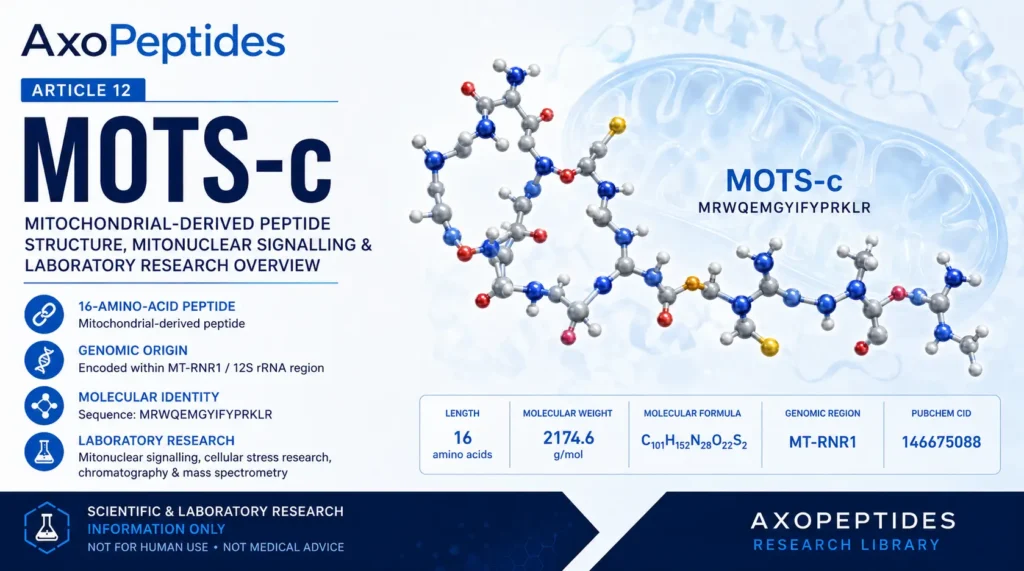
A scientific overview of MOTS-c covering its 16-amino-acid sequence, mitochondrial genomic origin, stress-associated nuclear translocation, mitonuclear signalling and laboratory characterisation.
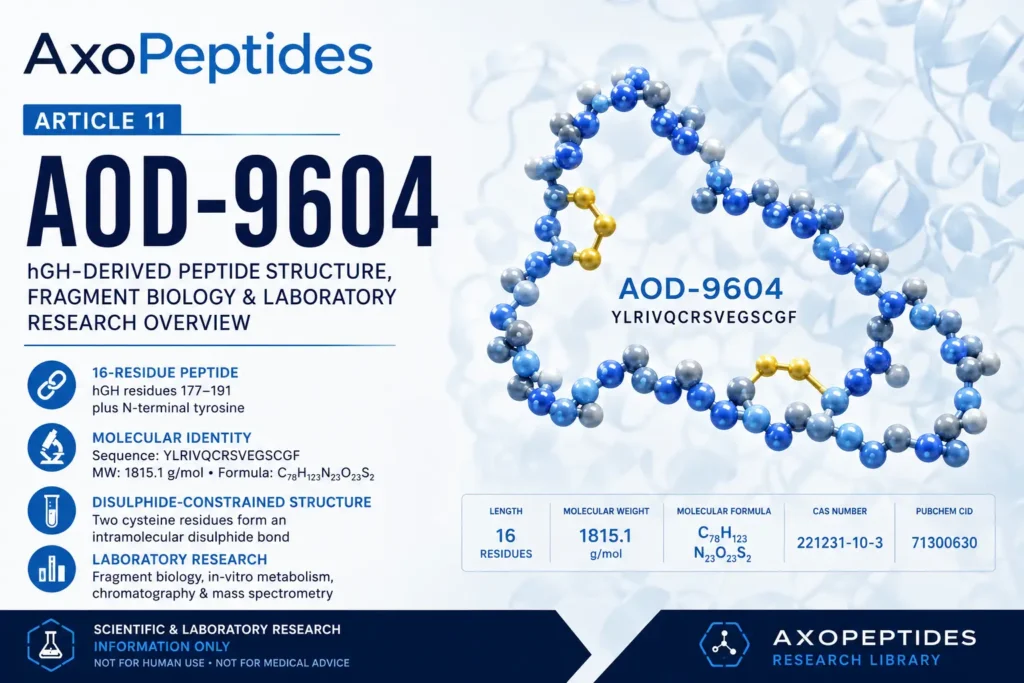
A scientific overview of AOD-9604 covering its 16-residue hGH-derived peptide architecture, amino-acid sequence, disulphide-constrained structure, experimental research and analytical characterisation.
A scientific overview of cagrilintide covering its amylin-derived peptide architecture, lipid modification, calcitonin-family receptor interactions and structural research.
A scientific overview of retatrutide covering its peptide architecture, triple-receptor pharmacology, structural biology, laboratory analysis and research limitations.
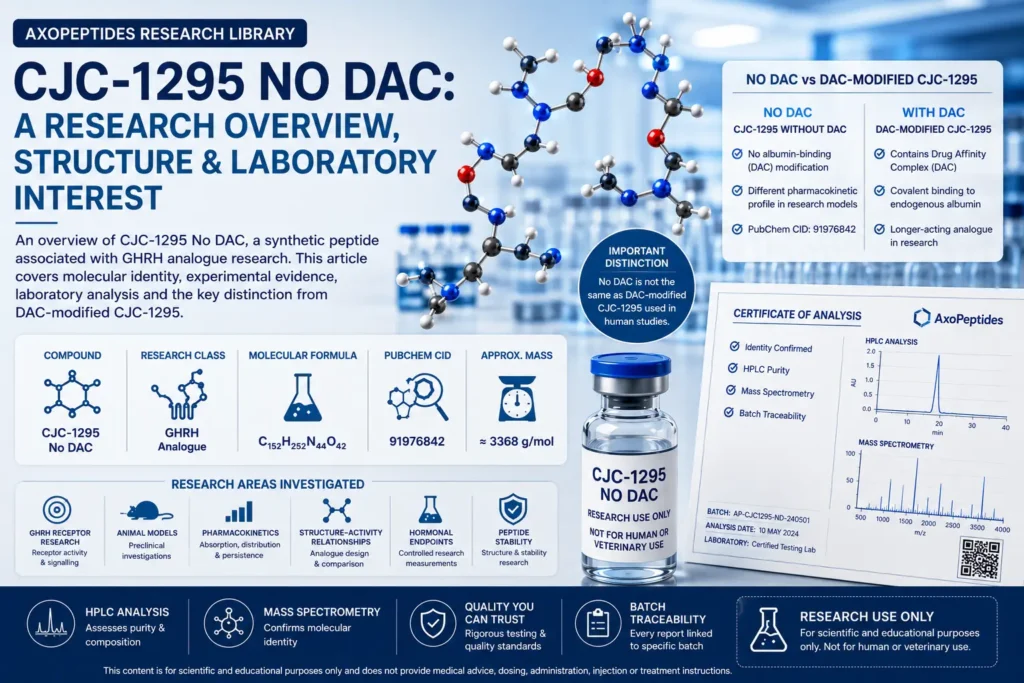
A scientific overview of CJC-1295 No DAC covering molecular identity, its relationship to GHRH analogues, laboratory analysis and the distinction from DAC-modified CJC-1295.
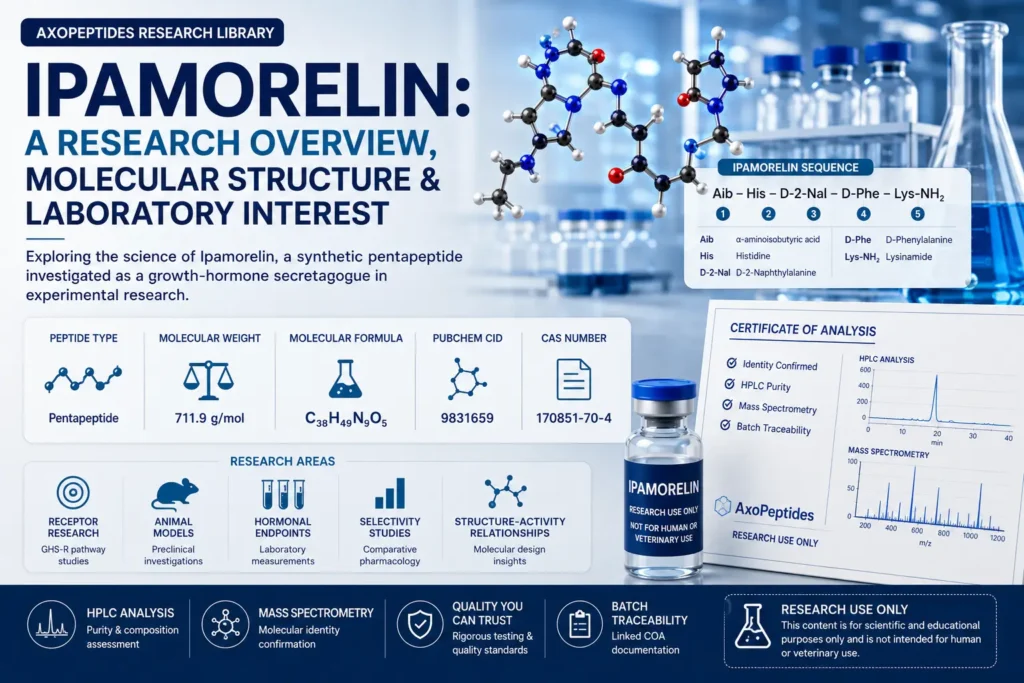
A scientific overview of Ipamorelin covering its molecular identity, pentapeptide structure, receptor research, experimental evidence, laboratory analysis and research limitations.
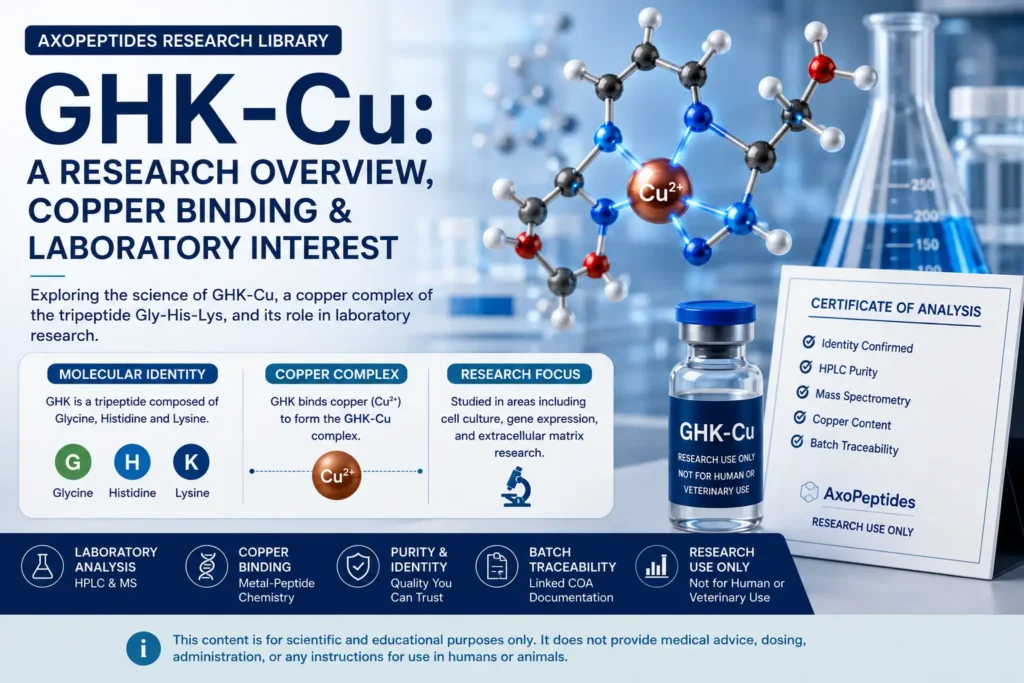
A scientific overview of GHK-Cu covering its molecular identity, copper-binding characteristics, experimental literature, analytical testing and research limitations.