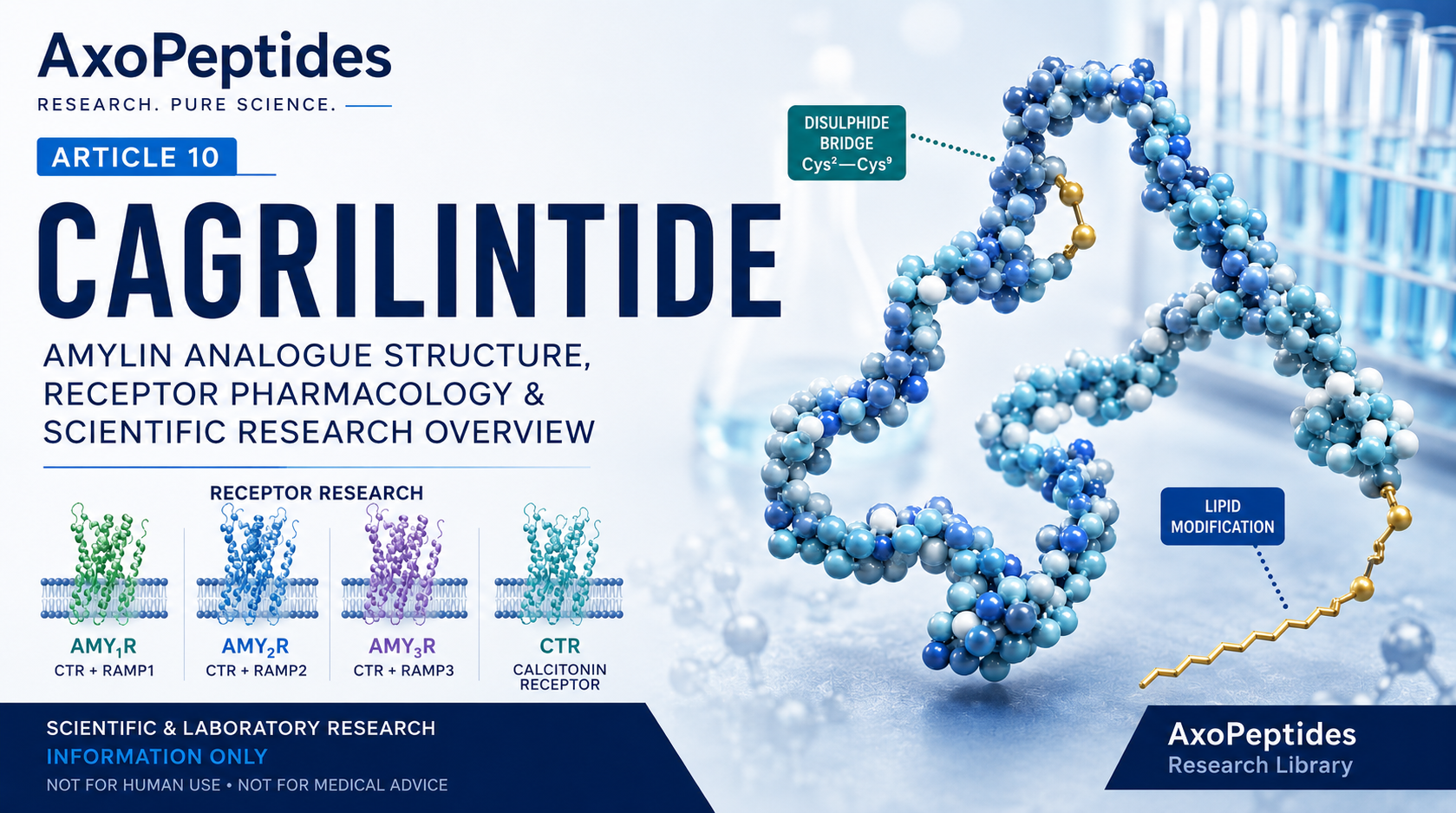
Cagrilintide: Amylin Analogue Structure,
Receptor Pharmacology & Scientific Research Overview
Cagrilintide is a synthetic lipidated peptide developed from
amylin-family peptide research. This scientific overview examines
its molecular architecture, structural modifications, interactions
with amylin and calcitonin-family receptors, cryo-electron microscopy
research and analytical characterisation.
R
Scientific & Laboratory Research Information
This article is intended for scientific and educational
information only. It contains no dosing, reconstitution,
administration, injection or personal-use instructions.
PEPTIDE FAMILYAmylin analogue
PEPTIDE SCAFFOLD37 residues
STRUCTURAL FEATURELipidated peptide
RECEPTOR RESEARCHAMY₁R / AMY₂R / AMY₃R / CTR
MOLECULAR OVERVIEW
What Is Cagrilintide?
Cagrilintide is a synthetic peptide developed through
structure–activity research involving the amylin peptide family.
Scientific literature describes it as a
lipidated amylin analogue. Its design combines
an amylin-family peptide backbone with specific amino-acid
substitutions and chemical modification.
This makes cagrilintide a useful research subject for examining
how peptide engineering influences receptor recognition,
molecular stability and receptor-complex dynamics.
Scientific focus
Cagrilintide research is particularly useful for studying
the relationship between peptide structure and signalling
through calcitonin-family receptor systems.
PEPTIDE FAMILY
What Is Amylin?
Amylin is a naturally occurring peptide belonging to the
calcitonin-family peptide system.
The native amylin peptide contains 37 amino-acid residues and
has characteristic structural features including an
intramolecular disulphide bridge near its N-terminus and an
amidated C-terminal residue.
Synthetic analogues can preserve parts of this molecular
architecture while incorporating deliberate substitutions or
chemical modifications.
NATURAL PEPTIDE
Amylin
→
ANALOGUE DESIGN
Sequence modification
→
RESEARCH MOLECULE
Cagrilintide
PEPTIDE CHEMISTRY
Cagrilintide Molecular Architecture
Cagrilintide is based on a 37-residue amylin-family peptide
scaffold.
Its structure contains several important molecular features that
distinguish it from a simple unmodified linear peptide.
0137-Residue Backbone
The peptide is built on an amylin-family molecular
architecture.
02Disulphide Bridge
Amylin-based peptides contain a covalent bridge between
cysteine residues near the N-terminal region.
03C-Terminal Amidation
The C-terminal end is chemically amidated rather than
remaining as a conventional free carboxyl group.
04Lipid Modification
Cagrilintide contains an attached lipid-related chemical
group linked to the peptide.
MOLECULAR ENGINEERING
Why Is Cagrilintide Lipidated?
Lipidation is a peptide-engineering strategy in which a
lipid-related chemical group is attached to a peptide molecule.
In structural research, the lipid conjugation represents an
additional molecular component that must be considered alongside
the amino-acid sequence.
01Peptide backbone
+
02Linker chemistry
+
03Lipid moiety
=
ENGINEERED PEPTIDECagrilintide
Simplified molecular-design illustration rather than a synthesis
or preparation protocol.
STRUCTURAL CHEMISTRY
The Cys²–Cys⁷ Disulphide Bridge
Amylin-family peptides contain a characteristic disulphide
bridge linking cysteine residues at positions 2 and 7.
A disulphide bridge is a covalent linkage formed between the
sulfur-containing side chains of two cysteine residues.
RESIDUE
Cys²
S — S
RESIDUE
Cys⁷
This local structural constraint contributes to the molecular
architecture presented to receptor-binding sites.
RECEPTOR PHARMACOLOGY
Which Receptors Are Studied With Cagrilintide?
Recent structural research has examined cagrilintide in complexes
with three amylin-receptor phenotypes and the calcitonin receptor.
AMYLIN RECEPTOR
AMY₁R
AMYLIN RECEPTOR
AMY₂R
AMYLIN RECEPTOR
AMY₃R
CALCITONIN RECEPTOR
CTR
These receptor systems belong to the broader calcitonin-family
signalling network.
RECEPTOR ARCHITECTURE
How Are Amylin Receptors Formed?
Amylin receptors are unusual because they are not defined by
a single receptor protein alone.
They are formed when the calcitonin receptor
(CTR) associates with one of three
receptor activity-modifying proteins
(RAMPs).
CTR + RAMP1AMY₁R
CTR + RAMP2AMY₂R
CTR + RAMP3AMY₃R
The presence of different RAMP proteins can change receptor
pharmacology and ligand interactions.
CALCITONIN-FAMILY RESEARCH
Cagrilintide & the Calcitonin Receptor
The calcitonin receptor can also be expressed independently of
RAMP proteins.
Structural work has investigated cagrilintide bound directly to
CTR as well as CTR-containing amylin-receptor complexes.
Important distinction
CTR and the three amylin-receptor phenotypes share a receptor
component but are not pharmacologically identical receptor
systems.
CRYO-ELECTRON MICROSCOPY
Structural Biology of Cagrilintide-Receptor Complexes
Cryogenic electron microscopy, commonly abbreviated
cryo-EM, allows researchers to study large
molecular complexes at near-atomic resolution.
In 2025, researchers reported structures of cagrilintide bound
to active Gs-coupled AMY₁R, AMY₂R, AMY₃R and CTR
complexes.
Peptide Orientation
Structural maps reveal how the peptide occupies the
receptor-binding region.
Residue Contacts
Individual amino-acid interactions can be examined
within the peptide-receptor complex.
Receptor Conformation
Structural models can reveal different receptor
conformational states.
MOLECULAR DYNAMICS
Why Are Receptor Dynamics Important?
Receptor structures are not completely rigid.
Structural research indicates that cagrilintide can produce
different conformational dynamics across calcitonin-family
receptor complexes.
PEPTIDE
Cagrilintide
→
RECEPTOR
AMYR / CTR
→
STRUCTURAL QUESTION
Conformational dynamics
Comparing these dynamics with other amylin-family or
calcitonin-family peptides can help researchers investigate
structure–activity relationships.
EXPERIMENTAL SCIENCE
How Is Cagrilintide Studied?
01Chemical
Sequence & modification
02Structural
Cryo-EM complexes
03Cellular
Receptor signalling
04Preclinical
Controlled models
Each experimental level answers different questions. A molecular
interaction observed in a receptor complex should remain described
as a molecular finding rather than being converted into a
broader claim.
ANALYTICAL CHEMISTRY
Laboratory Analysis of Cagrilintide
Modified peptides can require complementary analytical methods
because sequence, purity and attached chemical groups represent
separate aspects of molecular characterisation.
01Chromatography
HPLC can examine sample composition under defined
analytical conditions.
02Mass Spectrometry
Molecular mass-related data can contribute to
identification.
03Peptide Sequence
Sequence information helps define the peptide backbone
being investigated.
04Modification Analysis
Lipid conjugation and other structural modifications
form part of the complete molecular identity.
PubChem Chemical Representation
PubChem currently lists a cagrilintide acetate representation
under CID 164618153 with molecular formula
C194H312N54O59S2 and molecular weight of approximately
4409 g/mol.
Researchers should check which salt or chemical form is being
represented before comparing molecular formulas between
databases or analytical records.
ANALYTICAL INTERPRETATION
Purity, Identity & Structural Form
PURITY
Sample composition
Describes chromatographic composition under the stated
analytical conditions.
IDENTITY
Which molecule?
Addresses whether analytical evidence corresponds to
the expected molecular species.
STRUCTURAL FORM
Which representation?
Modified peptides may exist as different salt or
chemically represented forms.
Do not use HPLC purity as a substitute for identity.
A high chromatographic purity result does not by itself
establish peptide sequence, molecular mass or chemical
modification.
SCIENTIFIC CAUTION
Important Limitations When Reading Cagrilintide Research
Cagrilintide is a modified amylin analogue rather than
native amylin.
AMY₁R, AMY₂R and AMY₃R are distinct receptor phenotypes.
CTR and amylin receptors share structural components but
should not be treated as identical.
Structural binding and functional signalling are different
experimental questions.
Cryo-EM structures represent experimentally resolved
molecular states rather than every possible receptor state.
Cellular observations should remain identified as cellular
findings.
Preclinical findings should remain identified as preclinical.
Chromatographic purity does not by itself establish complete
molecular identity.
UNITED KINGDOM
Cagrilintide in the UK Research Context
Research-oriented scientific information should remain clearly
separated from medicinal presentation and personal-use guidance.
UK regulatory assessment can consider explicit and implicit
product claims, pharmacological properties, intended purpose and
the way a product is presented through websites, labelling,
advertising, social media and other promotional material.
A scientific article should therefore remain consistent with
its laboratory and research positioning throughout.
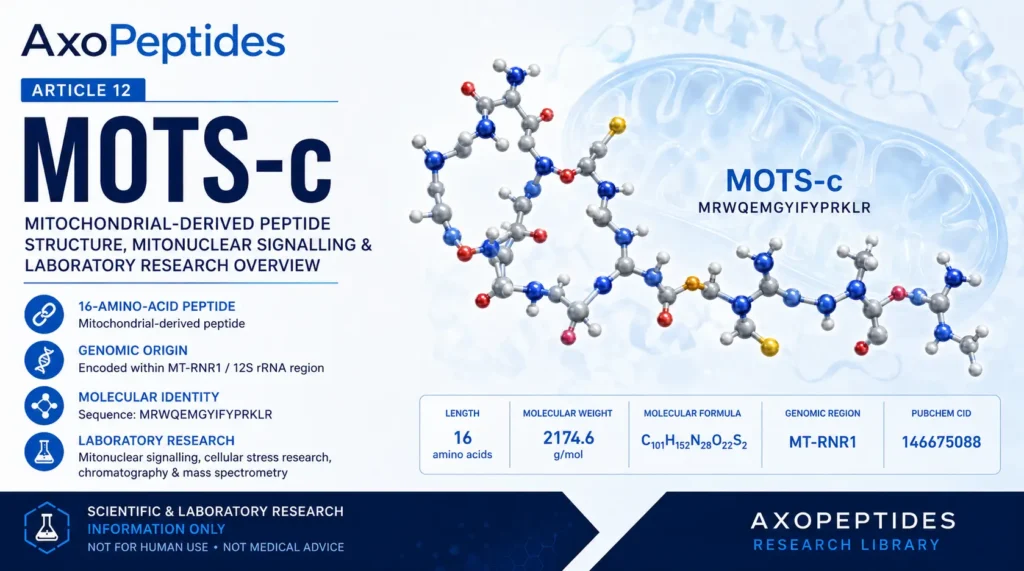
A scientific overview of MOTS-c covering its 16-amino-acid sequence, mitochondrial genomic origin, stress-associated nuclear translocation, mitonuclear signalling and laboratory characterisation.
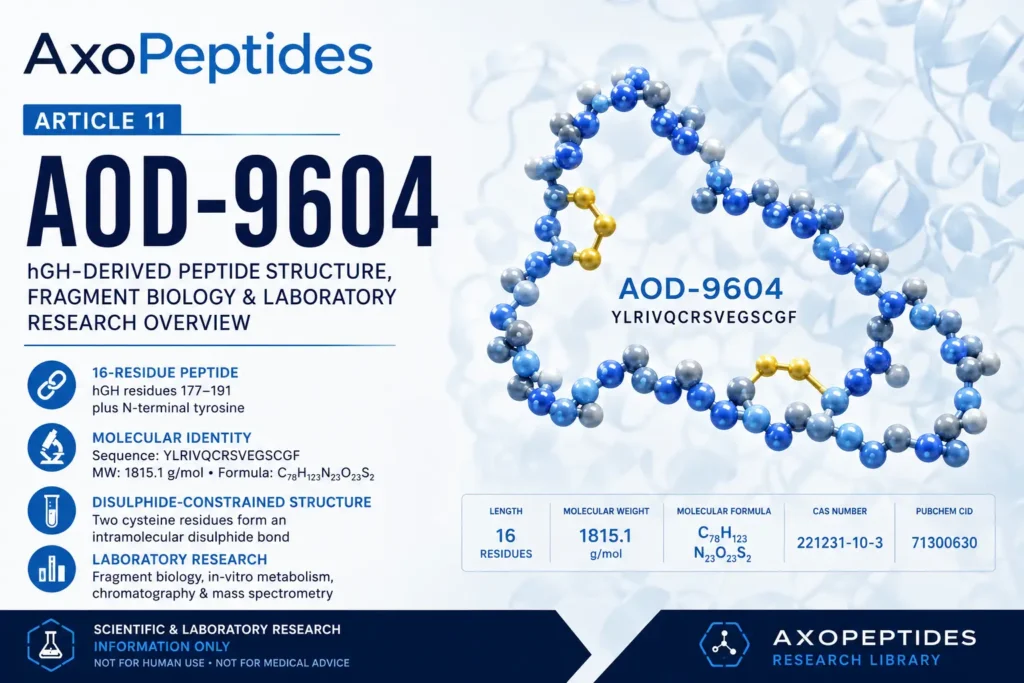
A scientific overview of AOD-9604 covering its 16-residue hGH-derived peptide architecture, amino-acid sequence, disulphide-constrained structure, experimental research and analytical characterisation.
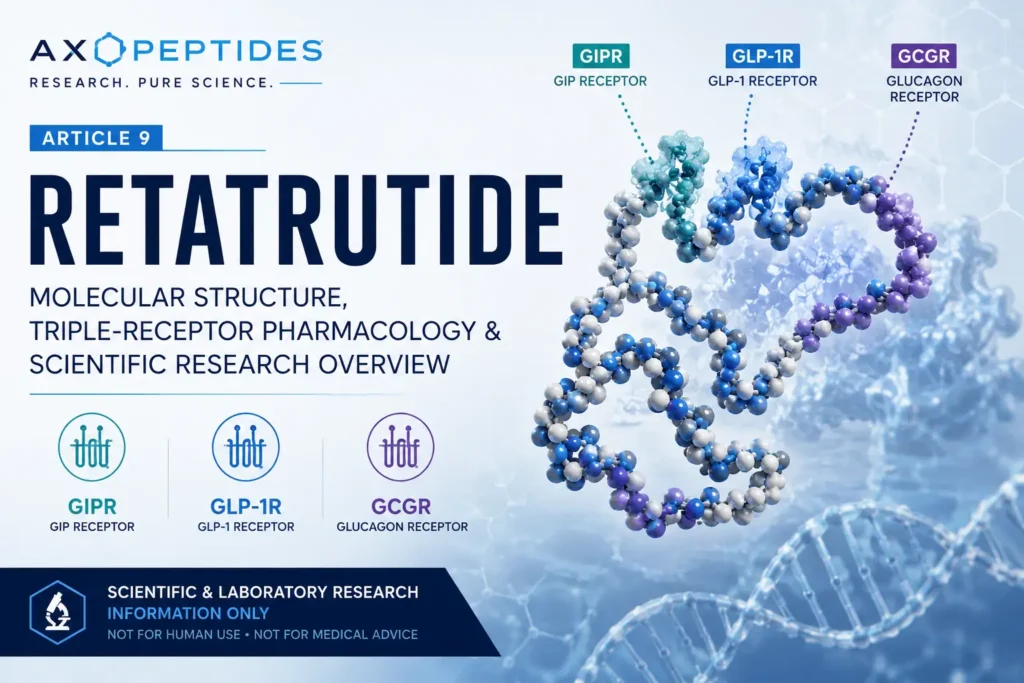
A scientific overview of retatrutide covering its peptide architecture, triple-receptor pharmacology, structural biology, laboratory analysis and research limitations.
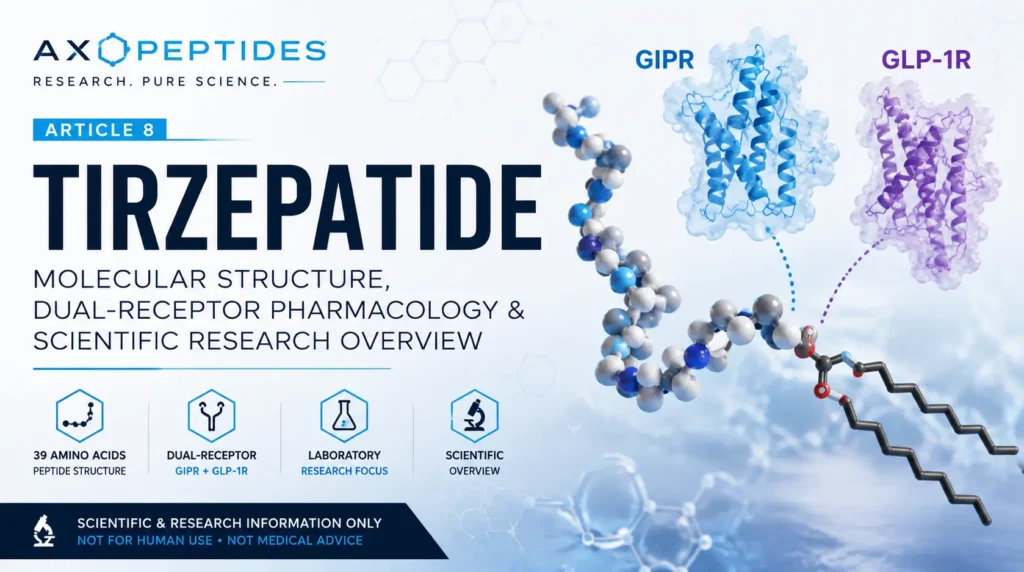
A scientific overview of tirzepatide covering its 39-amino-acid peptide architecture, molecular characteristics, GIPR and GLP-1R interactions, structural biology and laboratory research.
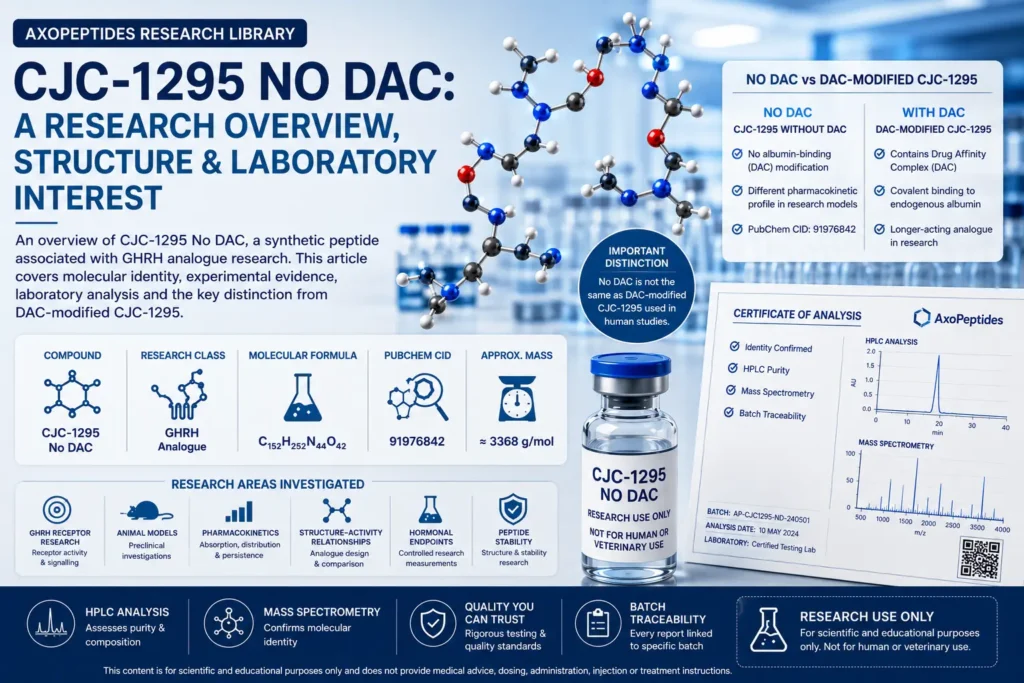
A scientific overview of CJC-1295 No DAC covering molecular identity, its relationship to GHRH analogues, laboratory analysis and the distinction from DAC-modified CJC-1295.
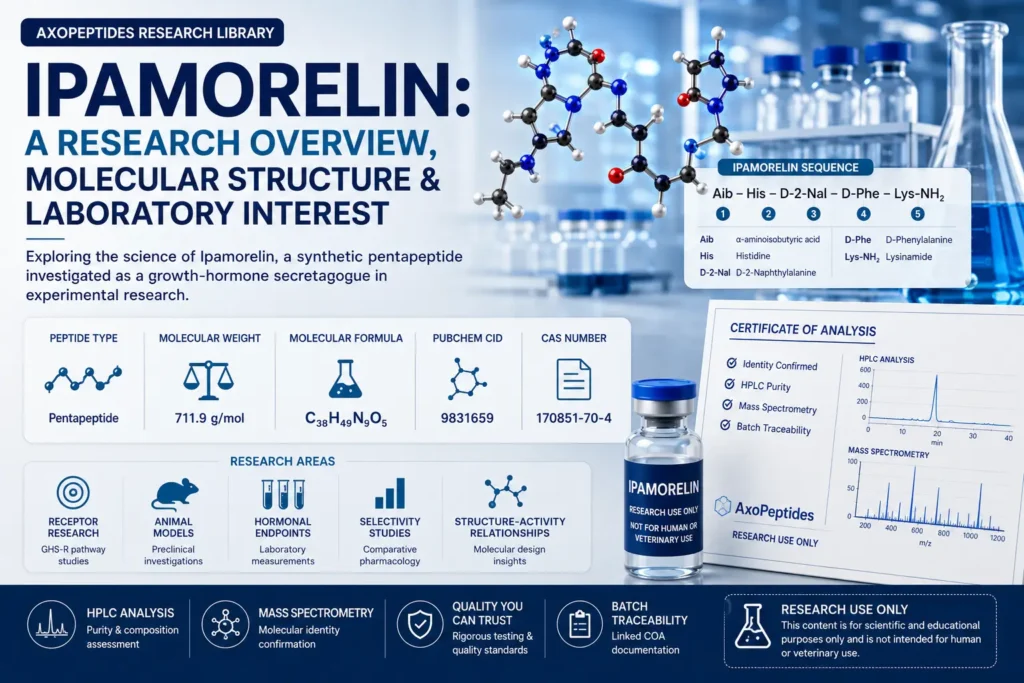
A scientific overview of Ipamorelin covering its molecular identity, pentapeptide structure, receptor research, experimental evidence, laboratory analysis and research limitations.
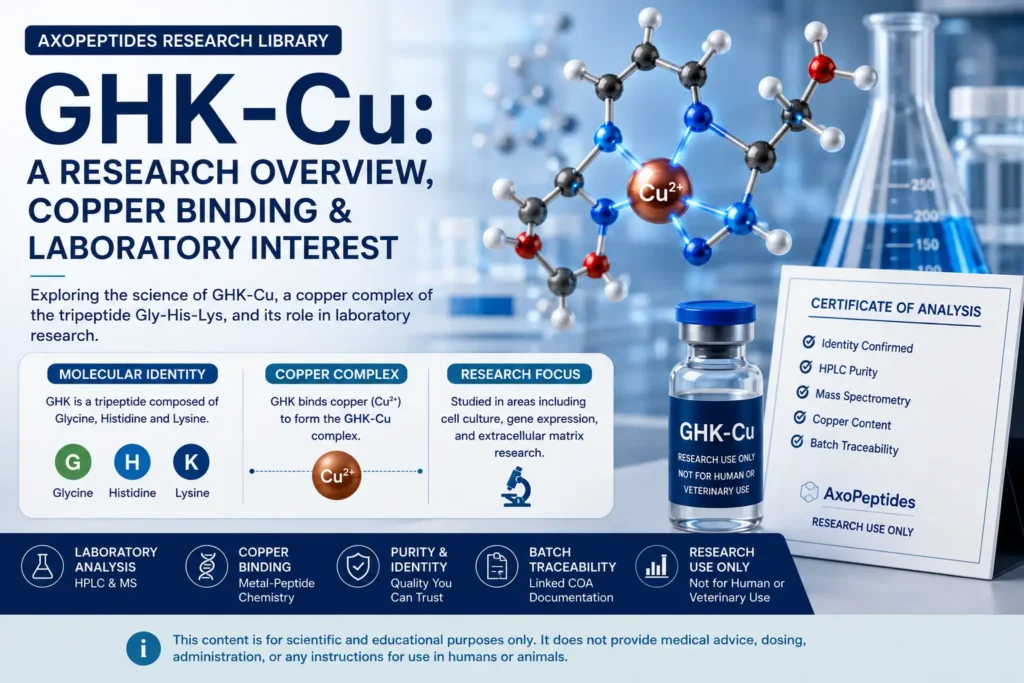
A scientific overview of GHK-Cu covering its molecular identity, copper-binding characteristics, experimental literature, analytical testing and research limitations.