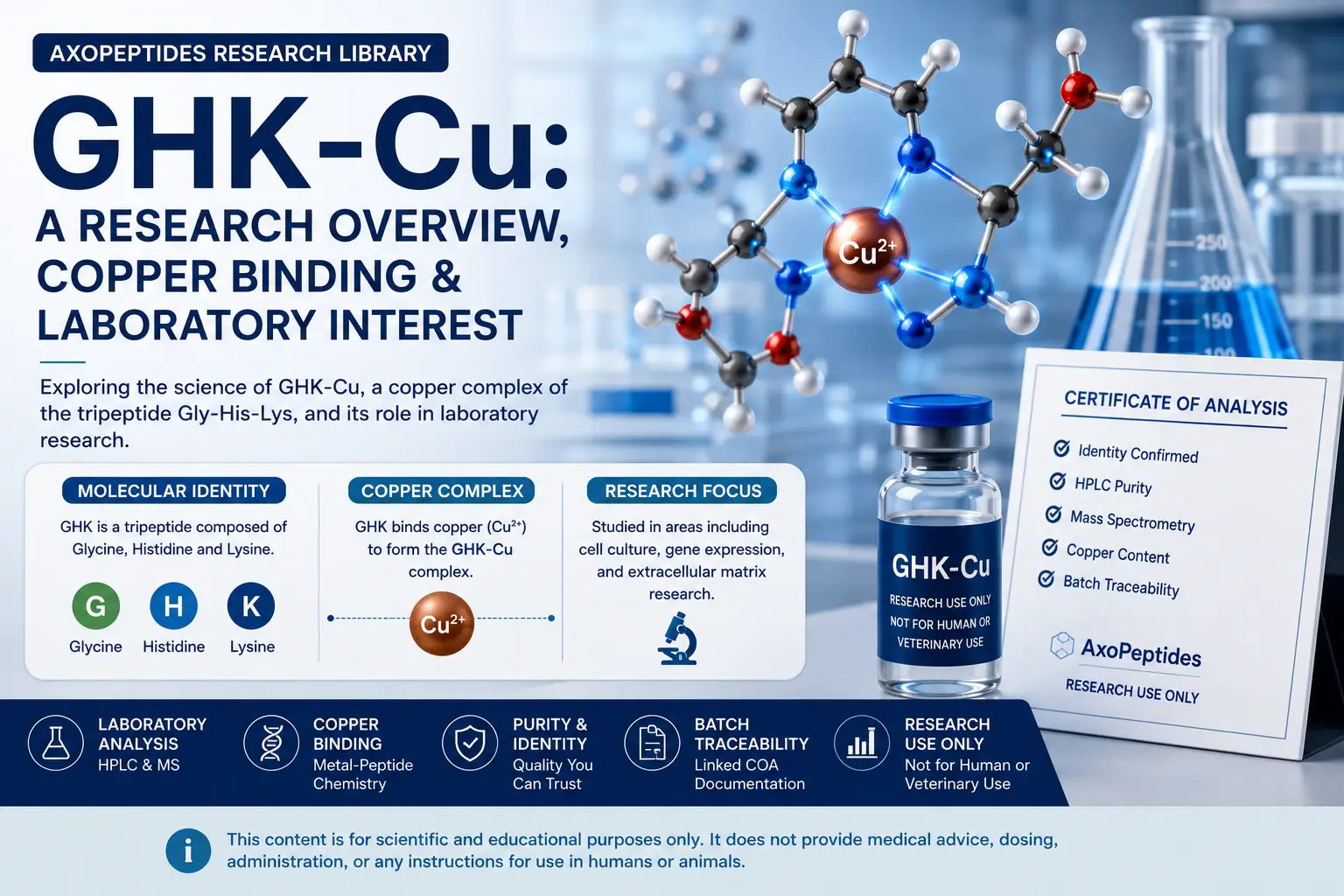
GHK-Cu: A Research Overview, Copper Binding & Laboratory Interest
GHK-Cu is a copper complex of the naturally occurring tripeptide
glycyl-L-histidyl-L-lysine (GHK). This scientific overview examines
its molecular identity, copper-binding chemistry, experimental research,
analytical characterisation and important limitations of the evidence.
Research Use Only
Scientific and educational information only. This article contains no
dosing, reconstitution, administration, injection, treatment or
personal-use instructions.
PEPTIDEGHK
SEQUENCEGly-His-Lys
COMPLEXCopper (II)
RESEARCH FOCUSMetal–Peptide Chemistry
MOLECULAR IDENTITY
What Is GHK-Cu?
GHK-Cu is a coordination complex formed when the tripeptide GHK
interacts with copper ions.
The abbreviation GHK represents the amino-acid sequence
glycyl-L-histidyl-L-lysine. When complexed with copper, it is commonly
described in scientific literature as GHK-Cu or copper tripeptide.
Gly – His – Lys + Cu²⁺
The distinction between GHK and GHK-Cu matters scientifically.
GHK describes the peptide itself, while GHK-Cu describes a
metal–peptide complex involving copper.
Key distinction
GHK and GHK-Cu are closely related but are not chemically identical
terms. Researchers should identify which molecular form is being
investigated when interpreting experimental literature.
TRIPEPTIDE
What Is GHK?
GHK is a short peptide composed of three amino-acid residues:
glycine, histidine and lysine.
GGlycineFirst residue
HHistidineSecond residue
KLysineThird residue
GHK has attracted scientific attention partly because of its
ability to coordinate metal ions, particularly copper.
This provides a useful example of how even a very short peptide
sequence can display chemically significant interactions determined
by the functional groups present within its amino-acid residues.
COORDINATION CHEMISTRY
Why Is Copper Binding Important in GHK-Cu Research?
Copper is a transition metal capable of forming coordination complexes
with suitable biological molecules.
GHK contains chemical groups capable of participating in copper
coordination. Researchers have therefore studied GHK-Cu as a
metal–peptide complex rather than simply treating it as an
unmodified three-amino-acid peptide.
01
GHKTripeptide
+
02
Cu²⁺Copper ion
→
03
GHK-CuCoordination complex
The presence of copper is an important analytical consideration.
Characterising a GHK-Cu research material therefore involves
questions that can extend beyond simply identifying the GHK sequence.
CHEMICAL CHARACTERISTICS
Molecular Characteristics of GHK-Cu
Chemical identifiers are useful because common names can vary between
publications, suppliers and analytical databases.
Common abbreviationGHK-Cu
Peptide sequenceGly-His-Lys
Complex typeCopper–peptide complex
PubChem nameCopper tripeptide
PubChem CID139035031
Molecular weight400.90 g/mol*
*Molecular information shown here follows the copper tripeptide
representation currently listed by PubChem. Molecular descriptors
can depend on the precise chemical representation, protonation state
and associated species.
EXPERIMENTAL LITERATURE
Why Has GHK-Cu Attracted Scientific Interest?
GHK and its copper complex have appeared in scientific literature
across several areas of experimental biology and chemistry.
The subjects below describe areas investigated by researchers.
They are not claims of personal benefit, treatment indications
or recommendations for use.
Copper Coordination
Investigation of the molecular interaction between GHK
and copper ions.
Cell-Culture Models
Experimental studies involving cultured cells and controlled
laboratory systems.
Gene-Expression Research
Laboratory studies examining changes in transcriptional
patterns under defined experimental conditions.
Extracellular Matrix Models
Experimental investigation of proteins and cellular environments
associated with extracellular structures.
Oxidative Chemistry
Research examining copper-associated chemistry and
redox-related experimental processes.
Analytical Chemistry
Characterisation of peptide identity, metal interaction
and sample composition.
Evidence context matters
An observation in a molecular, cell-culture or animal model
should be reported as an observation from that model. It should
not be rewritten as a claim about an outcome in a person.
EVIDENCE INTERPRETATION
Understanding GHK-Cu Research Evidence
Search results about GHK-Cu often combine mechanistic studies,
cell experiments, animal models, reviews and commercial claims.
These are not equivalent levels of evidence.
01Chemical & Molecular Research
Investigates molecular structure, coordination chemistry
and interactions under controlled conditions.
02In Vitro Research
Experiments involving isolated cells, proteins or other
laboratory systems.
03Preclinical Models
Experimental studies conducted in non-human biological models.
04Human Evidence
Requires separate assessment of the exact compound,
formulation, study design and endpoints investigated.
The existence of substantial experimental literature should therefore
not be interpreted as evidence that every commercial claim associated
with the term “copper peptide” has been established.
ANALYTICAL CHEMISTRY
Laboratory Analysis of GHK-Cu
Laboratory characterisation can address several different questions
about a research material.
01What components are detected?
Chromatographic analysis can help examine sample composition.
02Does the molecular data correspond?
Mass-spectrometric information can contribute to molecular
identification.
03Is copper present?
Elemental or metal-specific analysis may be relevant when
characterising a copper-containing complex.
04Which batch was analysed?
Traceability connects analytical documentation with the
material represented by that report.
High-Performance Liquid Chromatography
HPLC can separate detected sample components under defined
chromatographic conditions. A chromatogram can therefore contribute
information about sample composition and chromatographic purity.
Mass Spectrometry
Mass spectrometry measures mass-to-charge information. Depending
on the analytical method, this information can assist in assessing
whether detected molecular species correspond with expected
characteristics.
Copper Analysis
Because GHK-Cu is a metal–peptide complex, analytical questions may
also involve determining or quantifying copper. The appropriate
analytical technique depends on the specific research question.
QUALITY INTERPRETATION
Purity, Identity & Quantity Are Different Measurements
One of the most important principles in peptide analysis is that
purity, identity and quantity are not interchangeable.
Purity
Describes the relative composition detected under a specified
analytical method.
Identity
Addresses whether analytical evidence is consistent with
the expected molecular material.
Quantity
Addresses how much of a particular material is present
under the measurement method used.
A “99% purity” figure does not answer every analytical question.
Researchers should examine what was measured, which method was used,
whether molecular identity was assessed and which batch the report
actually represents.
DOCUMENTATION
What Should Researchers Look for in a GHK-Cu COA?
A Certificate of Analysis should provide enough information to
understand what sample was tested and how the reported analytical
result was obtained.
Material or sample name
Batch or sample identifier
Analytical method
Analysis date
Reported chromatographic result where applicable
Molecular identity information where tested
Testing laboratory information
Clear connection between the report and the represented batch
Laboratory Reports & Batch Documentation
View available AxoPeptides batch-linked Certificates of Analysis
and analytical documentation.
An analytical report has limited value if researchers cannot establish
which physical batch the report represents.
STEP 1Research Material
→
STEP 2Batch ID
→
STEP 3Laboratory Sample
→
STEP 4COA
→
STEP 5Research Record
Maintaining this chain improves documentation and makes it easier
to determine which analytical result corresponds to which research
material.
SCIENTIFIC CAUTION
Important Limitations of GHK-Cu Research
GHK-Cu has a substantial scientific literature, but several issues
should be considered when interpreting that literature.
GHK and GHK-Cu should not automatically be treated as chemically
identical research materials.
Results from isolated cells do not automatically predict outcomes
in an intact organism.
Animal-model observations should remain identified as preclinical.
Different studies may investigate different concentrations,
experimental systems and molecular preparations.
Commercial terminology may be less precise than terminology used
in analytical literature.
Chromatographic purity alone does not establish every aspect of
molecular identity or composition.
Scientific publications are not marketing claims.
Research findings should be described according to the compound,
model and endpoints actually investigated rather than converted
into claims about personal outcomes.
UNITED KINGDOM
GHK-Cu in the UK Research Context
UK regulatory classification does not depend solely on placing
“research use only” next to a product.
The MHRA considers factors including explicit and implicit claims,
pharmacological properties, intended purpose and how a product is
presented through websites, advertising, packaging, social media
and customer reviews when assessing whether a product may meet
the definition of a medicinal product.
For that reason, scientific research content should clearly separate
descriptions of experimental literature from claims about what a
product could do for an individual.
GHK refers to glycyl-L-histidyl-L-lysine. GHK-Cu describes
a copper complex involving this tripeptide.
Is GHK-Cu a peptide?
GHK is a three-amino-acid peptide. GHK-Cu is more precisely
described as the copper complex of that tripeptide.
What is the amino-acid sequence of GHK?
The sequence is glycine–histidine–lysine, commonly abbreviated
Gly-His-Lys or GHK.
Why is GHK-Cu blue?
Copper coordination complexes can display characteristic visible
colour because metal coordination affects electronic transitions.
Exact appearance can depend on composition and chemical environment.
Are GHK and GHK-Cu identical?
No. GHK describes the peptide, whereas GHK-Cu describes a
copper-associated complex of that peptide.
How is GHK-Cu analysed?
Depending on the research question, analytical approaches may
include chromatography, mass spectrometry and techniques relevant
to elemental or copper analysis.
Does HPLC purity prove molecular identity?
No. Chromatographic purity and molecular identity are separate
analytical questions and may require complementary evidence.
Why is batch-specific testing useful?
Batch-specific documentation helps establish which research
material corresponds to a particular analytical report.
SOURCES
Scientific & Regulatory References
PubChem — Copper tripeptide (GHK-Cu).
Chemical identifiers, molecular formula and molecular
characteristics for copper tripeptide.
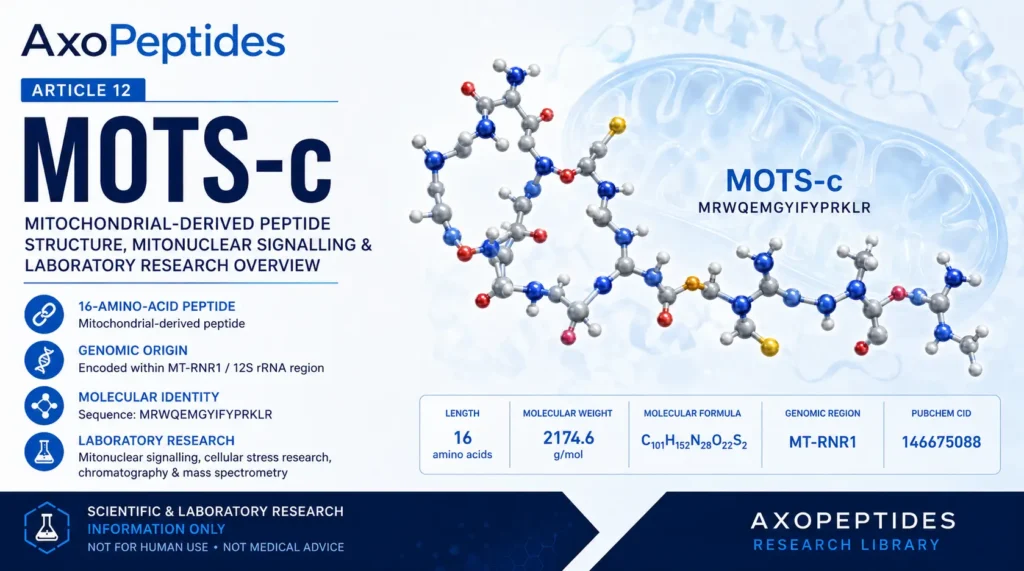
A scientific overview of MOTS-c covering its 16-amino-acid sequence, mitochondrial genomic origin, stress-associated nuclear translocation, mitonuclear signalling and laboratory characterisation.
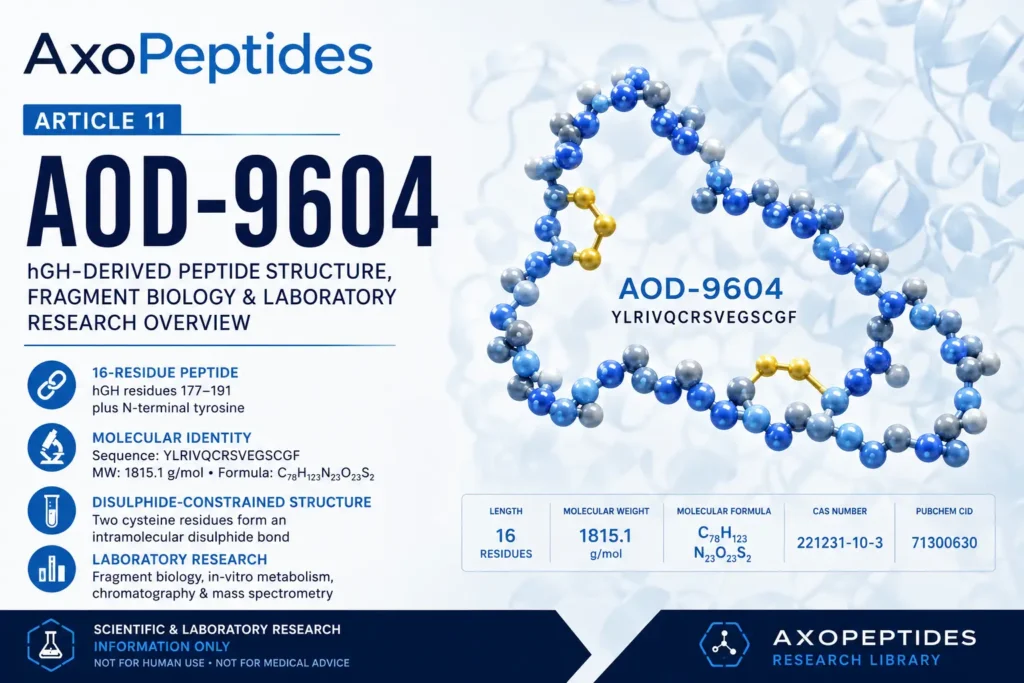
A scientific overview of AOD-9604 covering its 16-residue hGH-derived peptide architecture, amino-acid sequence, disulphide-constrained structure, experimental research and analytical characterisation.
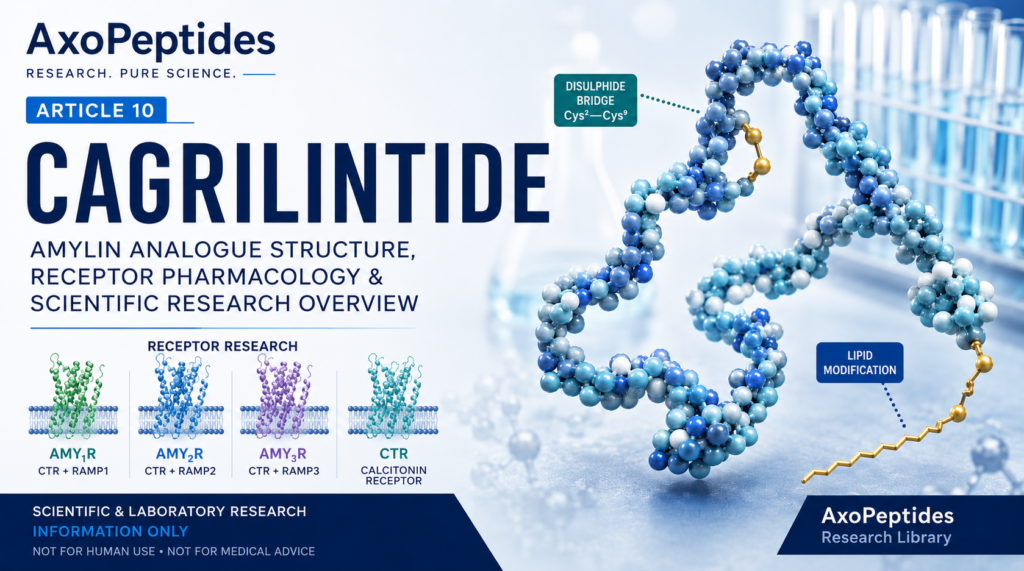
A scientific overview of cagrilintide covering its amylin-derived peptide architecture, lipid modification, calcitonin-family receptor interactions and structural research.
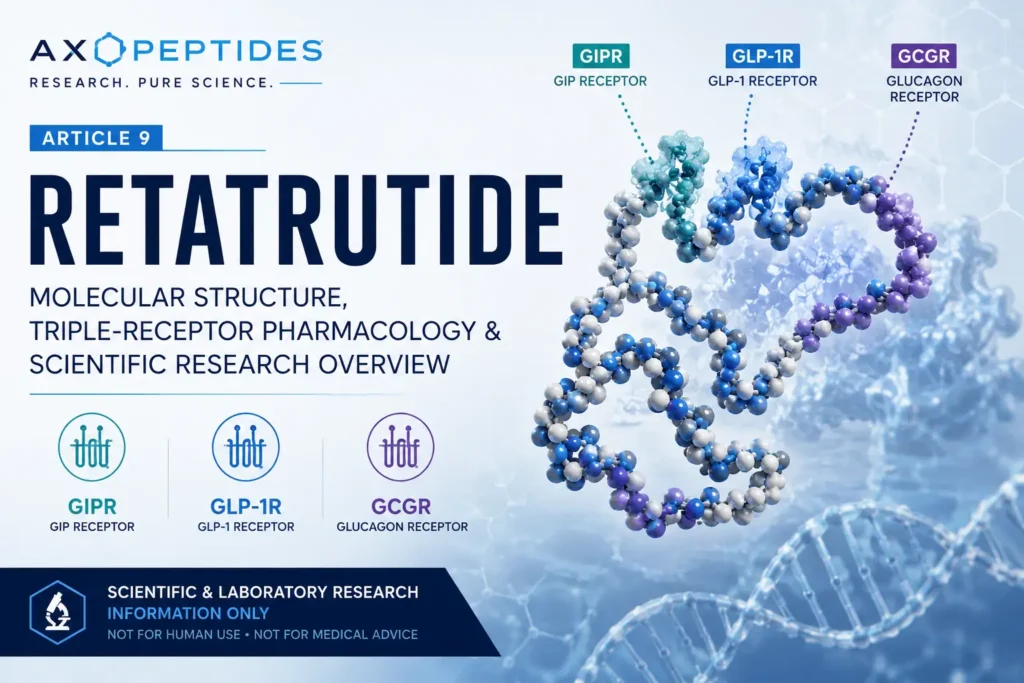
A scientific overview of retatrutide covering its peptide architecture, triple-receptor pharmacology, structural biology, laboratory analysis and research limitations.
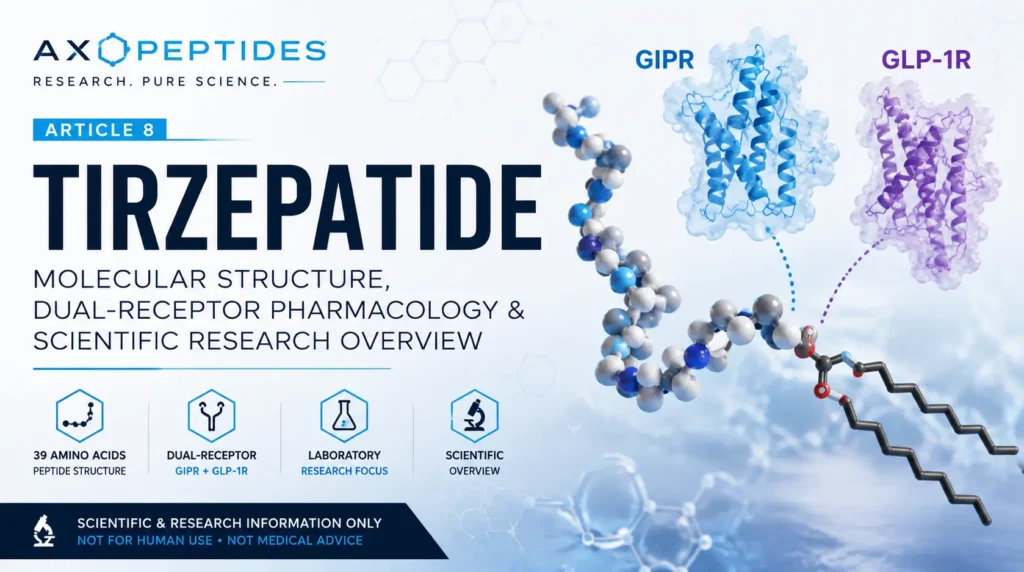
A scientific overview of tirzepatide covering its 39-amino-acid peptide architecture, molecular characteristics, GIPR and GLP-1R interactions, structural biology and laboratory research.
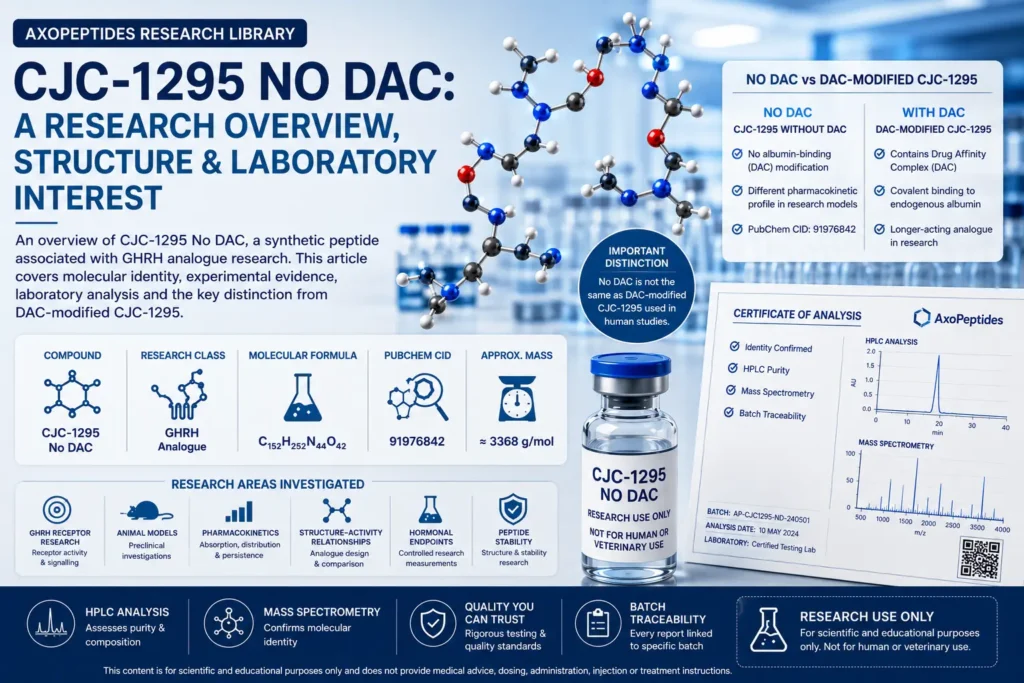
A scientific overview of CJC-1295 No DAC covering molecular identity, its relationship to GHRH analogues, laboratory analysis and the distinction from DAC-modified CJC-1295.
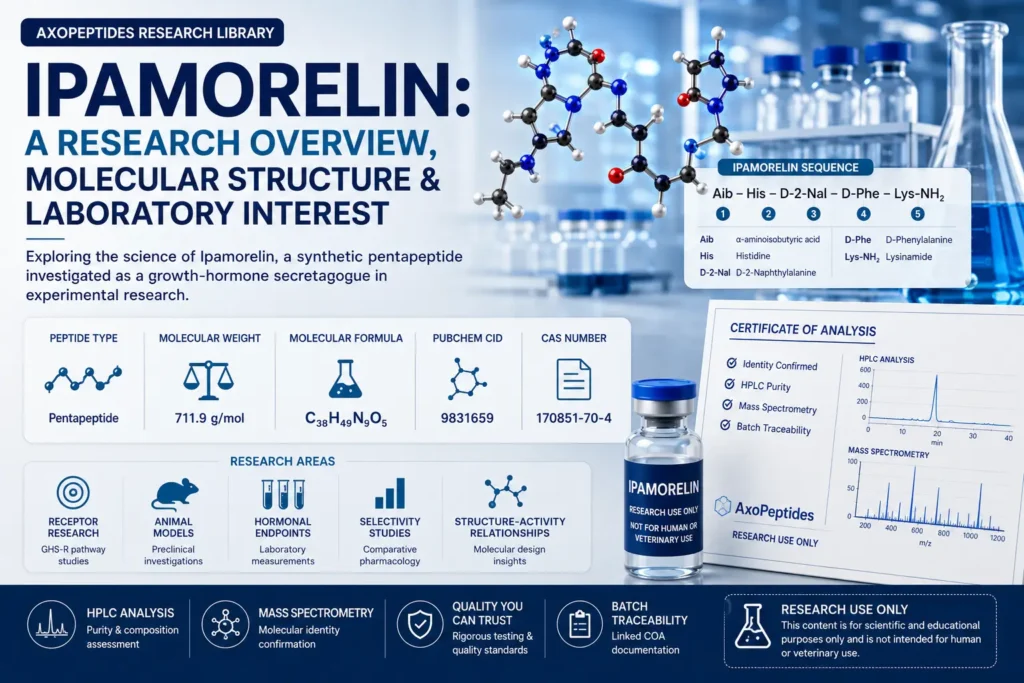
A scientific overview of Ipamorelin covering its molecular identity, pentapeptide structure, receptor research, experimental evidence, laboratory analysis and research limitations.