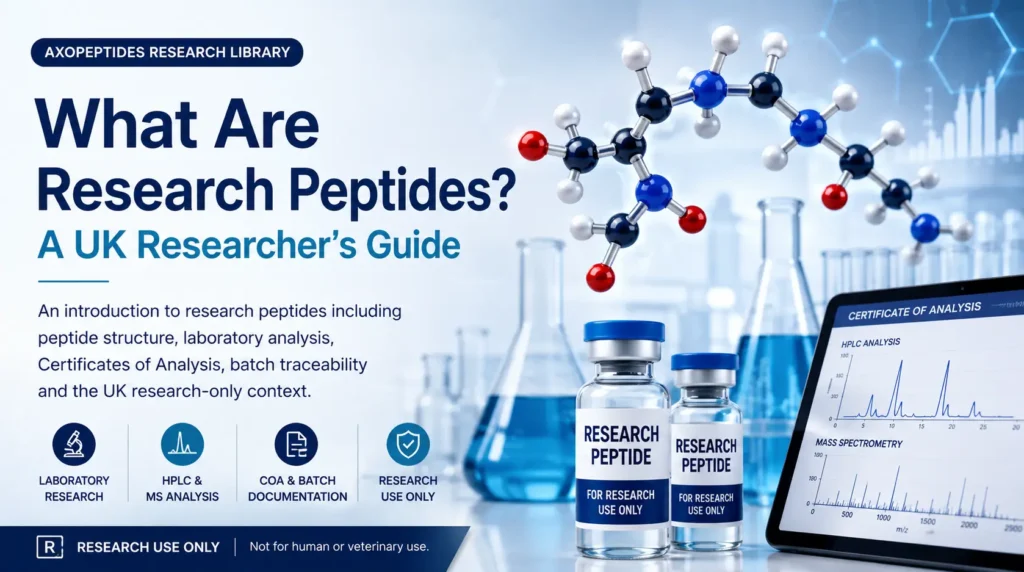
TB-500 is commonly discussed alongside thymosin beta-4 in peptide research, but the two terms should not be treated as chemically interchangeable. This guide examines their molecular relationship, experimental research background, analytical characterisation and the limitations of the available evidence.
R
Research Use Only
This article is provided for scientific and educational purposes. It contains no dosing information, reconstitution instructions, administration or injection guidance, treatment recommendations, human-use instructions or veterinary-use instructions.
TB-500 FragmentAc-LKKTETQ
Thymosin β443 amino acids
Key Research AreaActin interaction
Evidence ProfileMainly preclinical
Peptide identity
What Is TB-500?
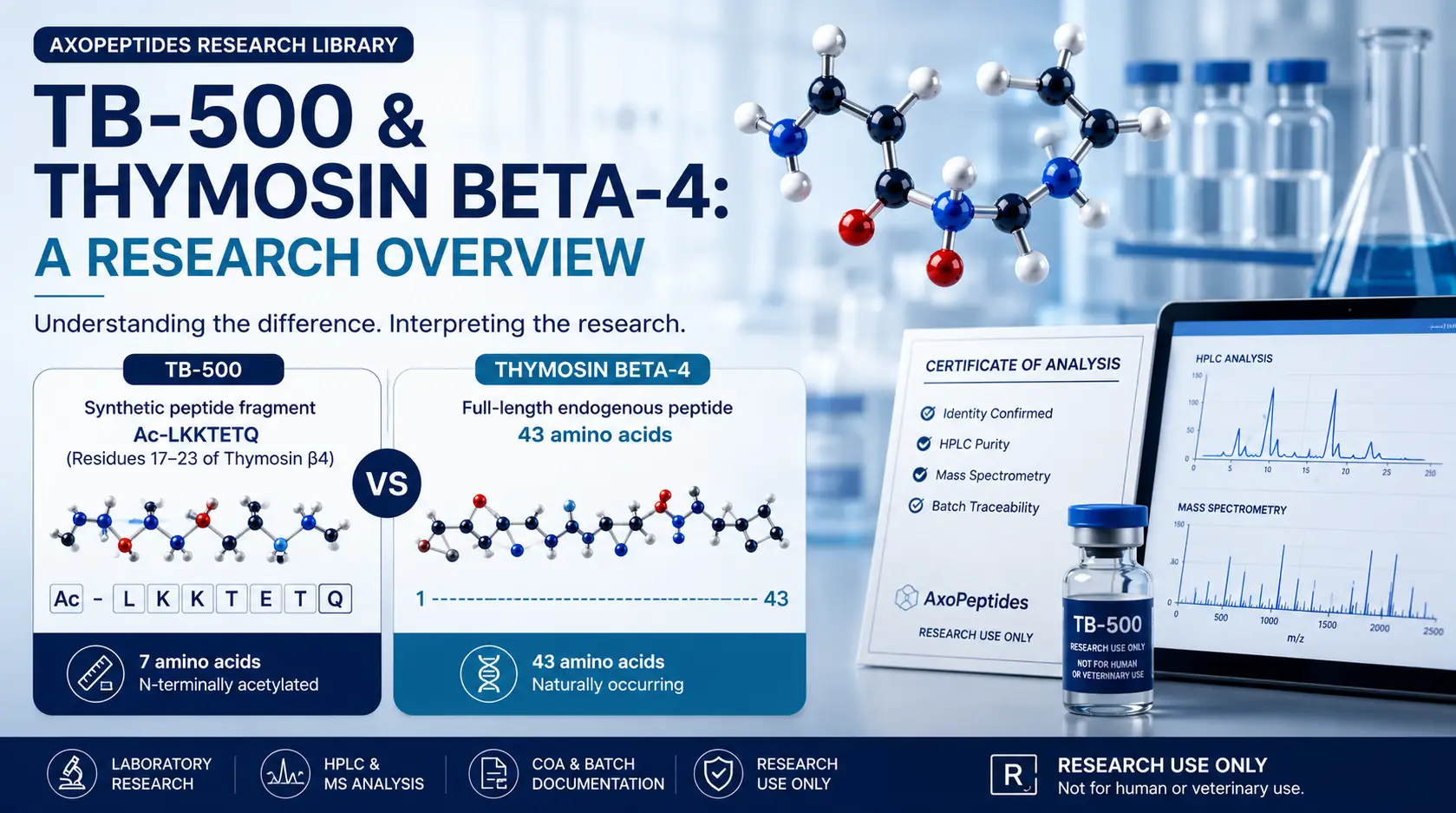
TB-500 is a synthetic peptide associated with a defined segment of the naturally occurring peptide thymosin beta-4.
Analytical research has identified the peptide associated with TB-500 as an N-terminally acetylated sequence corresponding to residues 17–23 of human thymosin beta-4:
Ac-LKKTETQ
This distinction is scientifically important. TB-500 should not automatically be described as though it were the complete thymosin beta-4 molecule.
Key distinction
TB-500 is associated with a short acetylated peptide fragment derived from a region of thymosin beta-4. Full-length thymosin beta-4 is a larger 43-amino-acid peptide.
Endogenous peptide
What Is Thymosin Beta-4?
Thymosin beta-4, commonly abbreviated as Tβ4 or Tβ4, is a naturally occurring peptide found widely in mammalian cells and biological fluids.
It contains 43 amino-acid residues and has been studied extensively because of its interaction with actin, an important cellular structural protein.
Thymosin beta-4 is commonly described in scientific literature as a major actin-sequestering molecule. Its interaction with actin has made it a subject of research in cell biology, cytoskeletal organisation and experimental models involving cellular movement and tissue responses.
Scientific terminology
TB-500 vs Thymosin Beta-4: What Is the Difference?
Online discussion frequently uses the names TB-500 and thymosin beta-4 interchangeably. From a chemical and scientific perspective, that is imprecise.
TB-500
Short synthetic peptide
Analytical literature has associated TB-500 with the N-terminally acetylated peptide sequence Ac-LKKTETQ derived from the 17–23 region of thymosin beta-4.
THYMOSIN β4
Full-length peptide
Thymosin beta-4 is the naturally occurring 43-amino-acid peptide containing the LKKTETQ region within its larger molecular sequence.
Why this matters when reading studies
Results from studies involving full-length thymosin beta-4 cannot automatically be attributed to TB-500. Researchers should verify exactly which compound was investigated in each publication.
Molecular structure
Molecular Relationship Between TB-500 & Thymosin Beta-4
The sequence LKKTETQ occurs within the central region of thymosin beta-4. Research into this region has focused particularly on its association with actin-binding activity.
Full-Length Tβ4
1
Residues 17–23
LKKTETQ
Full-Length Tβ4
43
TB-500 is associated in analytical literature with an acetylated version of this short sequence:
Ac-LKKTETQ.
Molecular research
Thymosin Beta-4 & Actin-Binding Research
One of the best characterised areas of thymosin beta-4 research concerns its interaction with actin.
Actin is a major cellular protein involved in the cytoskeleton, a structural network that contributes to cell shape, mechanical organisation and cellular movement.
Scientific studies have identified the LKKTETQ region of thymosin beta-4 as an important part of its actin-binding domain.
Actin
A major cytoskeletal protein present in eukaryotic cells.
Sequestration
Thymosin beta-4 has been studied for its ability to interact with monomeric actin.
Cytoskeleton
Actin dynamics contribute to cellular structure and experimental models of cell movement.
Experimental literature
Areas Investigated in Thymosin Beta-4 Research
Thymosin beta-4 has been investigated across numerous experimental systems. The categories below describe areas appearing in the scientific literature and do not represent claims of personal benefit or approved clinical applications.
Cell Migration
Laboratory models examining cellular movement and cytoskeletal processes.
Actin Dynamics
Molecular research involving actin binding and sequestration.
Angiogenesis Models
Experimental studies examining blood-vessel formation in laboratory and animal systems.
Dermal Models
Preclinical research involving experimental skin and tissue-response systems.
Corneal Models
Experimental research involving corneal cells and ocular tissue models.
Cardiovascular Models
Preclinical investigation involving cardiac and vascular experimental systems.
These research areas describe what scientists have investigated. They should not be interpreted as treatment indications, personal-use recommendations or claims that TB-500 produces equivalent outcomes.
Evidence quality
Understanding the Evidence Base
The TB-500 and thymosin beta-4 literature requires particularly careful interpretation because publications may examine different molecular forms.
Molecular studies
Mechanistic
Research examining actin interactions, peptide domains and molecular mechanisms.
Cell studies
In vitro
Experiments performed in cultured cells or isolated laboratory systems.
Animal studies
Preclinical
Experimental models investigating biological responses in animals.
Human studies
Compound-specific
Some human studies have evaluated full-length synthetic thymosin beta-4, but those data should not automatically be attributed to TB-500.
Human research
Has Thymosin Beta-4 Been Studied in Humans?
Full-length synthetic thymosin beta-4 has undergone human clinical investigation.
A published Phase I randomised study evaluated synthetic thymosin beta-4 in healthy volunteers and examined safety and pharmacokinetic characteristics.
Other research programmes have investigated full-length thymosin beta-4 in specific clinical research settings.
Do not conflate the evidence
Human studies of full-length thymosin beta-4 are evidence about the compound evaluated in those studies. They do not establish equivalent human evidence for TB-500 or other shortened peptide fragments.
Analytical chemistry
Laboratory Analysis of TB-500
Correct analytical identification is particularly important where related peptide names are frequently used interchangeably.
A laboratory analysing a peptide sample may use complementary techniques to examine chromatographic composition and molecular identity.
High-Performance Liquid Chromatography
HPLC separates detected components of a sample under specified chromatographic conditions.
The resulting chromatogram can provide information relevant to sample composition and chromatographic purity.
Mass Spectrometry
Mass spectrometry provides mass-to-charge information that can support assessment of molecular identity.
Measured mass information can be compared with the expected molecular characteristics of the peptide being investigated.
01
Sample
→
02
HPLC
→
03
Mass Data
→
04
Interpretation
Analytical documentation
TB-500 Purity, Identity & Certificates of Analysis
A Certificate of Analysis provides analytical information associated with a particular sample or production batch.
Relevant documentation may include:
sample or batch identifier;
name of the material submitted for analysis;
peptide sequence where appropriate;
analytical method;
chromatographic purity;
molecular mass information;
analysis date; and
testing laboratory information.
Purity and identity are different
A chromatographic purity result describes sample composition under a defined analytical method. It should not, by itself, be interpreted as complete proof that the material has the intended molecular identity.
COA & Laboratory Reports
View available AxoPeptides batch-linked analytical documentation and Certificates of Analysis.
Peptide research depends on the ability to identify the material associated with an analytical or experimental result.
Batch-level documentation helps researchers distinguish one material from another and can improve the traceability of experimental records.
STEP 1
Material
→
STEP 2
Batch ID
→
STEP 3
Analysis
→
STEP 4
COA
→
STEP 5
Research Record
Scientific caution
Important Limitations in TB-500 Research
Several limitations should be considered when reviewing information about TB-500 online or in scientific literature.
TB-500 and full-length thymosin beta-4 are frequently described as though they were identical.
Much of the biological literature concerns full-length thymosin beta-4 rather than TB-500.
Preclinical findings cannot automatically establish outcomes in humans.
Human research involving full-length thymosin beta-4 should not automatically be attributed to a shortened peptide fragment.
Product names alone do not establish molecular identity.
Analytical purity and molecular identity require separate consideration.
Reliable scientific interpretation requires checking the exact peptide, sequence, analytical method and experimental model described by each source.
United Kingdom
TB-500 in the UK Research Context
UK research-only presentation should maintain a clear distinction between scientific information and medicinal claims.
The Medicines and Healthcare products Regulatory Agency (MHRA) considers explicit and implicit claims, pharmacological characteristics, intended purpose and how a product is presented across websites, promotional material, packaging, social media and customer reviews when considering whether a product may meet the definition of a medicinal product.
The words Research Use Only should therefore not be treated as a substitute for consistent research-only presentation.
Research Language
Describe experimental findings according to the scientific model in which they were observed.
Research Imagery
Use laboratory, molecular and analytical imagery rather than imagery depicting personal administration.
Consistent Positioning
Product information and surrounding content should not contradict research-only statements.
This article deliberately does not contain:
dosing information;
reconstitution instructions;
injection guidance;
administration instructions;
treatment protocols;
personal recovery claims;
bodybuilding claims;
biohacking recommendations; or
customer-result testimonials.
Explore the AxoPeptides Research Catalogue
Browse research materials and associated laboratory documentation available through the AxoPeptides research catalogue.
Frequently Asked Questions About TB-500 & Thymosin Beta-4
Is TB-500 the same as thymosin beta-4?
No. Analytical literature identifies TB-500 with an acetylated short sequence derived from the 17–23 region of thymosin beta-4, while full-length thymosin beta-4 contains 43 amino-acid residues.
What is the sequence associated with TB-500?
Published analytical research has identified the N-terminally acetylated sequence Ac-LKKTETQ in TB-500.
Why is LKKTETQ important in thymosin beta-4 research?
The LKKTETQ region has been investigated as part of the central actin-binding domain of thymosin beta-4.
Has thymosin beta-4 been studied in humans?
Yes. Full-length synthetic thymosin beta-4 has undergone human clinical investigation. Those studies should not automatically be interpreted as human evidence for TB-500.
Is most TB-500-related biological evidence preclinical?
Much of the wider biological literature concerns thymosin beta-4 and experimental or preclinical models. Researchers should verify the exact compound used before attributing findings specifically to TB-500.
How can TB-500 be analysed?
Peptide analytical techniques can include high-performance liquid chromatography and mass spectrometry, depending on the question being investigated.
Does high HPLC purity prove TB-500 identity?
No. Chromatographic purity and molecular identity are separate analytical questions.
Why should a TB-500 COA include batch information?
Batch identification helps connect analytical results with the specific research material to which the documentation relates.
Scientific & regulatory sources
References
Esposito S, et al.
Synthesis and characterization of the N-terminal acetylated 17-23 fragment of thymosin beta 4 identified in TB-500.
2012.
Doping control analysis of TB-500, a synthetic version of an active region of thymosin beta-4, in equine urine and plasma.
Drug Testing and Analysis. 2012.
A randomized, placebo-controlled, single and multiple dose study of intravenous thymosin beta-4 in healthy volunteers.
Annals of the New York Academy of Sciences. 2010.
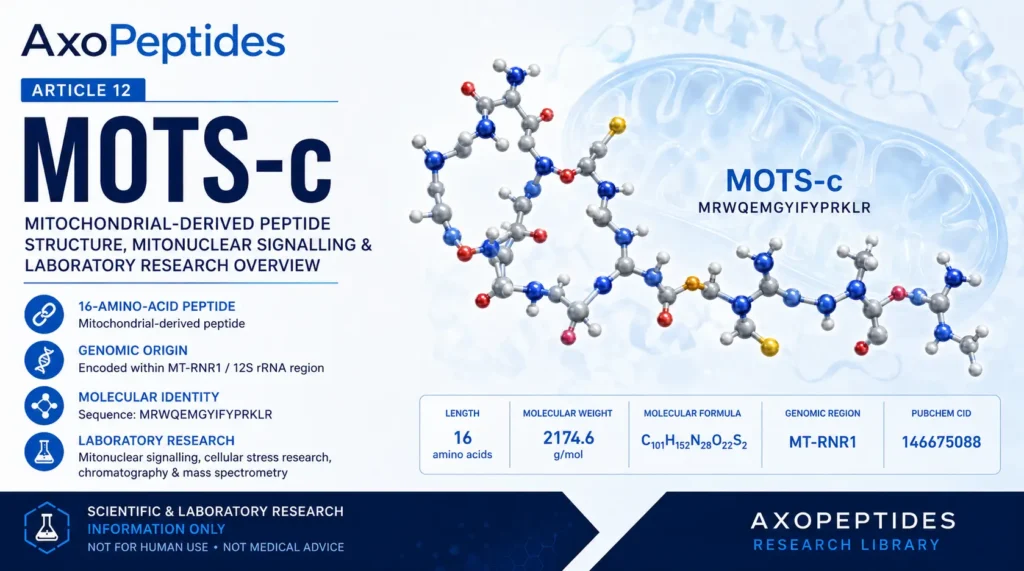
A scientific overview of MOTS-c covering its 16-amino-acid sequence, mitochondrial genomic origin, stress-associated nuclear translocation, mitonuclear signalling and laboratory characterisation.
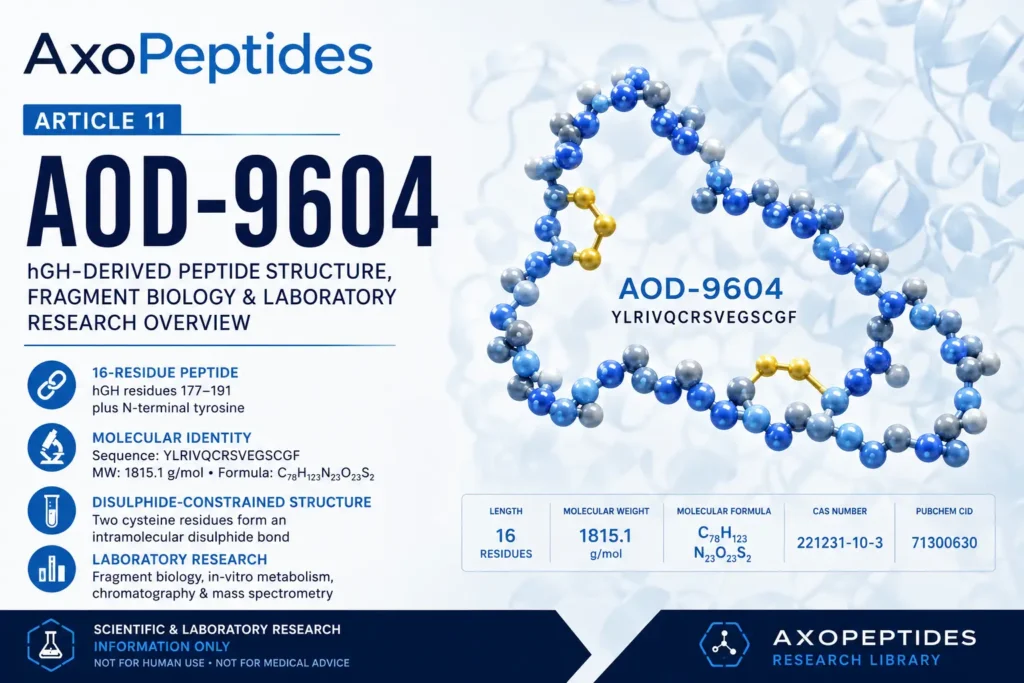
A scientific overview of AOD-9604 covering its 16-residue hGH-derived peptide architecture, amino-acid sequence, disulphide-constrained structure, experimental research and analytical characterisation.
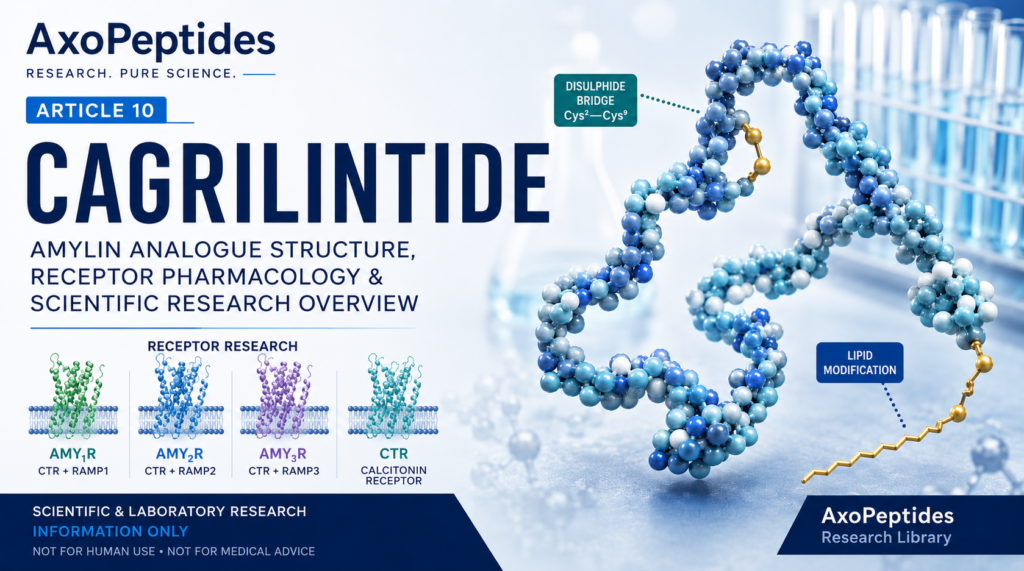
A scientific overview of cagrilintide covering its amylin-derived peptide architecture, lipid modification, calcitonin-family receptor interactions and structural research.
A scientific overview of retatrutide covering its peptide architecture, triple-receptor pharmacology, structural biology, laboratory analysis and research limitations.
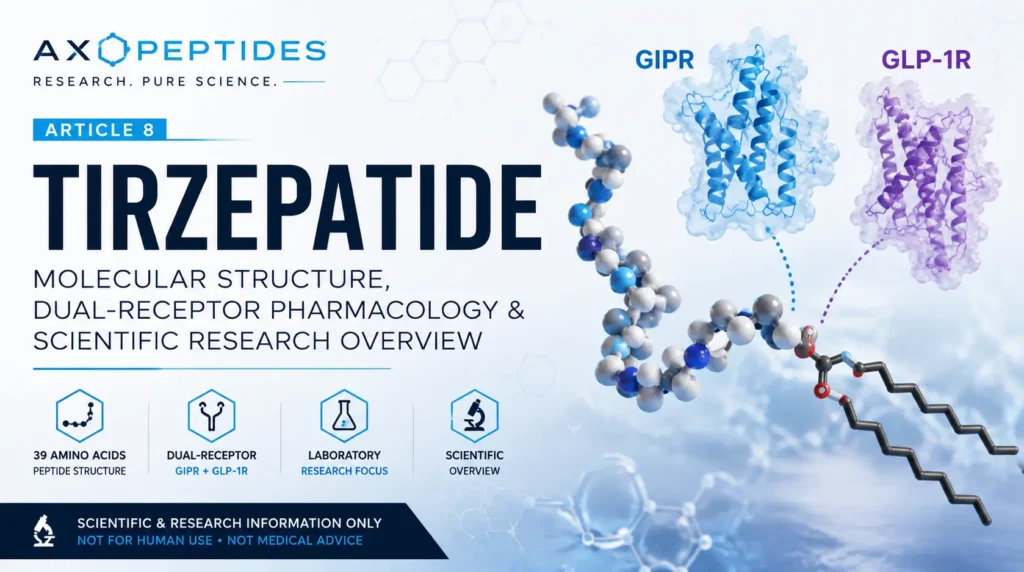
A scientific overview of tirzepatide covering its 39-amino-acid peptide architecture, molecular characteristics, GIPR and GLP-1R interactions, structural biology and laboratory research.
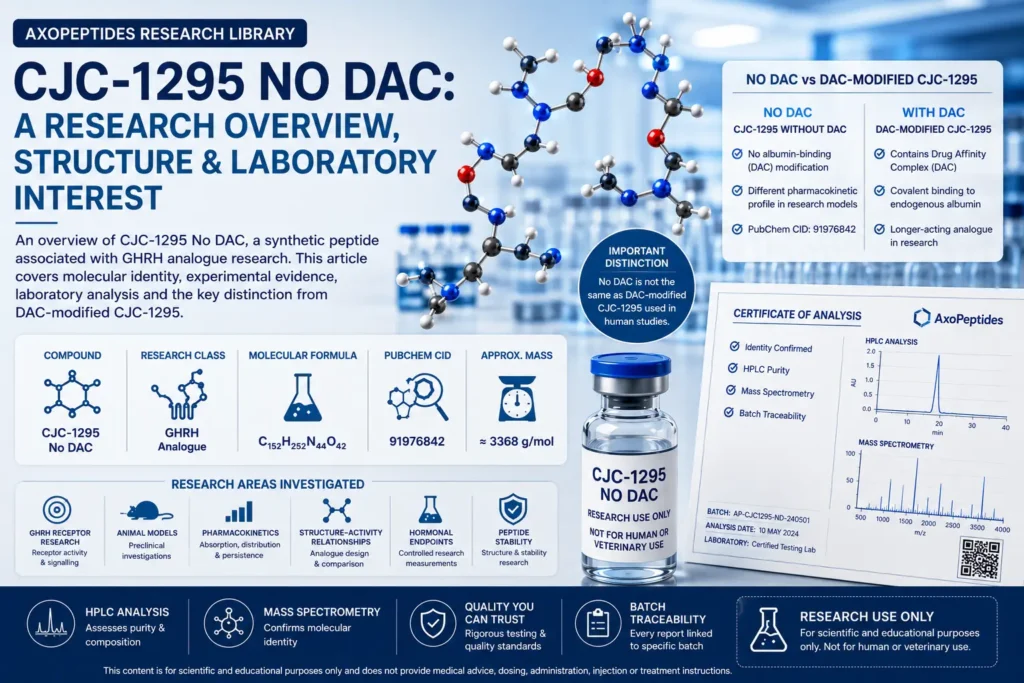
A scientific overview of CJC-1295 No DAC covering molecular identity, its relationship to GHRH analogues, laboratory analysis and the distinction from DAC-modified CJC-1295.
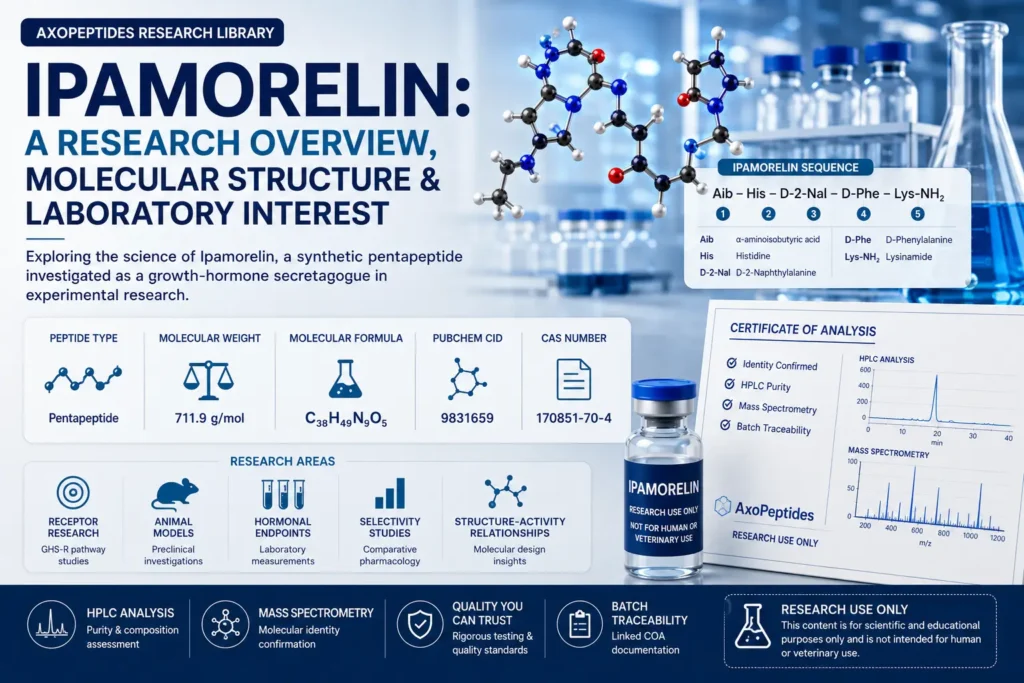
A scientific overview of Ipamorelin covering its molecular identity, pentapeptide structure, receptor research, experimental evidence, laboratory analysis and research limitations.
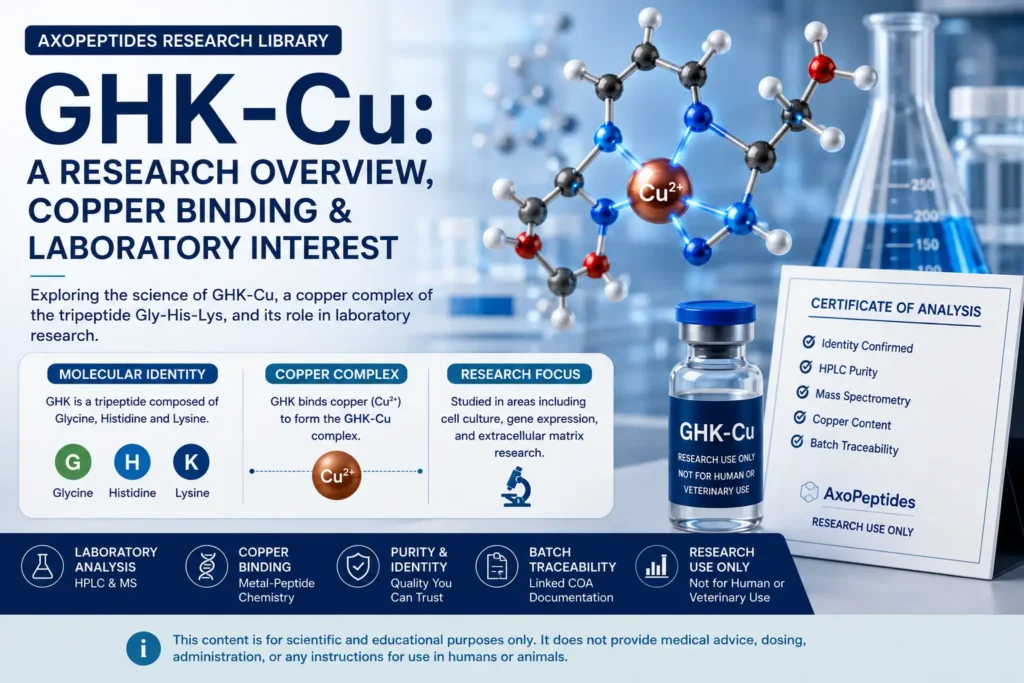
A scientific overview of GHK-Cu covering its molecular identity, copper-binding characteristics, experimental literature, analytical testing and research limitations.