Ipamorelin: A Research Overview, Molecular Structure & Laboratory Interest
Ipamorelin is a synthetic pentapeptide investigated in experimental
research as a growth-hormone secretagogue. This scientific overview
examines its molecular identity, structural characteristics, receptor
research, analytical testing and the limitations of the available evidence.
R
Research Use Only
This article is provided for scientific and educational purposes.
It contains no dosing, reconstitution, administration, injection,
treatment or personal-use instructions.
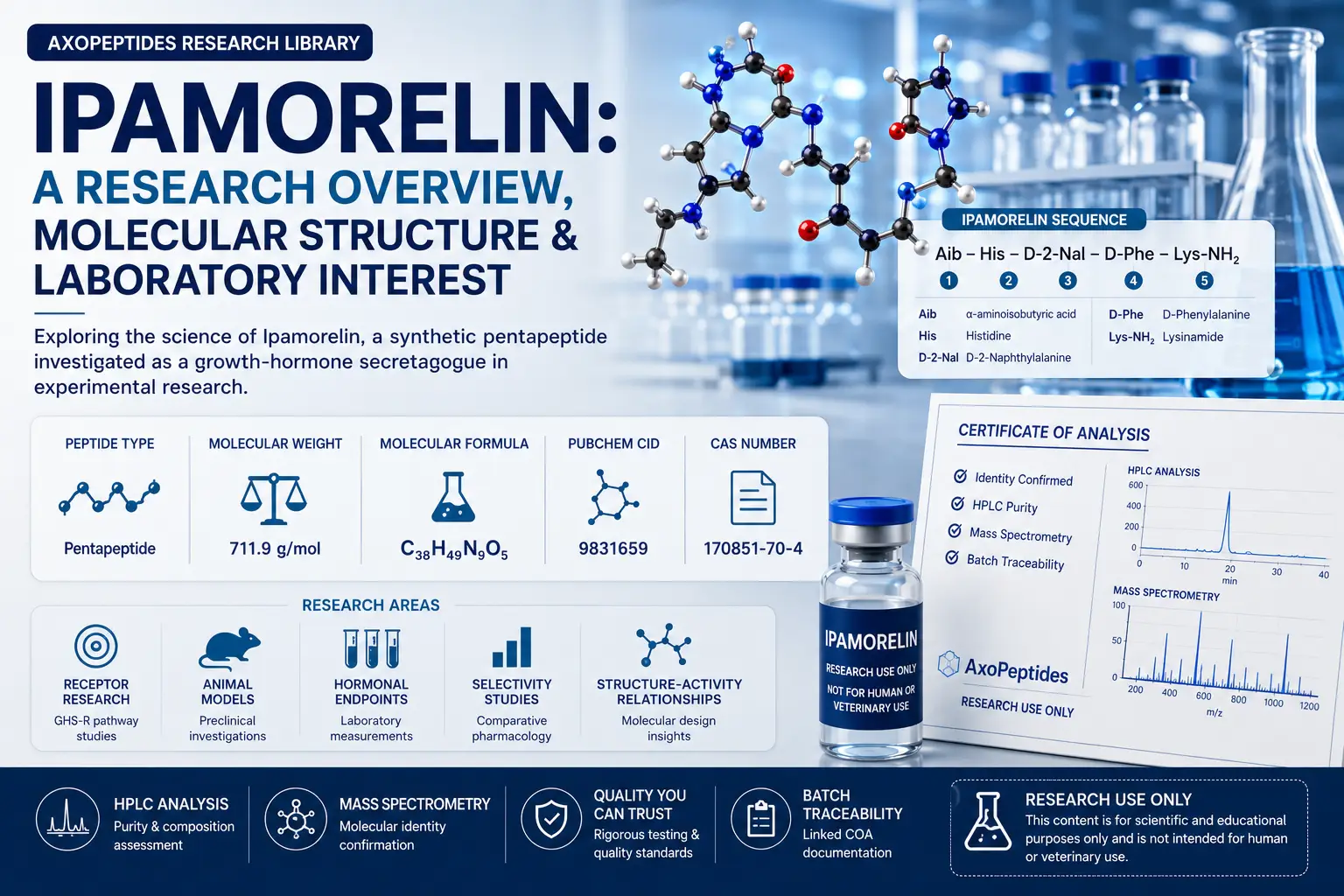
PEPTIDE TYPEPentapeptide
MOLECULAR WEIGHT711.9 g/mol
PUBCHEM CID9831659
CAS NUMBER170851-70-4
MOLECULAR IDENTITY
What Is Ipamorelin?
Ipamorelin is a synthetic peptide composed of five amino-acid or
amino-acid-derived residues, making it a pentapeptide.
It was described in scientific literature in the 1990s during research
into compounds known as growth-hormone secretagogues.
The original pharmacological research characterised Ipamorelin as a
selective growth-hormone secretagogue and examined its activity using
controlled laboratory and animal experimental systems.
Scientific context
The term “growth-hormone secretagogue” describes the experimental
pharmacological classification investigated in the literature.
It should not be interpreted here as a recommendation or indication
for personal use.
PEPTIDE STRUCTURE
Ipamorelin Molecular Structure
PubChem identifies Ipamorelin as a synthetic pentapeptide with the
condensed sequence:
Aib – His – D-2-Nal – D-Phe – Lys-NH₂
This sequence is more chemically complex than a conventional peptide
composed exclusively of the standard L-amino acids commonly found in proteins.
01Aibα-aminoisobutyric acid
02HisHistidine
03D-2-NalNaphthylalanine derivative
04D-PheD-phenylalanine
05Lys-NH₂Lysinamide terminus
Common nameIpamorelin
Research codeNNC-26-0161
Peptide length5 residues
Molecular formulaC₃₈H₄₉N₉O₅
Molecular weight711.9 g/mol
CAS number170851-70-4
PubChem CID9831659
RESEARCH TERMINOLOGY
What Is a Growth-Hormone Secretagogue?
In experimental pharmacology, a secretagogue is a substance investigated
for its ability to stimulate the release of another substance from a cell
or biological system.
Growth-hormone secretagogues are therefore a research class of compounds
investigated for interactions with signalling pathways associated with
growth-hormone release.
Ipamorelin was developed during research programmes examining this
pharmacological class.
RESEARCH COMPOUND
Ipamorelin
→
EXPERIMENTAL TARGET
GHS Receptor Pathway
→
MEASURED ENDPOINT
Laboratory Response
This diagram represents an experimental research concept and is not
an administration or treatment pathway.
RECEPTOR RESEARCH
Ipamorelin & Growth-Hormone Secretagogue Receptor Research
Early Ipamorelin research investigated its activity through the
receptor pathway associated with other growth-hormone secretagogues.
The growth-hormone secretagogue receptor is commonly abbreviated
GHS-R. Subsequent research in this field identified
ghrelin as an endogenous ligand associated with this receptor system.
Ligand Research
Studies investigate how compounds interact with specific
receptor systems.
Receptor Signalling
Laboratory models can examine signalling responses following
receptor interaction.
Pharmacological Profiling
Researchers compare activity across experimental endpoints
to characterise selectivity.
ORIGINAL RESEARCH
Why Was Ipamorelin Described as Selective?
A frequently cited 1998 study by Raun and colleagues described
Ipamorelin as a selective growth-hormone secretagogue.
Researchers compared Ipamorelin with other compounds in experimental
systems and examined several hormonal endpoints.
The term selective in this context refers to the
pharmacological profile reported under those experimental conditions.
It does not mean that a compound is automatically suitable, approved
or established for personal use.
Important evidence distinction
A pharmacological description such as “selective” should not be
converted into marketing language such as “safer”, “better” or
“side-effect free”. Those are different claims requiring their
own evidence.
EVIDENCE QUALITY
Understanding Ipamorelin Research Evidence
Scientific evidence about a research compound should be separated
according to the experimental model used.
01Molecular Research
Chemical structure, receptor interactions and molecular
characteristics.
02In Vitro Research
Experiments conducted using isolated cells or controlled
laboratory systems.
03Animal Research
Preclinical experiments examining biological responses
in non-human models.
04Human Research
Separate clinical research requiring assessment of study
design, population and measured endpoints.
EXPERIMENTAL MODELS
What Has Been Investigated in Ipamorelin Research?
Published Ipamorelin research has included pharmacological,
receptor and endocrine experimental models.
The following categories describe research questions rather than
claimed benefits:
Receptor Activity
Experimental investigation of signalling through
secretagogue-associated receptor pathways.
Hormonal Endpoints
Controlled studies measuring changes in defined biochemical
or hormonal variables.
Selectivity
Comparison of measured responses across different experimental
endpoints.
Structure–Activity Relationships
Research examining how molecular structure relates to
observed pharmacological activity.
Animal Models
Preclinical investigation performed in controlled
non-human systems.
Pharmacokinetic Research
Experimental investigation of how a research compound
behaves within a defined study system.
Describing an experimental endpoint is not equivalent to claiming
a benefit for a person. The distinction is particularly important
when scientific research is discussed on a commercial website.
HUMAN EVIDENCE
Has Ipamorelin Been Investigated in Human Research?
Ipamorelin has appeared in human clinical research, including
investigational studies involving gastrointestinal recovery endpoints.
The existence of clinical investigation does not itself establish
general clinical efficacy, regulatory approval or suitability for
personal use.
Researchers evaluating human evidence should examine the exact study
population, formulation, comparator, endpoints, statistical design
and outcome rather than relying on the fact that a trial occurred.
Clinical research ≠ established treatment
A compound can undergo clinical investigation without becoming
an authorised medicine or having an established therapeutic use.
ANALYTICAL CHEMISTRY
Laboratory Analysis of Ipamorelin
Analytical testing can help answer different questions about an
Ipamorelin research sample.
01Sample Composition
Chromatographic methods can examine detected components
under specified analytical conditions.
02Molecular Identity
Mass-spectrometric data can contribute evidence relevant
to molecular identification.
03Purity
Chromatographic results can describe relative sample
composition under the method used.
04Traceability
Batch identifiers connect analytical results to the
research material represented by the report.
High-Performance Liquid Chromatography
HPLC separates components of a sample according to their interaction
with the chromatographic system. The resulting chromatogram can
provide information about detected components and relative
chromatographic purity.
Mass Spectrometry
Mass spectrometry provides mass-to-charge information that can be
compared with expected molecular characteristics. This can contribute
to assessment of molecular identity.
ANALYTICAL INTERPRETATION
Ipamorelin Purity Is Not the Same as Identity
A common mistake in peptide research is to treat a high chromatographic
purity percentage as though it answers every question about a sample.
Purity
What proportion of detected chromatographic material is
represented by a particular peak?
Identity
Is the analytical evidence consistent with the expected
molecular compound?
Quantity
How much of the relevant material is present according
to an appropriate quantitative method?
Researchers should distinguish these measurements.
A result reported as “99% HPLC purity” does not by itself
establish molecular identity, absolute quantity or every
aspect of sample composition.
ANALYTICAL DOCUMENTATION
What Should an Ipamorelin COA Show?
A Certificate of Analysis should make it possible to understand
which material was analysed and what testing was performed.
Material or sample name
Batch or sample identifier
Analytical method
Analysis date
Chromatographic results where applicable
Molecular identity data where tested
Testing laboratory information
Connection between the report and represented batch
COA & Laboratory Reports
View available AxoPeptides batch-linked Certificates of Analysis
and laboratory documentation.
Analytical documentation is most useful when the tested sample can
be connected to the research material represented by the report.
STEP 1
Material
→
STEP 2
Batch ID
→
STEP 3
Sample
→
STEP 4
Analysis
→
STEP 5
COA
Batch-specific records improve traceability and help distinguish
analytical results associated with different research materials.
SCIENTIFIC CAUTION
Important Limitations of Ipamorelin Research
Several limitations should be considered when interpreting
information about Ipamorelin.
Early pharmacological studies include substantial in vitro
and animal-model evidence.
Results observed in animal models cannot automatically be
translated into outcomes in humans.
Receptor activity does not by itself establish a clinical outcome.
The term “selective” describes a reported experimental
pharmacological profile and should not be interpreted as
meaning risk-free.
The existence of human investigation does not establish
regulatory approval.
Online discussions frequently mix scientific observations
with unsupported personal-use claims.
Analytical purity and molecular identity are separate questions.
UNITED KINGDOM
Ipamorelin in the UK Research Context
Research-only presentation should remain clearly separated from
medicinal or personal-use claims.
Current MHRA guidance states that classification of a product can
involve consideration of explicit and implicit claims, pharmacological
properties, intended purpose and presentation through websites,
advertisements, packaging, social media and customer reviews.
Consequently, simply displaying the words Research Use Only
does not neutralise contradictory claims elsewhere on a website.
Ipamorelin is a synthetic pentapeptide investigated in
pharmacological research as a growth-hormone secretagogue.
How many residues does Ipamorelin contain?
Ipamorelin is a pentapeptide, meaning its structure contains
five amino-acid or amino-acid-derived residues.
What is the sequence of Ipamorelin?
PubChem represents its condensed sequence as
Aib-His-D-2-Nal-D-Phe-Lys-NH₂.
What is the molecular weight of Ipamorelin?
PubChem currently lists a molecular weight of approximately
711.9 g/mol.
What is the CAS number for Ipamorelin?
The CAS Registry Number commonly associated with Ipamorelin
is 170851-70-4.
Why is Ipamorelin called a growth-hormone secretagogue?
The terminology comes from pharmacological research examining
its activity within growth-hormone-secretagogue receptor
signalling systems.
What does “selective” mean in Ipamorelin research?
It refers to the pharmacological response profile reported in
experimental studies. It should not be interpreted as meaning
universally safe or suitable for personal use.
Has Ipamorelin been researched in humans?
Ipamorelin has appeared in human clinical investigation.
Clinical investigation does not by itself establish an
authorised or generally accepted therapeutic use.
How can Ipamorelin be analysed in a laboratory?
Depending on the analytical question, techniques may include
high-performance liquid chromatography and mass spectrometry.
Does high HPLC purity confirm Ipamorelin identity?
Not by itself. Chromatographic purity and molecular identity
represent different analytical questions.
Why does an Ipamorelin COA need a batch number?
Batch identification helps connect analytical results to the
specific research material represented by the report.
SCIENTIFIC & REGULATORY SOURCES
References
Raun K, Hansen BS, Johansen NL, et al.
Ipamorelin, the first selective growth hormone secretagogue.
European Journal of Endocrinology. 1998;139(5):552–561.
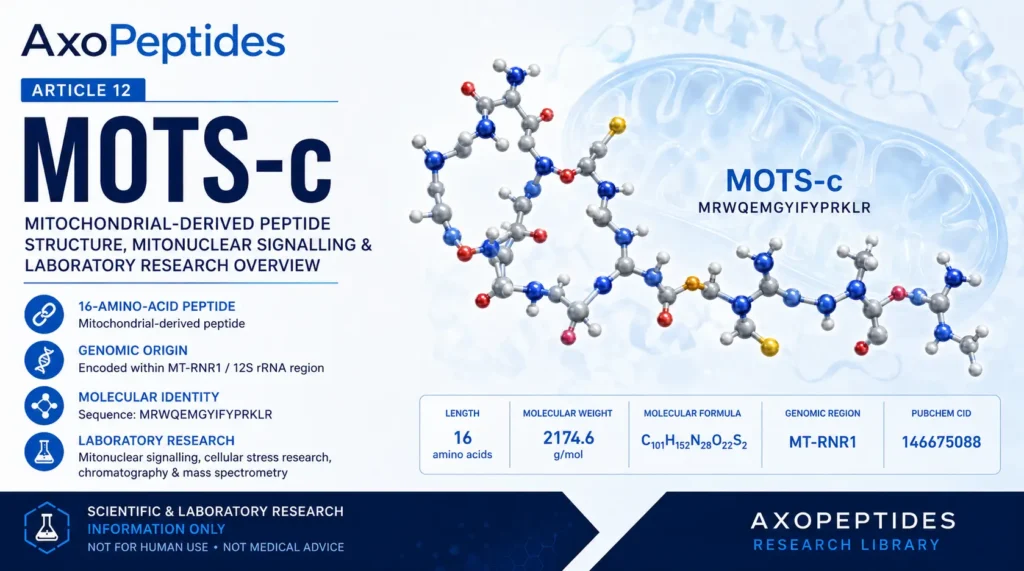
A scientific overview of MOTS-c covering its 16-amino-acid sequence, mitochondrial genomic origin, stress-associated nuclear translocation, mitonuclear signalling and laboratory characterisation.
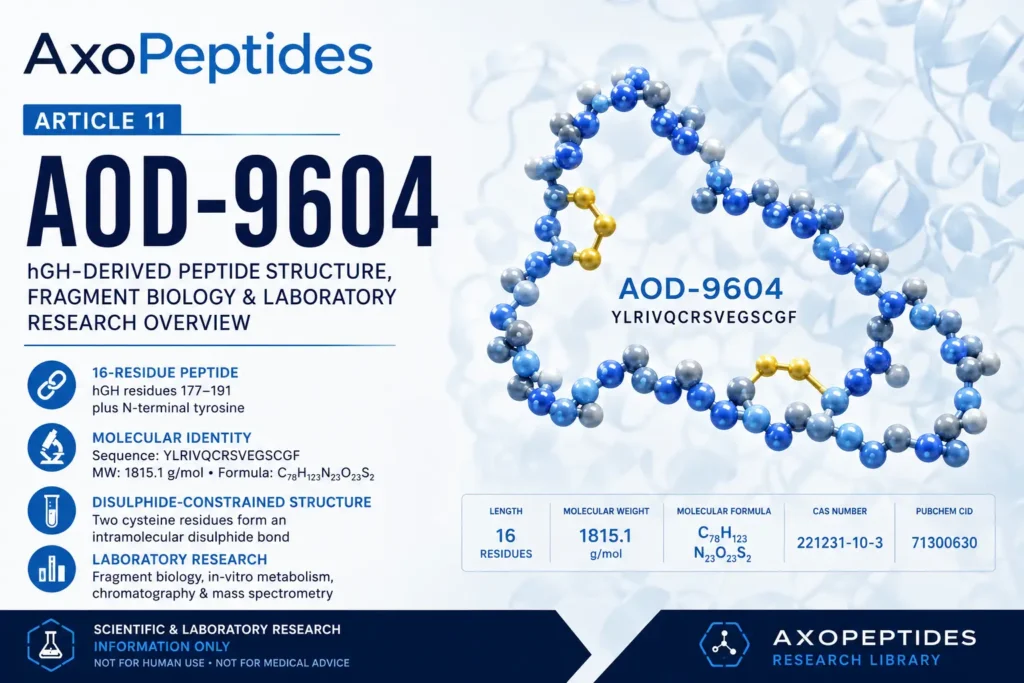
A scientific overview of AOD-9604 covering its 16-residue hGH-derived peptide architecture, amino-acid sequence, disulphide-constrained structure, experimental research and analytical characterisation.
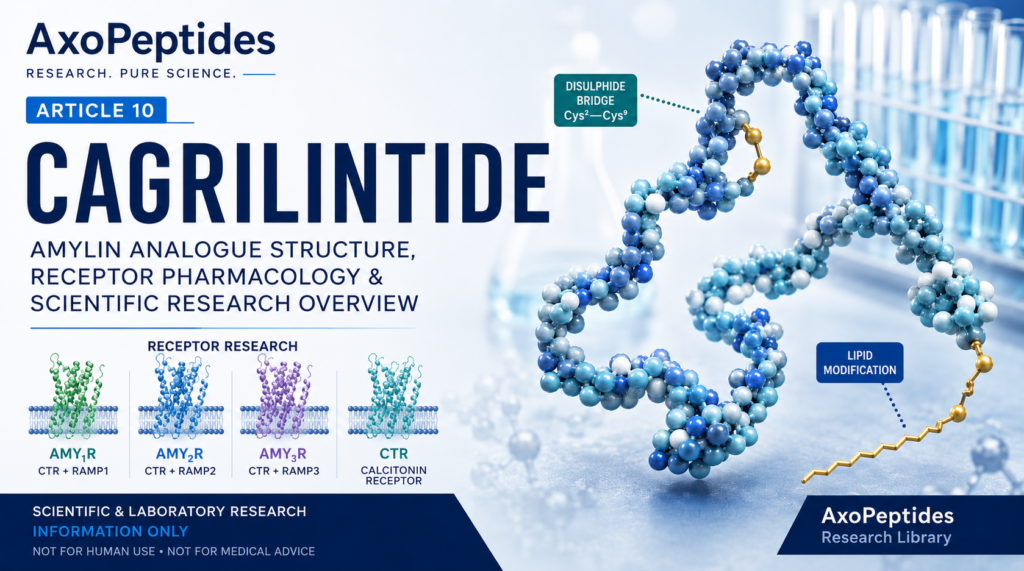
A scientific overview of cagrilintide covering its amylin-derived peptide architecture, lipid modification, calcitonin-family receptor interactions and structural research.
A scientific overview of retatrutide covering its peptide architecture, triple-receptor pharmacology, structural biology, laboratory analysis and research limitations.
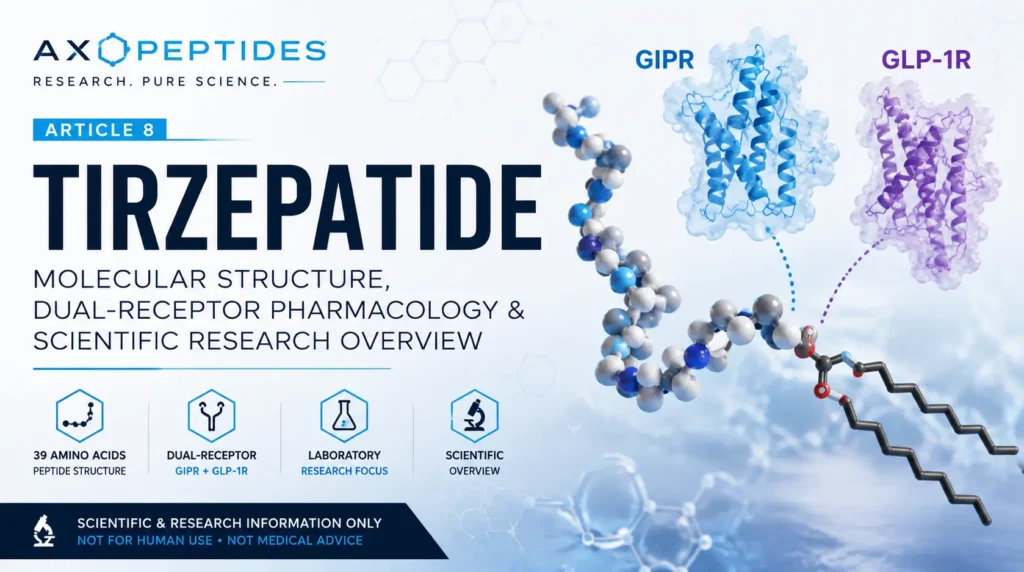
A scientific overview of tirzepatide covering its 39-amino-acid peptide architecture, molecular characteristics, GIPR and GLP-1R interactions, structural biology and laboratory research.
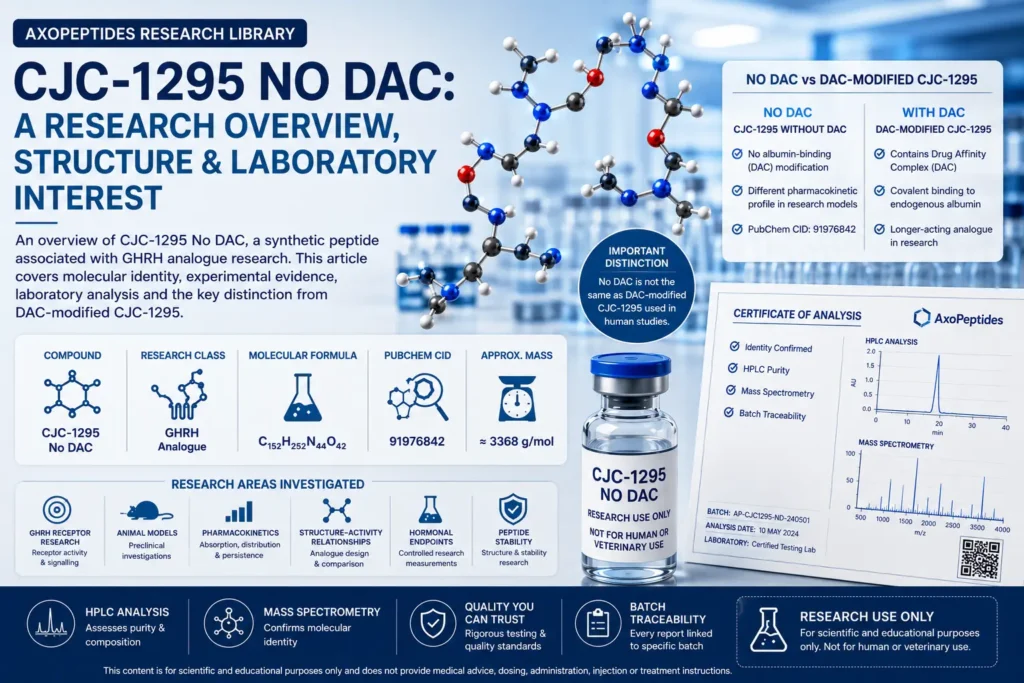
A scientific overview of CJC-1295 No DAC covering molecular identity, its relationship to GHRH analogues, laboratory analysis and the distinction from DAC-modified CJC-1295.
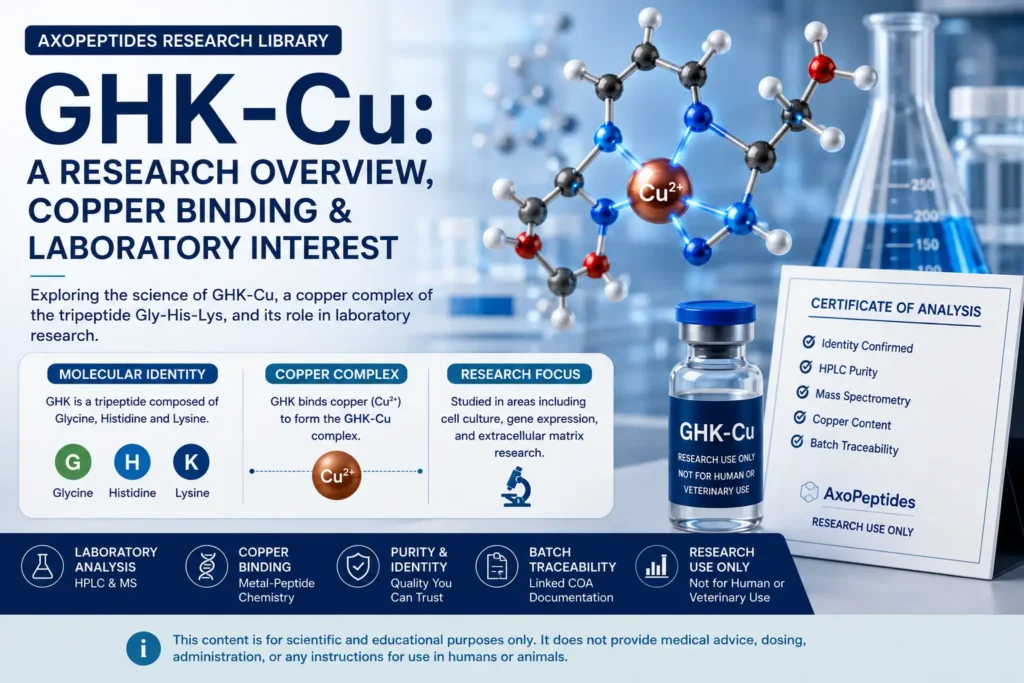
A scientific overview of GHK-Cu covering its molecular identity, copper-binding characteristics, experimental literature, analytical testing and research limitations.