Retatrutide: Molecular Structure, Triple-Receptor Pharmacology
& Scientific Research Overview
Retatrutide is a synthetic peptide investigated in molecular
pharmacology for its interaction with three related class B
G-protein-coupled receptor systems. This scientific overview
examines its molecular architecture, receptor interactions,
structural biology, experimental pharmacology and laboratory
characterisation.
R
Scientific & Laboratory Research Information
This article is intended for scientific and educational
purposes and contains no dosing, reconstitution,
administration or treatment instructions.
RESEARCH NAMERetatrutide
DEVELOPMENT CODELY3437943
MOLECULAR WEIGHT≈ 4731 g/mol
RECEPTOR RESEARCHGIPR + GLP-1R + GCGR
MOLECULAR OVERVIEW
What Is Retatrutide?
Retatrutide is a synthetic peptide also identified in scientific
literature by the development code LY3437943.
It has attracted particular research interest because one
molecular structure can interact with three distinct receptor
systems:
RECEPTOR 01
GIPRGIP receptor
RECEPTOR 02
GLP-1RGLP-1 receptor
RECEPTOR 03
GCGRGlucagon receptor
All three belong to the class B family of
G-protein-coupled receptors, but they remain distinct molecular
targets with their own structural and signalling characteristics.
Scientific focus
Triple-receptor activity makes retatrutide useful for studying
how a single engineered peptide can engage multiple related
receptor systems within controlled experimental models.
PEPTIDE CHEMISTRY
Retatrutide Molecular Structure
Retatrutide is a chemically engineered peptide rather than an
unmodified naturally occurring peptide sequence.
Chemical databases identify retatrutide with the molecular
formula:
C221H342N46O68
COMMON NAME
Retatrutide
RESEARCH CODE
LY3437943
MOLECULAR FORMULA
C221H342N46O68
MOLECULAR WEIGHT
≈ 4731 g/mol
Molecular formula and molecular weight are useful reference
properties, but neither measurement alone demonstrates sample
purity or complete molecular identity.
MOLECULAR ENGINEERING
How Was Retatrutide Molecularly Designed?
Multi-receptor peptide design involves modifying a peptide
backbone so that a single molecule can interact with more than
one receptor system.
Retatrutide was developed through this type of rational peptide
engineering, with sequence changes selected to produce measurable
activity across GIPR, GLP-1R and GCGR.
01Peptide backbone
+
02Sequence engineering
+
03Structural modification
=
RESULTTriple-receptor research peptide
Simplified molecular-design concept rather than a complete
chemical synthesis pathway.
RECEPTOR PHARMACOLOGY
What Does Triple-Receptor Agonism Mean?
In molecular pharmacology, an agonist is a ligand capable of
activating a receptor and initiating measurable receptor-mediated
signalling.
Retatrutide has been experimentally characterised as an agonist
at three receptor systems.
SYNTHETIC PEPTIDE
Retatrutide
01GIPR
02GLP-1R
03GCGR
Three receptors does not mean identical pharmacology.
A ligand can show different potency, efficacy, binding
interactions and downstream signalling characteristics at
each receptor.
RECEPTOR 01
Retatrutide & GIP Receptor Research
The glucose-dependent insulinotropic polypeptide receptor,
abbreviated GIPR, belongs to the class B GPCR
family.
Retatrutide research has included receptor-binding and
signalling experiments designed to characterise its interaction
with GIPR.
LIGAND
Retatrutide
→
TARGET
GIPR
→
EXPERIMENT
Receptor signalling
RECEPTOR 02
Retatrutide & GLP-1 Receptor Research
The GLP-1 receptor, abbreviated GLP-1R, is another
class B GPCR studied extensively in peptide-receptor pharmacology.
Retatrutide has been investigated using assays designed to
measure receptor activation and downstream signalling at GLP-1R.
Comparing its behaviour across GLP-1R and other receptors can help
researchers investigate how peptide sequence and receptor structure
influence pharmacological activity.
RECEPTOR 03
Retatrutide & Glucagon Receptor Research
The glucagon receptor is commonly abbreviated
GCGR.
GCGR is structurally related to GIPR and GLP-1R but remains a
distinct receptor with its own ligand-recognition and signalling
characteristics.
Incorporation of GCGR activity alongside GIPR and GLP-1R
differentiates retatrutide from peptide molecules designed to
interact with only one or two of these receptor systems.
Single receptor1 molecular target
Dual receptor2 molecular targets
Triple receptorGIPR + GLP-1R + GCGR
STRUCTURAL BIOLOGY
Structural Research on Retatrutide
Structural biology allows researchers to investigate how peptide
ligands occupy and interact with receptor-binding pockets.
Published structural research has examined retatrutide complexes
involving GIPR, GLP-1R and GCGR.
01Ligand Orientation
Structural models can reveal how a peptide is positioned
within a receptor complex.
02Residue Interactions
Individual amino-acid contacts can contribute to
receptor recognition and activation.
03Receptor Conformation
Structural studies can examine receptor states associated
with ligand engagement.
Structural information complements functional receptor assays
because molecular interaction and receptor signalling represent
related but distinct experimental questions.
MOLECULAR PHARMACOLOGY
Receptor Signalling Research
Receptor activation can be investigated using cellular assays
that measure downstream signalling events.
Class B GPCR research frequently evaluates signalling pathways
involving intracellular second messengers and receptor-regulatory
mechanisms.
cAMP Signalling
Experimental assays can measure changes in intracellular
cyclic AMP following receptor activation.
Receptor Recruitment
Laboratory systems can investigate interactions with
proteins involved in receptor regulation.
Internalisation
Researchers can examine changes in receptor localisation
following ligand exposure in cellular models.
Comparative Potency
Functional assays can compare activity across GIPR,
GLP-1R and GCGR under defined experimental conditions.
EXPERIMENTAL SCIENCE
How Is Retatrutide Studied in Research?
Retatrutide research can be separated into different experimental
levels, each addressing different scientific questions.
01Molecular
Structure & chemistry
02Receptor
Binding & activation
03Cellular
Signalling assays
04Preclinical
Controlled experimental models
Results from one experimental level should not automatically
be interpreted as evidence belonging to another level.
EVIDENCE INTERPRETATION
Why Experimental Context Matters
Scientific claims should remain connected to the experimental
system that generated them.
STRUCTUREMolecular evidence
Describes receptor complexes, peptide orientation,
molecular interactions and structural characteristics.
CELLULARFunctional assays
Measure receptor activation or downstream signalling
within controlled cellular systems.
PRECLINICALExperimental models
Examine molecular and biological responses in defined
non-clinical research systems.
Evidence should not be overextended.
A receptor-binding result demonstrates a molecular interaction
under defined conditions. It does not automatically establish
conclusions outside that experimental context.
ANALYTICAL CHEMISTRY
Laboratory Analysis of Retatrutide
Analytical characterisation of complex synthetic peptides can
involve several complementary techniques.
01HPLC
Chromatographic methods can separate detected sample
components under specified analytical conditions.
02Mass Spectrometry
Molecular mass-related information can contribute to
assessment of molecular identity.
03Sequence Characterisation
Amino-acid sequence is fundamental to defining a
synthetic peptide's molecular identity.
04Modification Analysis
Engineered peptides may require analytical consideration
of attached chemical modifications as well as the
peptide backbone.
High-Performance Liquid Chromatography
HPLC separates components according to their interaction with
the selected chromatographic system. The resulting data can
provide information about relative sample composition.
Mass Spectrometry
Mass spectrometry generates mass-to-charge information that
can be compared with expected molecular characteristics.
ANALYTICAL INTERPRETATION
Purity, Identity & Quantity Are Different
Researchers should avoid treating these analytical terms as
interchangeable.
PURITY
Sample composition
Relative composition detected under a defined
chromatographic method.
IDENTITY
Which molecule?
Evidence that the material corresponds with the expected
molecular species.
QUANTITY
How much material?
A separate measurement requiring an appropriate
quantitative analytical method.
A high purity percentage does not answer every question.
Molecular identity and absolute quantity require their own
analytical evidence.
SCIENTIFIC CAUTION
Important Limitations When Reading Retatrutide Research
GIPR, GLP-1R and GCGR are related but distinct receptor systems.
Activity at three receptors does not imply identical potency
or signalling behaviour at each receptor.
Receptor-binding data and functional signalling data answer
different experimental questions.
Results from cellular systems should remain identified as
cellular experimental findings.
Preclinical findings should remain identified as preclinical.
Molecular structure alone cannot establish every functional
characteristic of a research peptide.
HPLC purity alone does not establish complete molecular identity.
Scientific conclusions should remain limited to the endpoints
and models actually examined.
UNITED KINGDOM
Retatrutide in the UK Research Context
Research content should maintain a clear distinction between
scientific discussion and medicinal presentation.
Current MHRA guidance states that regulatory assessment can
consider explicit and implicit claims, pharmacological properties,
intended purpose and the way a product is presented through
websites, advertising, packaging, social media and other
promotional material.
Scientific articles should therefore remain consistent with
laboratory and research positioning throughout the page.
Frequently Asked Research Questions About Retatrutide
What is retatrutide?
Retatrutide is a synthetic peptide, also identified as
LY3437943, investigated for activity at GIPR, GLP-1R and GCGR.
Is retatrutide a peptide?
Yes. Retatrutide is an engineered synthetic peptide molecule.
What is LY3437943?
LY3437943 is the development code used for retatrutide in
scientific literature.
Which receptors are studied with retatrutide?
Research has characterised activity at the GIP receptor,
GLP-1 receptor and glucagon receptor.
What does triple-receptor agonism mean?
It describes a single ligand capable of activating three
distinct receptor systems under experimental conditions.
Are GIPR, GLP-1R and GCGR the same receptor?
No. They are related class B G-protein-coupled receptors
but remain separate molecular targets.
Has retatrutide been studied using structural biology?
Yes. Published structural research has examined receptor
complexes involving retatrutide and GIPR, GLP-1R and GCGR.
What is the molecular formula of retatrutide?
PubChem reports the molecular formula as C221H342N46O68.
What is the molecular weight of retatrutide?
PubChem reports an approximate molecular weight of
4731 g/mol.
How can retatrutide be characterised analytically?
Depending on the research question, techniques can include
chromatography, mass spectrometry and other methods suitable
for peptide identity and structural characterisation.
Does HPLC purity confirm molecular identity?
Not by itself. Chromatographic purity and molecular identity
are separate analytical questions.
SCIENTIFIC & REGULATORY SOURCES
References & Further Reading
PubChem — Retatrutide
Chemical structure, molecular formula and compound
information.
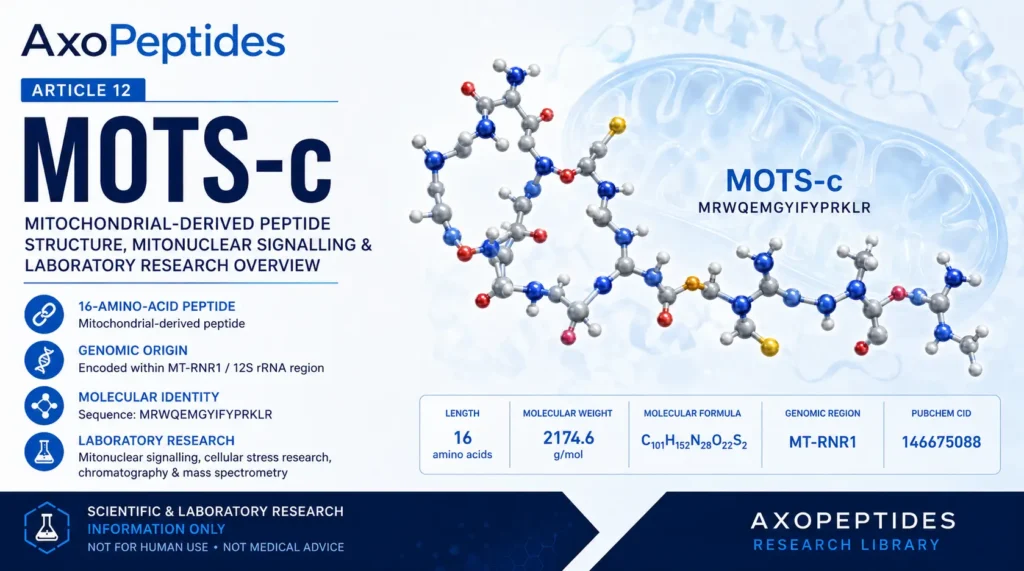
A scientific overview of MOTS-c covering its 16-amino-acid sequence, mitochondrial genomic origin, stress-associated nuclear translocation, mitonuclear signalling and laboratory characterisation.
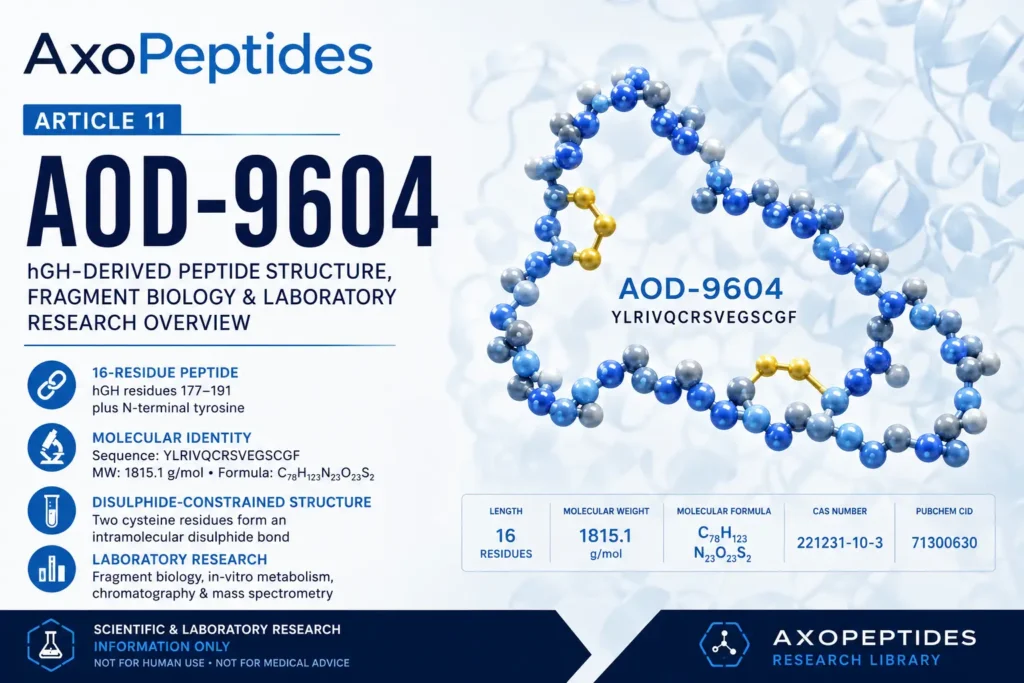
A scientific overview of AOD-9604 covering its 16-residue hGH-derived peptide architecture, amino-acid sequence, disulphide-constrained structure, experimental research and analytical characterisation.
A scientific overview of cagrilintide covering its amylin-derived peptide architecture, lipid modification, calcitonin-family receptor interactions and structural research.
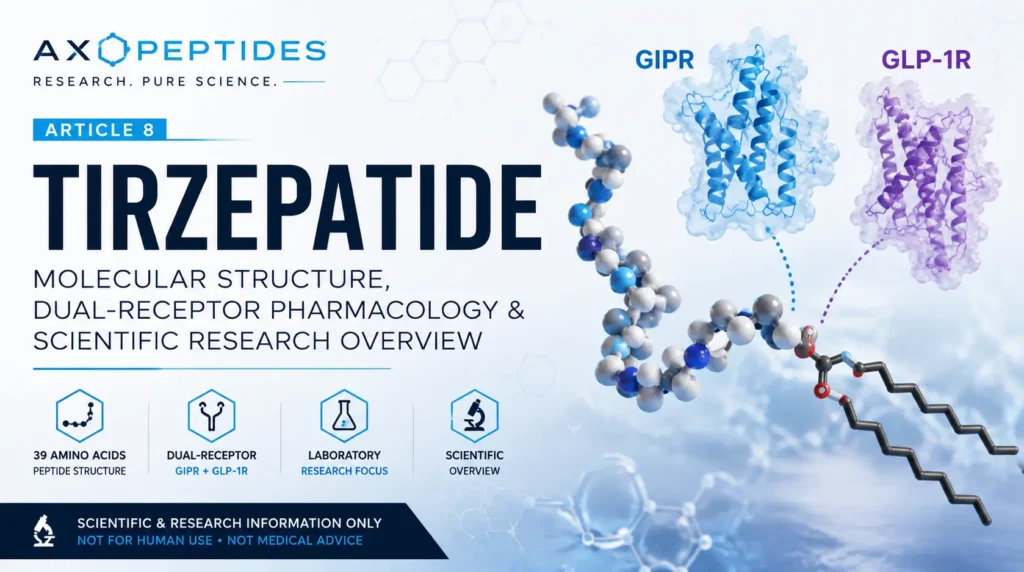
A scientific overview of tirzepatide covering its 39-amino-acid peptide architecture, molecular characteristics, GIPR and GLP-1R interactions, structural biology and laboratory research.
A scientific overview of NAD+ covering its role as a cellular cofactor, redox chemistry, NAD-dependent enzymes, laboratory analysis and research limitations.
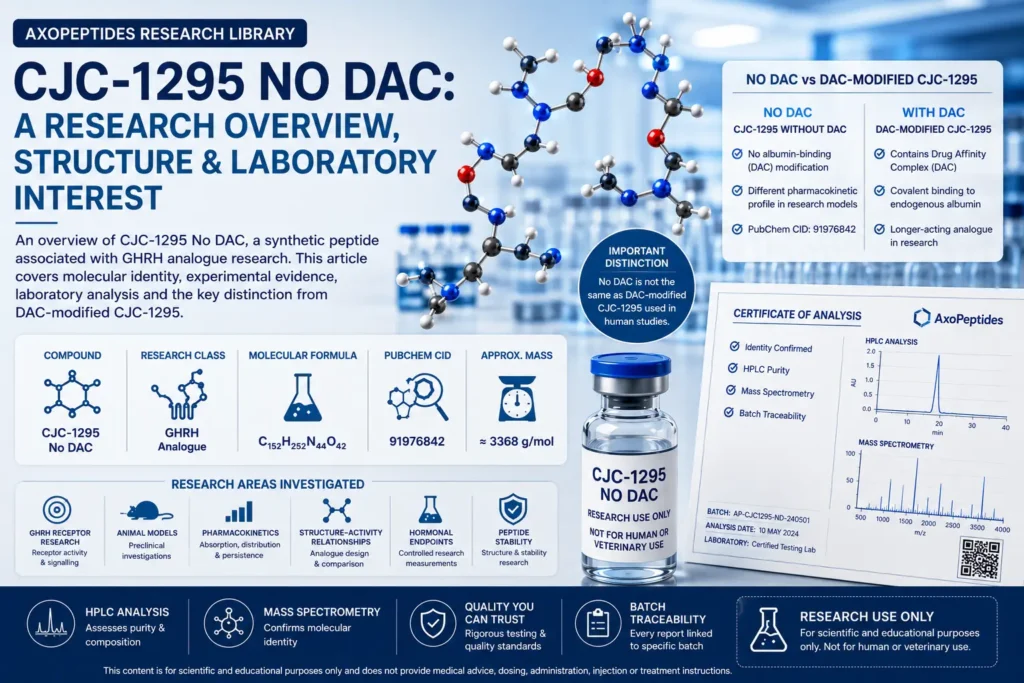
A scientific overview of CJC-1295 No DAC covering molecular identity, its relationship to GHRH analogues, laboratory analysis and the distinction from DAC-modified CJC-1295.
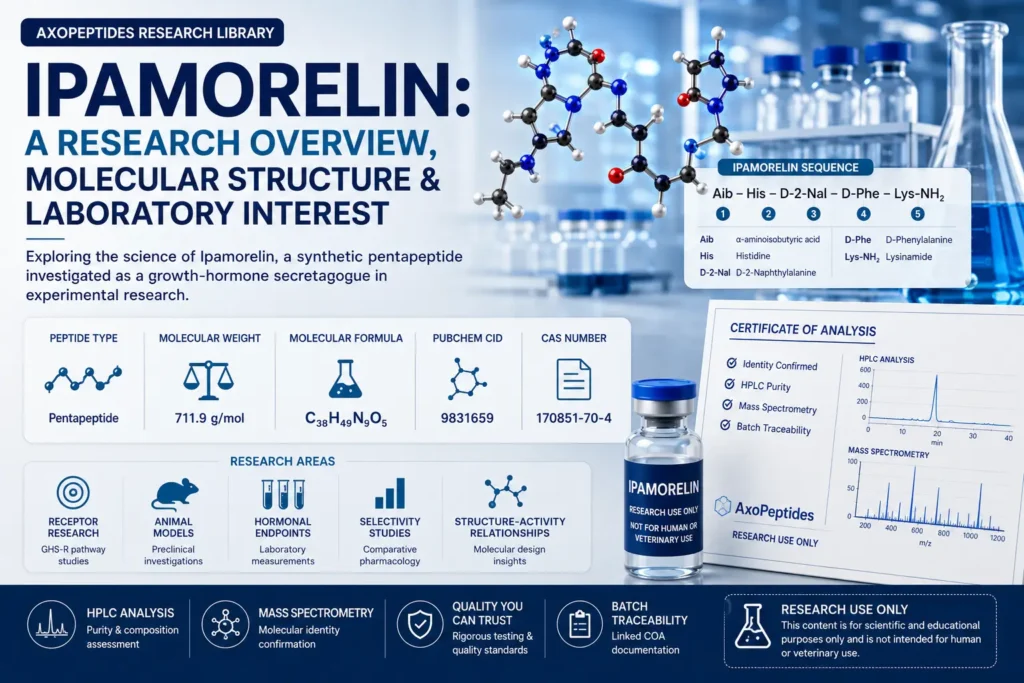
A scientific overview of Ipamorelin covering its molecular identity, pentapeptide structure, receptor research, experimental evidence, laboratory analysis and research limitations.
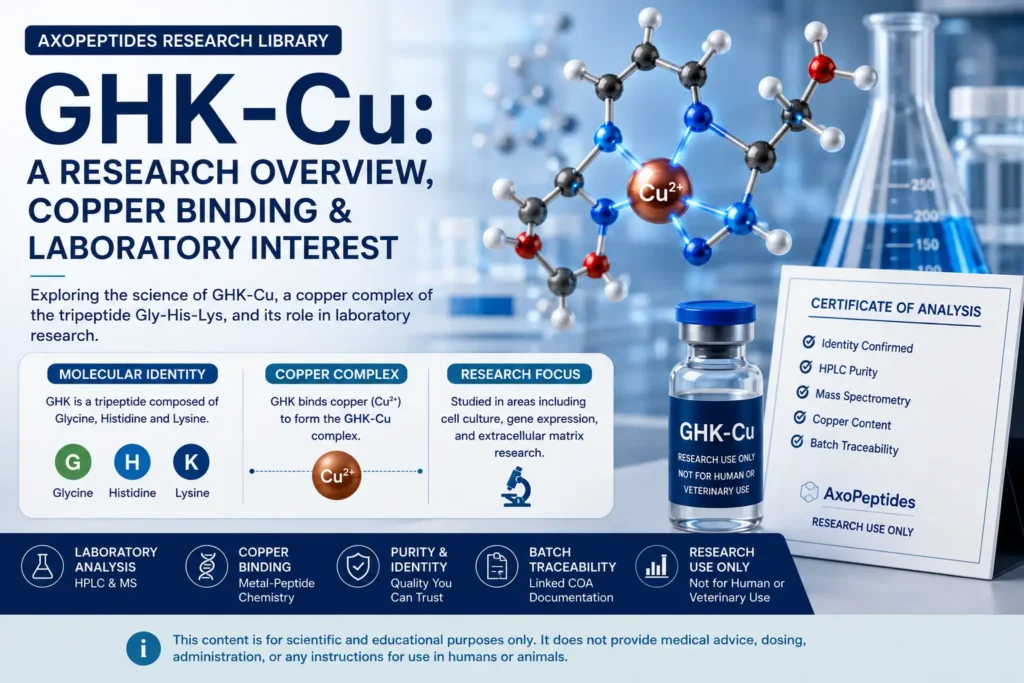
A scientific overview of GHK-Cu covering its molecular identity, copper-binding characteristics, experimental literature, analytical testing and research limitations.