AxoPeptides Research Library · Article 19
DSIP: Delta Sleep-Inducing Peptide Structure, Sequence Biology & Laboratory Research Overview
Nonapeptide Structure · WAGGDASGE Sequence · Experimental Research
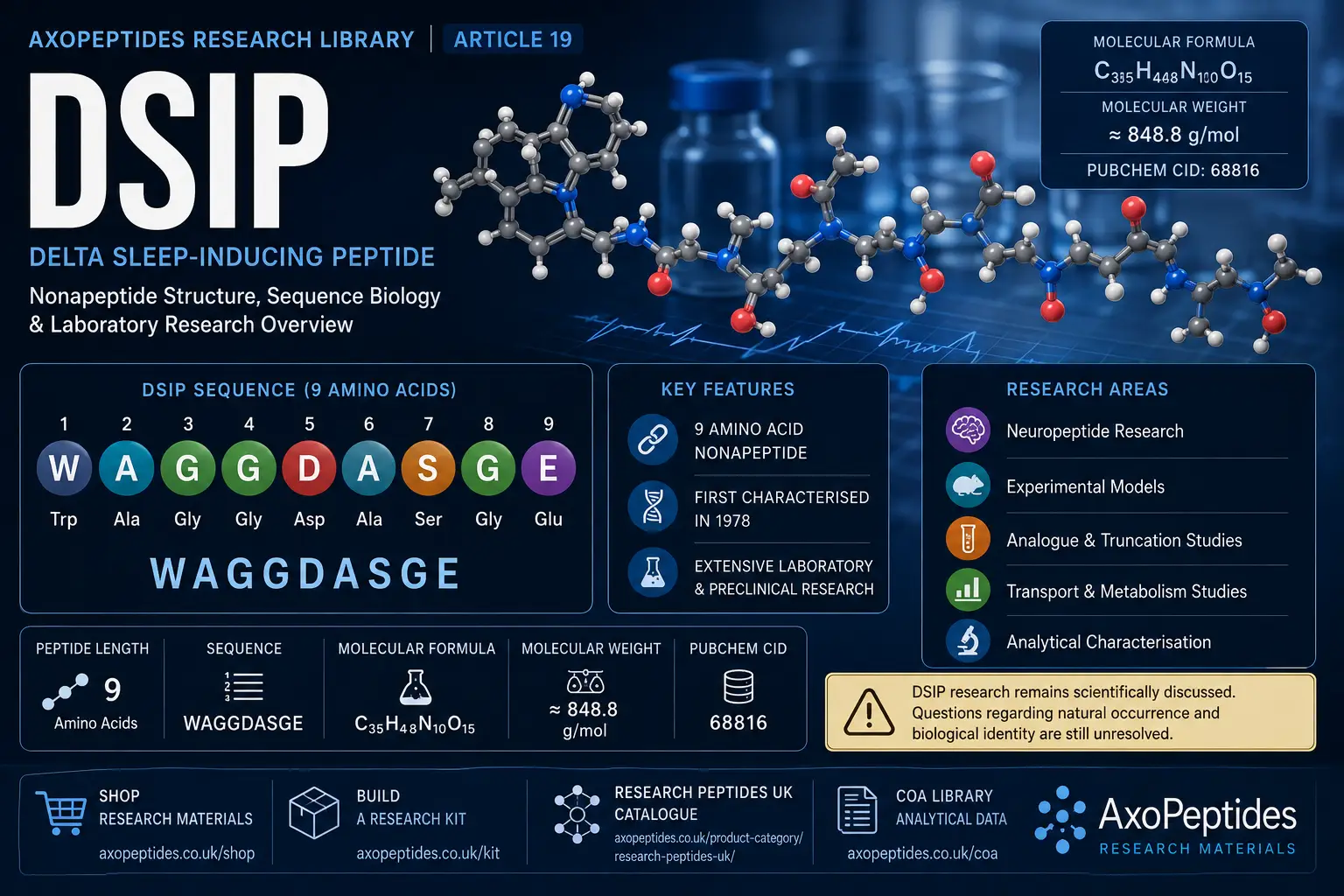
Delta Sleep-Inducing Peptide, commonly abbreviated DSIP,
is a nine-amino-acid peptide originally characterised during
experimental neuropeptide research in the 1970s.
Its established chemical sequence is
Trp-Ala-Gly-Gly-Asp-Ala-Ser-Gly-Glu, abbreviated
WAGGDASGE. Research literature has investigated DSIP through
peptide sequencing, analogue studies, biochemical experiments,
metabolism studies and analytical characterisation.
Researchers exploring related compounds can browse the
Research Peptides UK catalogue
,
visit the
AxoPeptides Shop
or
build a research kit
.
Research information notice:
This article is provided for scientific and educational
reference only. It contains no dosing, reconstitution,
administration, injection, treatment or personal-use instructions.
Research Profile
Compound
Delta Sleep-Inducing Peptide
Abbreviation
DSIP
Peptide Length
9 Amino Acids
Sequence
WAGGDASGE
Molecular Formula
C35H48N10O15
Molecular Weight
≈ 848.8 g/mol
PubChem CID
68816
Molecular Overview
What Is DSIP?
DSIP is a short peptide containing nine amino-acid residues.
It was originally isolated during experiments investigating
peptide-like factors associated with electrophysiological
observations in animal research.
Amino-acid analysis and sequence determination established
the peptide sequence as:
Nine-Residue Sequence
WAGGDASGE
Trp – Ala – Gly – Gly – Asp – Ala – Ser – Gly – Glu
Peptide Architecture
The Nine Residues of DSIP
DSIP is classified as a nonapeptide because its molecular
backbone contains nine amino-acid residues joined through
peptide bonds.
Compound Reference
DSIP Molecular Characteristics
Chemical identifiers help distinguish the intact nine-residue
peptide from truncated fragments, modified analogues and
other DSIP-related compounds.
Common Name
Delta Sleep-Inducing Peptide
Abbreviation
DSIP
Sequence
WAGGDASGE
Peptide Length
9 Residues
Molecular Formula
C35H48N10O15
Molecular Weight
≈ 848.8 g/mol
PubChem CID
68816
Historical Peptide Research
Original Isolation & Sequence Characterisation
The DSIP sequence was reported in 1978 following isolation
of peptide material during animal experimental research.
Amino-acid analysis and sequence determination identified the
nine-residue WAGGDASGE peptide and established the chemical
structure subsequently referred to as DSIP.
01
Isolation
Peptide-containing experimental material was separated.
02
Amino-Acid Analysis
Residue composition was investigated analytically.
03
Sequence Determination
The final WAGGDASGE order was established.
Analogue Research
DSIP Sequence & Analogue Research
Historical DSIP research included comparison of the intact
nine-residue peptide with modified sequences, shortened
fragments and related analogues.
Such experiments are useful for studying structure–activity
relationships because they test whether changing a residue or
shortening a peptide alters a measured experimental response.
REFERENCE
WAGGDASGE
Intact nine-residue DSIP
VARIABLE
Residue Substitution
One or more residues can be changed.
VARIABLE
Peptide Truncation
Shorter fragments can be compared experimentally.
Peptide Metabolism Research
DSIP Transport & Metabolism Studies
Laboratory research has investigated how DSIP behaves in
biological barrier models and how rapidly the peptide can
undergo enzymatic degradation.
For example, cultured epithelial-cell systems have been used
to examine peptide transport and metabolic breakdown under
controlled experimental conditions.
01
Intact Peptide
WAGGDASGE is introduced into the experimental system.
02
Barrier Model
Controlled cell systems can be used for transport studies.
03
Metabolite Analysis
Degradation and peptide fragments can then be measured.
Scientific Uncertainty
Why DSIP Research Requires Careful Interpretation
DSIP has a long history in experimental peptide literature,
but several scientific questions surrounding its endogenous
occurrence and biological identity remain unresolved.
Later reviews have discussed the possibility that some
historical DSIP-like immunoreactivity could involve DSIP-like
molecules rather than establishing that every observation
represents the intact WAGGDASGE peptide.
This distinction is important when interpreting older literature:
a chemically defined synthetic peptide and an endogenous
immunoreactive signal are not automatically the same analytical finding.
Evidence Interpretation
Different DSIP Experiments Answer Different Questions
01
Chemical
Sequence and molecular identity
02
Biochemical
Metabolism and degradation
03
Cell Model
Transport and barrier experiments
04
Preclinical
Controlled animal models
Analytical Science
Laboratory Characterisation of DSIP
Modern analytical characterisation can examine several
independent properties of a synthetic DSIP sample.
Available analytical documentation for AxoPeptides research
materials can also be reviewed through the
COA Library
.
01
Sequence Reference
WAGGDASGE defines the expected nine-residue sequence.
02
HPLC
Chromatography can examine relative sample composition.
03
Mass Spectrometry
Mass-related data can contribute to molecular identity assessment.
Analytical Interpretation
Purity, Identity & Quantity Are Different Questions
PURITY
Sample Composition
Relative chromatographic composition under the method used.
IDENTITY
Which Molecule?
Addresses whether analytical evidence is consistent with intact DSIP.
QUANTITY
How Much Material?
Requires an appropriate quantitative analytical method.
Scientific Caution
Important Limitations When Reading DSIP Research
✓ DSIP is a chemically defined nine-residue peptide with the sequence WAGGDASGE.
✓ Historical DSIP literature spans several decades and experimental methodologies.
✓ DSIP-like immunoreactivity does not automatically prove the presence of intact WAGGDASGE.
✓ Questions concerning endogenous DSIP occurrence have remained scientifically debated.
✓ Results from isolated biochemical systems and whole-organism models represent different evidence levels.
✓ Modified analogues and truncated DSIP fragments should not be treated as identical to intact DSIP.
✓ HPLC purity alone does not establish complete molecular identity.
United Kingdom
DSIP in the UK Research Context
Scientific discussion of research compounds should remain clearly
separated from medicinal presentation and personal-use instructions.
MHRA guidance explains that assessment of borderline products can
take account of explicit and implicit claims, pharmacological,
metabolic or immunological properties, intended purpose and
overall presentation.
Research terminology should therefore remain consistent across
product descriptions, advertising, website content and other
surrounding presentation.
This article intentionally provides no:
Dosing
Reconstitution
Injection Guidance
Administration
Treatment Claims
Personal-Use Guidance
Sleep Advice
Testimonials
AxoPeptides Research Catalogue
Explore Research Materials
Browse available research materials individually or select
multiple compounds using the AxoPeptides Research Kit Builder.
Scientific FAQ
Frequently Asked Research Questions About DSIP
What is DSIP?
DSIP is the abbreviation for Delta Sleep-Inducing Peptide,
a chemically defined nine-residue peptide.
How many amino acids are in DSIP?
DSIP contains nine amino-acid residues and is therefore a nonapeptide.
What is the DSIP sequence?
The sequence is Trp-Ala-Gly-Gly-Asp-Ala-Ser-Gly-Glu,
abbreviated WAGGDASGE.
What is the molecular formula of DSIP?
PubChem lists C35H48N10O15 for Delta Sleep-Inducing Peptide.
What is the molecular weight of DSIP?
The molecular mass of the intact peptide is approximately
848.8 g/mol.
When was the DSIP sequence characterised?
A sequence-characterisation paper describing WAGGDASGE
was published in 1978.
Is the endogenous biology of DSIP completely established?
No. Later scientific reviews have noted unresolved questions
regarding natural DSIP occurrence and DSIP-like immunoreactivity.
Does HPLC purity prove DSIP identity?
No. Chromatographic purity and molecular identity are
separate analytical questions.
Scientific Sources
References & Further Reading
Original publications and independent scientific databases
should be reviewed in their full context when evaluating DSIP research.
PubChem — Delta Sleep-Inducing Peptide
Molecular formula, sequence, synonyms and chemical identifiers.
View PubChem ↗
Schoenenberger GA, et al. — 1978
Original amino-acid analysis and sequence determination
identifying the WAGGDASGE peptide.
View PubMed ↗
Augustijns PF, et al. — 1995
Experimental investigation of DSIP transport and metabolism
using a cultured epithelial-cell model.
View PubMed ↗
Kovalzon VM, et al. — 2006
Review discussing unresolved questions concerning natural
DSIP occurrence and DSIP-like biological signals.
View PubMed ↗
MHRA — Borderline Products Guidance
UK guidance concerning claims, pharmacological properties,
intended purpose and public presentation.
View GOV.UK Guidance ↗
Continue Exploring
Explore AxoPeptides Research Resources
Browse research materials, build a multi-product research kit,
explore the peptide catalogue or review available analytical documentation.
Research Catalogue
Shop Research Materials
Browse the complete AxoPeptides research catalogue.
Visit Shop →
Research Kit Builder
Build a Research Kit
Select multiple research materials in one kit.
Build a Research Kit →
Analytical Records
COA Library
Review available laboratory and analytical documentation.
View COA Library →
Scientific & Laboratory Research Information
This page is intended for scientific, laboratory and educational
information. It provides no dosing, reconstitution, administration,
injection, treatment or personal-use guidance.