AxoPeptides Research Library · Article 18
Thymosin Alpha-1: 28-Amino-Acid Structure, Prothymosin-α Origin & Laboratory Research Overview
28-Residue Peptide · N-Terminal Acetylation · Structural Research
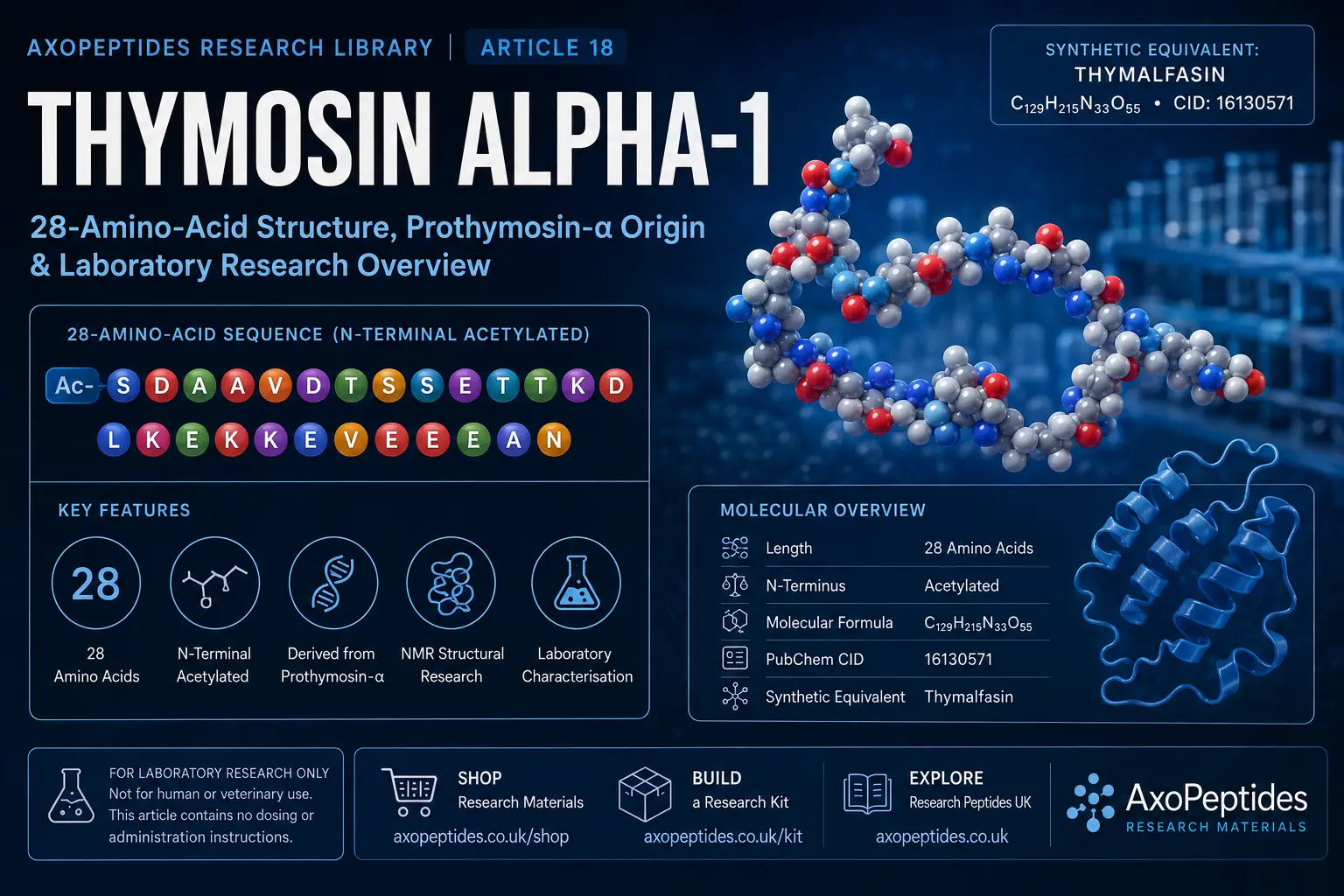
Thymosin Alpha-1 is a naturally occurring 28-amino-acid peptide
derived from the larger prothymosin-alpha precursor. Its molecular
identity includes an N-terminal acetyl group and a highly acidic
amino-acid composition.
Scientific research has examined its complete amino-acid sequence,
precursor relationship, conformational properties and molecular
behaviour using biochemical, structural and analytical techniques.
Researchers exploring related materials can browse the
Research Peptides UK catalogue
,
visit the
AxoPeptides Shop
or
build a research kit
.
Research information notice:
This article is provided for scientific and educational reference
only. It contains no dosing, reconstitution, administration,
injection, treatment or personal-use instructions.
Research Profile
Peptide
Thymosin Alpha-1
Synthetic Equivalent
Thymalfasin
Length
28 Amino Acids
N-Terminus
Acetylated
Molecular Formula
C129H215N33O55
PubChem CID
16130571
Molecular Overview
What Is Thymosin Alpha-1?
Thymosin Alpha-1 is a 28-residue peptide originally identified
and isolated during research on thymosin fraction 5.
Subsequent molecular research established that the peptide is
related to prothymosin-alpha, a substantially larger precursor
protein from which the 28-residue sequence can be derived.
The fully synthetic molecule corresponding to Thymosin Alpha-1
is commonly known as thymalfasin.
Amino-Acid Sequence
Thymosin Alpha-1 Sequence
The mature peptide contains 28 amino-acid residues and an
acetylated N-terminus.
28-Residue Sequence
Ac-SDAAVDTSSEITTKDLKEKKEVEEEAEN
Peptide Architecture
Understanding the 28-Residue Architecture
Thymosin Alpha-1 is considerably longer than many short
experimental peptides. Its sequence contains a high proportion
of acidic residues, particularly glutamate and aspartate.
01
28 Residues
The complete mature peptide contains twenty-eight amino-acid residues.
02
Acidic Composition
Multiple glutamate and aspartate residues contribute to its chemical character.
03
Terminal Modification
The peptide begins with an N-terminal acetyl group.
Post-Translational Chemistry
N-Terminal Acetylation
An important feature of mature Thymosin Alpha-1 is
N-terminal acetylation.
Acetylation modifies the chemical structure at the amino end
of the peptide and therefore forms part of the molecular identity
that should be considered during synthesis and analytical
characterisation.
01
Peptide Backbone
Twenty-eight residues define the mature sequence.
02
N-Terminal Acetyl Group
Acetylation changes the chemistry of the peptide terminus.
03
Analytical Identity
Sequence and terminal modification should both be considered.
Precursor Biology
Relationship to Prothymosin Alpha
Thymosin Alpha-1 should not be confused with the much larger
prothymosin-alpha precursor.
Molecular research places the Thymosin Alpha-1 sequence within
prothymosin-alpha, demonstrating how a defined peptide sequence
can arise from a larger precursor protein.
Larger Precursor
Prothymosin Alpha
Defined Peptide
Thymosin Alpha-1
28-residue acetylated peptide
Synthetic Peptide Reference
What Is Thymalfasin?
Thymalfasin is the chemically synthesised version of
Thymosin Alpha-1 and corresponds to the same 28-residue
acetylated peptide structure.
Chemical databases commonly use the thymalfasin name when
cataloguing molecular formula, structure and compound identifiers.
Structural Biology
NMR Structural Research
Nuclear magnetic resonance spectroscopy has been used to
investigate the three-dimensional conformational behaviour
of the complete 28-residue peptide.
Published work using high-field NMR and molecular-dynamics
calculations generated a structural model of Thymosin Alpha-1
under defined solvent conditions.
01
Peptide Sample
Complete 28-residue Thymosin Alpha-1.
02
NMR Spectroscopy
Nuclear magnetic resonance provides structural constraints.
03
Molecular Modelling
Computational methods can refine conformational models.
Structural Interpretation
Experimental Conditions Matter
Peptide conformation is not necessarily represented by one
permanently fixed three-dimensional arrangement.
Solvent composition, temperature and experimental methodology
can influence the conformational ensemble observed during
structural research. NMR-derived structures should therefore
be interpreted in the context of the experimental conditions.
Analytical Science
Laboratory Characterisation of Thymosin Alpha-1
Analytical characterisation can combine sequence information,
chromatographic analysis and mass-related measurements.
Available laboratory documentation for AxoPeptides research
materials can also be reviewed through the
COA Library
.
01
Sequence Reference
The 28-residue acetylated sequence provides the expected molecular reference.
02
HPLC
Chromatography can examine relative sample composition.
03
Mass Spectrometry
Molecular mass data can contribute to peptide identity assessment.
Analytical Interpretation
Purity, Identity & Quantity Are Different Questions
PURITY
Sample Composition
Relative chromatographic composition under the analytical method used.
IDENTITY
Which Molecule?
Addresses whether analytical evidence corresponds with Thymosin Alpha-1.
QUANTITY
How Much Material?
A separate analytical question requiring an appropriate quantitative method.
Scientific Caution
Important Limitations When Reading Thymosin Alpha-1 Research
✓ Thymosin Alpha-1 is a 28-residue peptide and should not be confused with other thymosin-family peptides.
✓ Thymosin Alpha-1 and thymosin beta-family peptides are chemically distinct peptide families.
✓ N-terminal acetylation forms part of the mature peptide structure.
✓ Structural measurements should remain tied to the solvent and experimental conditions used.
✓ Biochemical and structural observations answer different scientific questions.
✓ HPLC purity alone does not establish complete molecular identity.
United Kingdom
Thymosin Alpha-1 in the UK Research Context
Scientific discussion of research compounds should remain clearly
separated from medicinal presentation and personal-use instructions.
MHRA guidance explains that assessment of borderline products can
take account of explicit and implicit claims, pharmacological
properties, intended purpose and overall presentation.
Research terminology should therefore remain consistent across
product descriptions, advertising and other surrounding website content.
This article intentionally provides no:
Dosing
Reconstitution
Injection Guidance
Administration
Treatment Claims
Personal-Use Guidance
Performance Claims
Testimonials
AxoPeptides Research Catalogue
Explore Research Materials
Browse available research materials individually or select
multiple compounds through the AxoPeptides Research Kit Builder.
Scientific FAQ
Frequently Asked Research Questions About Thymosin Alpha-1
What is Thymosin Alpha-1?
Thymosin Alpha-1 is an N-terminally acetylated peptide
containing 28 amino-acid residues.
How many amino acids are in Thymosin Alpha-1?
The mature peptide contains 28 amino-acid residues.
Is Thymosin Alpha-1 acetylated?
Yes. The mature peptide contains an N-terminal acetyl modification.
What is thymalfasin?
Thymalfasin is the chemically synthesised version corresponding
to the Thymosin Alpha-1 peptide.
What is the Thymosin Alpha-1 sequence?
Ac-SDAAVDTSSEITTKDLKEKKEVEEEAEN.
Is Thymosin Alpha-1 related to prothymosin alpha?
Yes. The Thymosin Alpha-1 sequence is associated with
the larger prothymosin-alpha precursor.
Has the structure of Thymosin Alpha-1 been studied by NMR?
Yes. Published NMR research has investigated the
three-dimensional conformational properties of the
28-residue peptide.
Does HPLC purity prove Thymosin Alpha-1 identity?
No. Chromatographic purity and complete molecular identity
are separate analytical questions.
Scientific Sources
References & Further Reading
Scientific databases and original publications should be
reviewed in their full context when evaluating
Thymosin Alpha-1 research.
PubChem — Thymalfasin
Molecular formula, structure and compound identifiers for synthetic Thymosin Alpha-1.
View PubChem ↗
Goldstein AL, et al. — 1977
Original isolation and amino-acid sequence analysis of the 28-residue peptide.
View PubMed ↗
Elizondo-Riojas MA, et al. — 2011
NMR structural investigation of the complete 28-residue Thymosin Alpha-1 peptide.
View PubMed ↗
Liu B, et al. — 2013
Research concerning generation of mature N-terminally acetylated Thymosin Alpha-1.
View Publication ↗
MHRA — Borderline Products Guidance
lass=”yoast-text-mark” />>UK guidance concerning claims, intended purpose and overall product presentation.
View GOV.UK Guidance ↗
Continue Exploring
Explore AxoPeptides Research Resources
Browse research materials, build a multi-product research kit,
explore the peptide catalogue or review available analytical documentation.
Research Catalogue
Shop Research Materials
Browse the complete AxoPeptides research catalogue.
Visit Shop →
Research Kit Builder
Build a Research Kit
Select multiple research materials in one kit.
Build a Research Kit →
Analytical Records
COA Library
Review available laboratory and analytical documentation.
View COA Library →
Scientific & Laboratory Research Information
This page is intended for scientific, laboratory and educational
information. It provides no dosing, reconstitution, administration,
injection, treatment or personal-use guidance.