AxoPeptides Research Library · Article 15
Selank: Tuftsin-Derived Heptapeptide Structure, Fragment Biology & Laboratory Research Overview
Peptide Structure · Tuftsin Relationship · Analytical Research
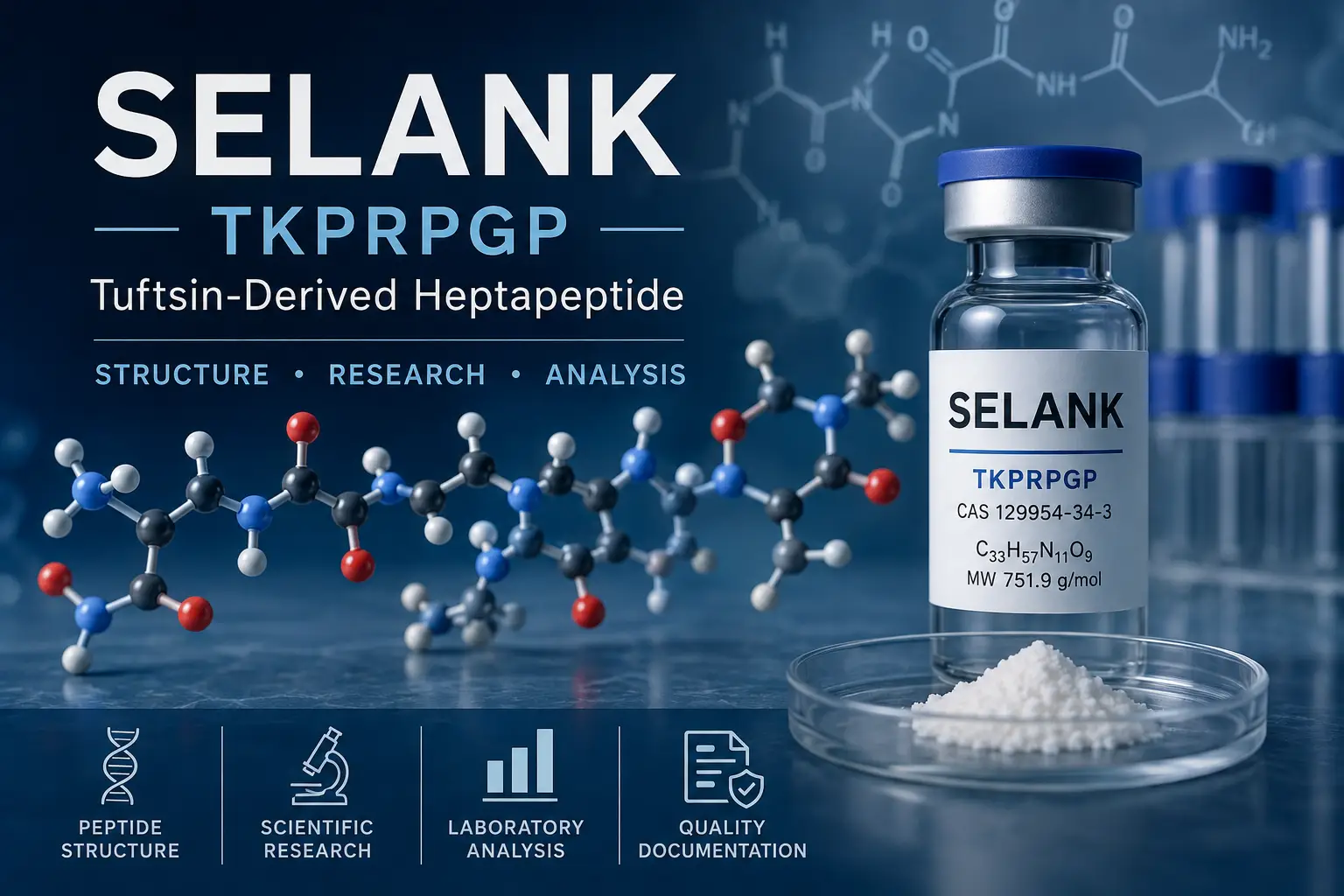
Selank is a synthetic seven-amino-acid peptide with the sequence
Thr-Lys-Pro-Arg-Pro-Gly-Pro. Its molecular architecture combines
the four-residue tuftsin sequence with a C-terminal Pro-Gly-Pro
tripeptide.
This research overview examines Selank from a molecular and
laboratory perspective, including peptide structure, sequence
relationships, fragment-based research, biochemical experiments
and analytical characterisation.
Researchers exploring related materials can browse the
Research Peptides UK catalogue
,
visit the
AxoPeptides Shop
or
build a research kit
containing multiple selected research materials.
Research information notice:
This article is provided for scientific and educational reference.
It does not provide dosing, reconstitution, administration,
injection, treatment or personal-use instructions.
Research Profile
Compound
Selank
Sequence
TKPRPGP
Peptide Length
7 Amino Acids
Molecular Formula
C33H57N11O9
Molecular Weight
≈ 751.9 g/mol
CAS
129954-34-3
PubChem CID
11765600
Molecular Overview
What Is Selank?
Selank is a synthetic heptapeptide composed of seven amino-acid
residues. Its standard sequence is:
One-Letter Sequence
TKPRPGP
Thr – Lys – Pro – Arg – Pro – Gly – Pro
The first four residues correspond to the tetrapeptide tuftsin.
The final Pro-Gly-Pro sequence extends that peptide framework,
giving Selank its own distinct molecular identity.
Peptide Architecture
The Seven Residues of Selank
Each residue contributes to the complete TKPRPGP peptide sequence.
The final three residues form the Pro-Gly-Pro region.
Structural Relationship
How Is Selank Related to Tuftsin?
Tuftsin is the tetrapeptide Thr-Lys-Pro-Arg, abbreviated TKPR.
Selank incorporates this sequence and extends it at the C-terminal
end with Pro-Gly-Pro.
Tuftsin
TKPR
4 amino acids
C-Terminal Extension
PGP
Pro-Gly-Pro
Selank
TKPRPGP
7 amino acids
Scientific distinction:
Sharing part of an amino-acid sequence does not make two peptides
chemically identical. The additional PGP sequence gives Selank
a different molecular structure from tuftsin.
Compound Reference
Selank Molecular Characteristics
Standardised chemical identifiers help distinguish the parent
Selank compound from related peptides and alternative chemical forms.
Common Name
Selank
Sequence
TKPRPGP
Molecular Formula
C33H57N11O9
Molecular Weight
751.9 g/mol
CAS Registry Number
129954-34-3
PubChem CID
11765600
Peptide Research
Fragment-Based Peptide Research
Selank provides a molecular example of how a short natural peptide
sequence can be extended to form a separate synthetic research
molecule.
01
Reference Sequence
Tuftsin provides the TKPR peptide sequence incorporated
into Selank.
02
Sequence Extension
Pro-Gly-Pro extends the C-terminal side of the
tuftsin-related sequence.
03
Independent Characterisation
The resulting seven-residue peptide can then be studied
as its own molecular entity.
Biochemical Research
Selank & Peptide-Degrading Enzyme Research
Published biochemical research has examined Selank in controlled
enzyme systems involving peptide degradation.
Studies of this type allow researchers to investigate molecular
interactions in isolated biochemical systems and compare related
peptide structures under defined experimental conditions.
System
Biochemical Enzyme Assay
Research Question
Enzyme Interaction
Evidence interpretation:
Observations made in isolated enzyme systems should remain described
as biochemical findings rather than being extended beyond the
experimental conditions that generated them.
Preclinical Molecular Research
BDNF-Related Experimental Research
Published preclinical research has examined brain-derived
neurotrophic factor, abbreviated BDNF, as a molecular marker
in experimental Selank studies.
In rat research models, investigators have measured BDNF-related
changes in selected tissues under defined experimental conditions.
Such observations remain preclinical findings tied to the model,
analytical method and endpoints examined.
Evidence Level
Preclinical
Experimental Model
Animal Research
Evidence Interpretation
Different Experiments Answer Different Questions
Selank research can involve several experimental levels.
These should not be treated as interchangeable.
01
Chemical
Sequence, structure and molecular identity
02
Biochemical
Defined molecular or enzyme systems
03
Ex Vivo
Measurements in isolated biological tissue
04
Preclinical
Controlled animal research models
Analytical Science
Laboratory Characterisation of Selank
A synthetic peptide can be investigated using several complementary
analytical approaches. Different analytical methods answer different
questions about the material.
Researchers can also review available
Certificates of Analysis
and laboratory records associated with AxoPeptides research materials.
01
Sequence Reference
TKPRPGP defines the expected amino-acid order of
the parent Selank peptide.
02
Chromatography
Chromatographic methods can investigate detected
sample composition under defined analytical conditions.
03
Mass Spectrometry
Molecular mass-related measurements can contribute
to assessment of peptide identity.
Analytical Interpretation
Purity, Identity & Quantity Are Different Questions
PURITY
Sample Composition
Relative chromatographic composition under the analytical
method used.
IDENTITY
Which Molecule?
Evidence that analysed material is consistent with
the expected Selank molecule.
QUANTITY
How Much Material?
A separate quantitative question requiring an
appropriate analytical measurement.
A chromatographic purity percentage should not be treated as
independent confirmation of sequence, molecular identity and
absolute quantity.
Chemical Representation
Parent Selank & Salt Forms
Chemical databases can contain separate records for a parent peptide
and its associated salt forms. These records should not be treated
as chemically interchangeable.
Parent Compound
Selank
C33H57N11O9
Separate Chemical Representation
Selank Diacetate
Separate database representation from the parent compound.
Scientific Caution
Important Limitations When Reading Selank Research
✓ Selank is structurally related to tuftsin but is not chemically identical to tuftsin.
✓ The Pro-Gly-Pro extension changes the molecular identity of the peptide.
✓ Results from isolated enzyme systems should remain identified as biochemical evidence.
✓ Ex-vivo measurements and whole-organism research answer different scientific questions.
✓ Animal research findings should remain identified as preclinical.
✓ A molecular-marker observation does not establish every possible downstream consequence.
✓ HPLC purity alone does not establish complete molecular identity.
United Kingdom
Selank in the UK Research Context
Scientific discussion of research compounds should remain clearly
separated from medicinal presentation and personal-use instructions.
MHRA assessment of borderline products can consider explicit and
implicit claims, pharmacological properties, intended purpose and
the overall way a product is presented.
Website content, advertising, packaging and other promotional
presentation can contribute to that assessment. Research terminology
should therefore remain consistent with the surrounding content.
This article intentionally provides no:
Dosing
Reconstitution
Injection Guidance
Administration
Treatment Claims
Personal-Use Guidance
Cognitive Claims
Testimonials
AxoPeptides Research Catalogue
Browse Research Materials
Explore available research peptides individually or select
multiple materials using the AxoPeptides Research Kit Builder.
Scientific FAQ
Frequently Asked Research Questions About Selank
What is Selank?
Selank is a synthetic seven-residue peptide with the amino-acid sequence TKPRPGP.
How many amino acids are in Selank?
Selank contains seven amino-acid residues.
What is the Selank sequence?
Thr-Lys-Pro-Arg-Pro-Gly-Pro, abbreviated TKPRPGP.
How is Selank related to tuftsin?
The first four Selank residues correspond to the tuftsin sequence TKPR.
What is PGP?
PGP is the abbreviation for Pro-Gly-Pro, the final three residues of Selank.
What is the molecular formula of Selank?
The parent Selank compound is represented as C33H57N11O9.
What is the molecular weight of Selank?
The parent peptide has a molecular weight of approximately 751.9 g/mol.
Does HPLC purity confirm Selank identity?
Not by itself. Chromatographic purity and molecular identity are separate analytical questions.
Scientific Sources
References & Further Reading
Independent scientific databases and publications are provided
for research reference and should be reviewed within the context
of the original source.
PubChem — Selank
Molecular formula, molecular weight, identifiers and compound information.
View PubChem ↗
PubChem — Tuftsin
Molecular reference information for the TKPR tetrapeptide.
View PubChem ↗
Kost NV, et al. — 2001
Experimental biochemical research involving Selank and peptide-degrading enzyme systems.
View PubMed ↗
Kolik LG, et al. — 2019
Preclinical research involving BDNF-related measurements in an animal experimental model.
View PubMed ↗
MHRA — Borderline Products Guidance
UK regulatory guidance concerning product presentation, claims and intended purpose.
View GOV.UK Guidance ↗
Continue Exploring
Explore AxoPeptides Research Resources
Continue exploring the AxoPeptides research catalogue, build a
multi-product research kit, browse available research peptides or
review analytical documentation.
Research Catalogue
Shop Research Materials →
Browse the complete AxoPeptides catalogue.
Research Kit Builder
Build a Research Kit →
Select multiple research materials in one kit.
Peptide Catalogue
Research Peptides UK →
Explore peptide research materials by category.
Analytical Records
View COA Library →
Review available laboratory documentation.
Scientific & Laboratory Research Information
This page is intended for scientific, laboratory and educational
information. It provides no dosing, reconstitution, administration,
injection, treatment or personal-use guidance.