AxoPeptides Research Library · Article 16
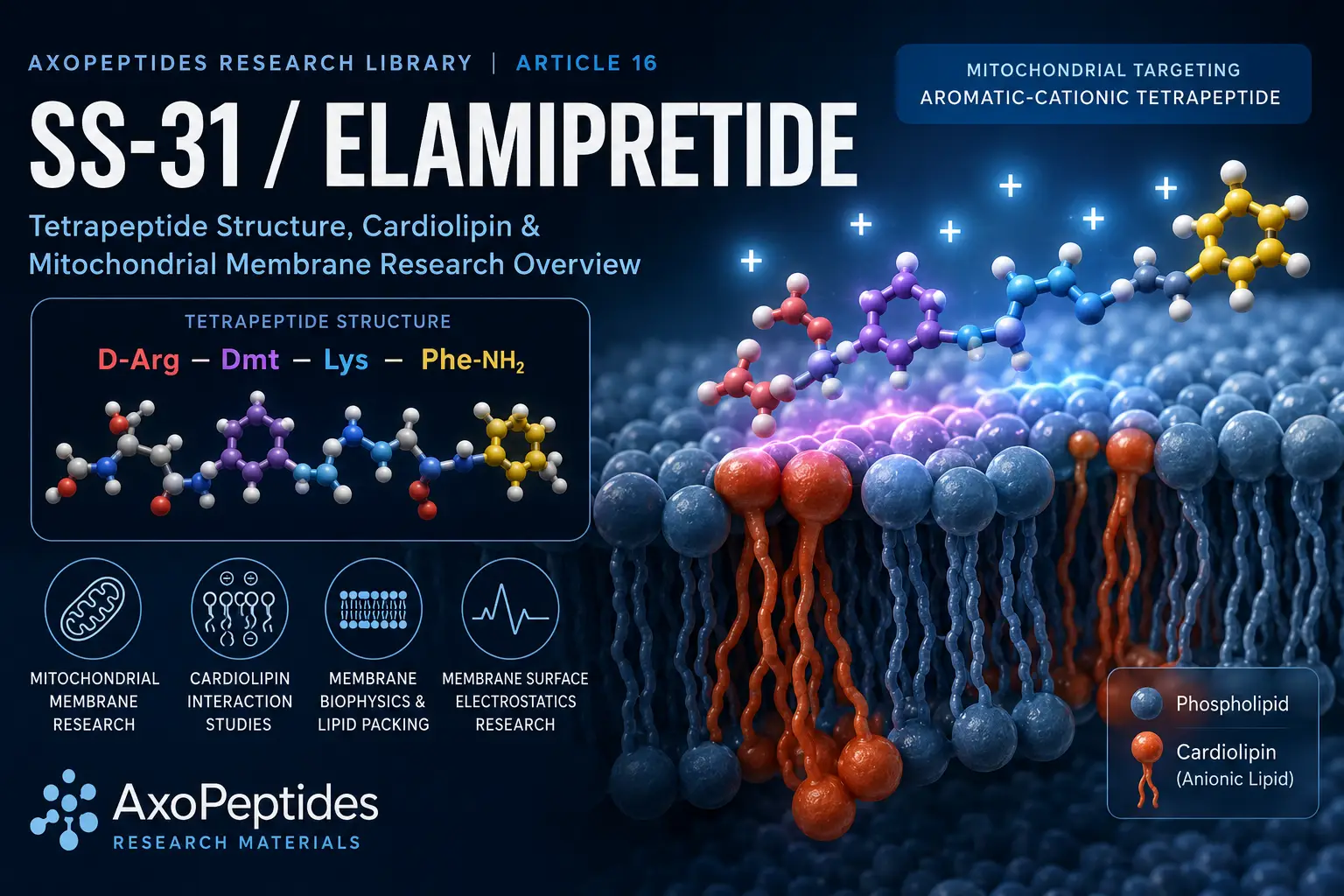
SS-31 / Elamipretide: Tetrapeptide Structure, Cardiolipin & Mitochondrial Membrane Research Overview
Tetrapeptide Structure · Cardiolipin Research · Membrane Biophysics
SS-31, also known as elamipretide, is a synthetic tetrapeptide
studied extensively in mitochondrial and membrane-biophysics
research. Its compact molecular architecture combines positively
charged and aromatic structural features within a four-residue
peptide framework.
Experimental studies have examined the interaction of SS-31 with
lipid bilayers, cardiolipin-containing membranes, mitochondrial
membrane interfaces and associated protein environments.
Researchers exploring related compounds can browse the
Research Peptides UK catalogue
,
visit the
AxoPeptides Shop
or
build a research kit
.
Research information notice:
This article is provided for scientific and educational reference.
It contains no dosing, reconstitution, administration, injection,
treatment or personal-use instructions.
Research Profile
Compound
Elamipretide
Research Name
SS-31
Peptide Length
4 Residues
Structure
D-Arg–Dmt–Lys–Phe-NH₂
Molecular Formula
C32H49N9O5
Molecular Weight
≈ 639.8 g/mol
PubChem CID
11764719
Molecular Overview
What Is SS-31 / Elamipretide?
SS-31 is a synthetic four-residue peptide also known as elamipretide.
Scientific literature commonly places it within the family of
aromatic-cationic peptides investigated in mitochondrial research.
Its structure contains D-arginine, a modified tyrosine residue
known as 2′,6′-dimethyltyrosine, lysine and an amidated
phenylalanine residue.
Simplified Structural Sequence
D-Arg – Dmt – Lys – Phe-NH₂
Dmt = 2′,6′-dimethyltyrosine
Tetrapeptide Architecture
Four-Residue Molecular Structure
The SS-31 structure contains only four residues, but those residues
have distinct chemical properties that are important when interpreting
membrane-biophysics research.
01
D-Arg
D-arginine residue
02
Dmt
2′,6′-dimethyltyrosine
04
Phe-NH₂
Amidated phenylalanine
Structure–Property Research
Why Is the SS-31 Structure of Research Interest?
SS-31 is frequently described as an aromatic-cationic peptide.
This reflects the combination of positively charged and aromatic
structural features within the molecule.
01
Cationic Features
Arginine and lysine contribute positively charged
side-chain chemistry relevant to membrane electrostatics.
02
Aromatic Features
Dmt and phenylalanine contribute aromatic and hydrophobic
features to the tetrapeptide.
03
Compact Architecture
The complete compound is built from a short four-residue
peptide framework.
Membrane Biophysics
SS-31 & Mitochondrial Membrane Research
A major area of SS-31 research concerns its interaction with
lipid membranes, particularly membrane systems used to model
mitochondrial interfaces.
Experimental work has investigated peptide partitioning into
membrane interfacial regions and how membrane charge and lipid
composition influence that interaction.
Model System
Lipid Bilayers
Organelle System
Mitochondrial Membranes
Research Focus
Peptide–Membrane Interaction
Mitochondrial Lipid Research
Cardiolipin & SS-31 Research
Cardiolipin is an anionic phospholipid strongly associated with
the inner mitochondrial membrane and plays an important role in
mitochondrial membrane organisation.
Cardiolipin-containing membranes are widely used in SS-31 research.
Controlled biophysical experiments can examine peptide association,
membrane partitioning, lipid packing and electrostatic effects.
Membrane Context
Inner Mitochondrial Membrane
Research Question
Peptide–Lipid Interaction
Biophysical Research
Membrane Surface Electrostatics
Membrane surfaces can carry different electrical characteristics
depending on lipid composition. This is particularly relevant when
studying a peptide containing positively charged residues.
Published biophysical research has reported that SS-31 binding is
influenced by membrane surface charge and that peptide association
can alter measurable surface electrostatic properties.
Evidence interpretation:
Membrane-electrostatic observations are biophysical measurements.
They should remain described within the conditions of the membrane
systems in which they were obtained.
Membrane Structure
Lipid Packing & Membrane Organisation
Lipid bilayers are dynamic structures whose physical properties
depend on molecular composition, charge and interactions between
lipids and other molecules.
In model systems, SS-31 has been investigated for measurable
changes in lipid packing following membrane association.
01
Lipid Composition
Different lipid mixtures create different membrane environments.
02
Peptide Association
SS-31 can associate with membrane interfacial regions.
03
Physical Measurement
Lipid organisation and packing can then be compared experimentally.
Molecular Interaction Research
Mitochondrial Protein Interaction Studies
Research has also investigated molecular environments surrounding
SS-31 within mitochondria, including potential associations with
mitochondrial proteins.
Techniques such as proteomic analysis and cross-linking can be used
to identify proteins found in proximity to a research peptide.
Such findings describe association patterns rather than proving a
complete molecular mechanism on their own.
Experimental Science
How Is SS-31 Studied Experimentally?
Different experimental systems answer different questions about
the compound.
01
Chemical
Structure & molecular identity
02
Biophysical
Model membrane interactions
03
Organelle
Isolated mitochondrial systems
04
Preclinical
Controlled experimental models
Analytical Science
Laboratory Characterisation of SS-31
Characterising SS-31 requires attention to both peptide sequence
and its non-standard structural features.
Available analytical records for AxoPeptides research materials
can be reviewed through the
COA Library
.
01
Structural Reference
Expected residue order and chemical modifications should be defined.
02
Chromatography
HPLC can investigate relative sample composition under defined conditions.
03
Mass Spectrometry
Mass-related measurements can contribute to molecular identity assessment.
Analytical Interpretation
Purity, Identity & Quantity Are Different Questions
PURITY
Sample Composition
Relative chromatographic composition under the analytical method used.
IDENTITY
Which Molecule?
Addresses whether analytical evidence is consistent with SS-31.
QUANTITY
How Much Material?
Requires an appropriate quantitative analytical method.
Scientific Caution
Important Limitations When Reading SS-31 Research
✓ SS-31 contains specialised structural features and should not be represented simply as four standard amino acids.
✓ Model lipid-bilayer observations remain biophysical evidence.
✓ Cardiolipin interaction results depend on membrane composition and experimental conditions.
✓ Isolated mitochondrial experiments differ from cellular and whole-organism systems.
✓ Protein-association studies do not independently establish a complete molecular mechanism.
✓ Preclinical findings should remain clearly identified as preclinical.
✓ HPLC purity alone does not establish complete molecular identity.
United Kingdom
SS-31 in the UK Research Context
Scientific discussion of research compounds should remain clearly
separated from medicinal presentation and personal-use instructions.
MHRA guidance explains that assessment of borderline products can
consider explicit and implicit claims, pharmacological properties,
intended purpose and overall product presentation.
Research-only terminology should therefore remain consistent with
product descriptions, advertising and other surrounding presentation.
This article intentionally provides no:
Dosing
Reconstitution
Injection Guidance
Administration
Treatment Claims
Personal-Use Guidance
Performance Claims
Testimonials
AxoPeptides Research Catalogue
Explore Research Materials
Browse available research materials individually or select
multiple items through the AxoPeptides Research Kit Builder.
Scientific FAQ
Frequently Asked Research Questions About SS-31
What is SS-31?
SS-31 is a synthetic four-residue peptide also known as elamipretide.
What is another name for SS-31?
Elamipretide is the commonly used compound name.
How many residues are in SS-31?
SS-31 contains four residues and is therefore a tetrapeptide.
What is the SS-31 structure?
It is commonly represented as D-Arg–Dmt–Lys–Phe-NH₂,
where Dmt denotes 2′,6′-dimethyltyrosine.
What is cardiolipin?
Cardiolipin is an anionic phospholipid strongly associated
with the inner mitochondrial membrane.
Why is cardiolipin studied with SS-31?
SS-31 research has examined interactions with cardiolipin-containing
and other negatively charged membrane systems.
What is the molecular formula of elamipretide?
PubChem lists C32H49N9O5 for elamipretide.
Does HPLC purity prove SS-31 identity?
No. Chromatographic purity and molecular identity are separate analytical questions.
Scientific Sources
References & Further Reading
Independent scientific sources should be reviewed in their
original context when evaluating SS-31 research.
PubChem — Elamipretide
Molecular formula, molecular identifiers and compound reference information.
View PubChem ↗
Mitchell W, et al. — 2020
Biophysical research examining SS-31 interaction with lipid
bilayers, lipid packing and membrane surface electrostatics.
View PubMed ↗
Mitchell W, et al. — 2022
Structure–activity research involving mitochondria-targeted
aromatic-cationic tetrapeptides including SS-31.
View PubMed ↗
MHRA — Borderline Products Guidance
UK guidance concerning product claims, intended purpose and medicinal-product classification.
View GOV.UK Guidance ↗
Continue Exploring
Explore AxoPeptides Research Resources
Browse available research materials, build a multi-product research
kit, explore the peptide catalogue or review available analytical documentation.
Research Catalogue
Shop Research Materials
Browse the complete AxoPeptides research catalogue.
Visit Shop →
Research Kit Builder
Build a Research Kit
Select multiple research materials in one kit.
Build a Research Kit →
Analytical Records
COA Library
Review available laboratory and analytical documentation.
View COA Library →
Scientific & Laboratory Research Information
This page is intended for scientific, laboratory and educational
information. It provides no dosing, reconstitution, administration,
injection, treatment or personal-use guidance.