Semax: ACTH-Derived Heptapeptide Structure,
Gene-Expression Research & Laboratory Overview
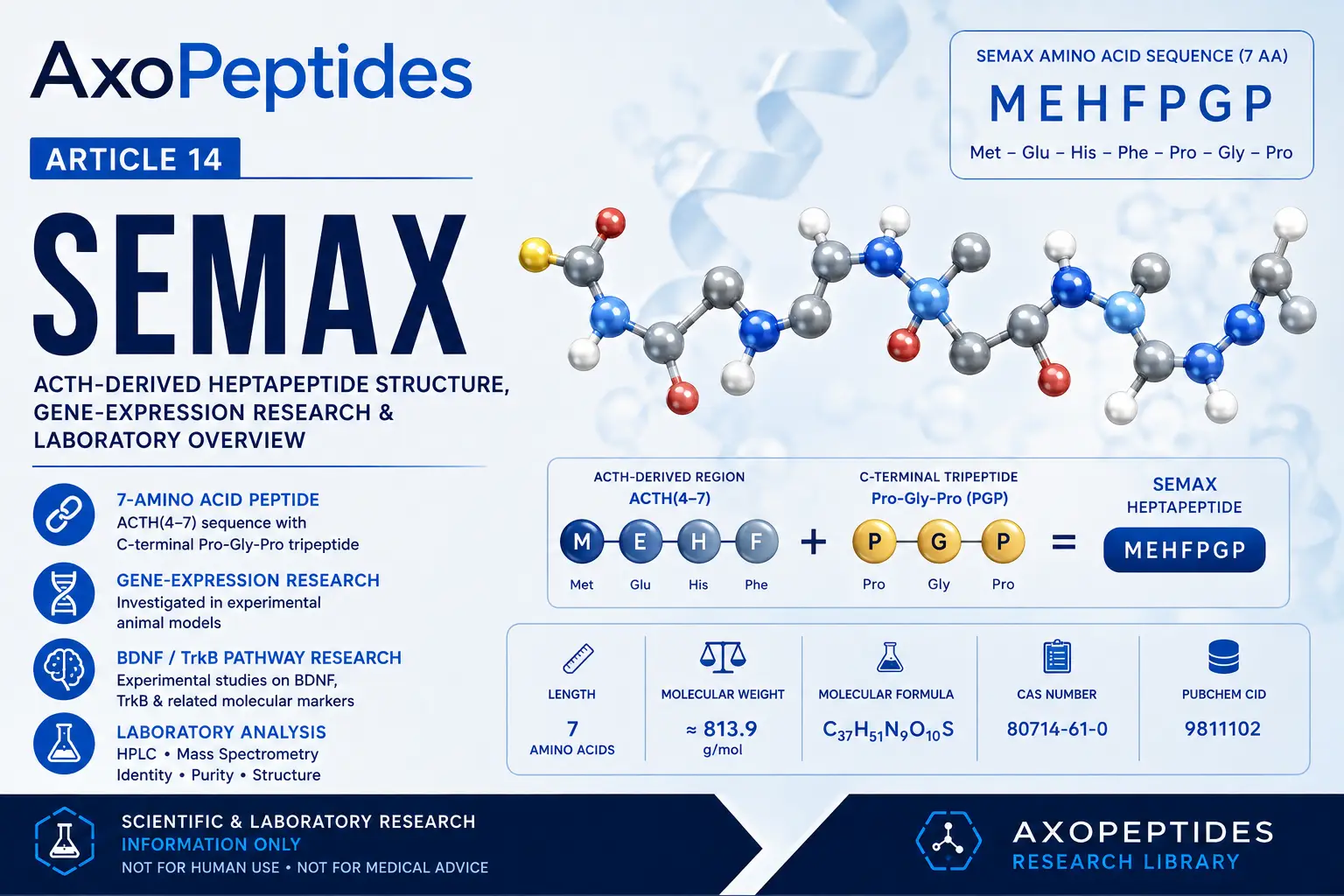
Semax is a synthetic seven-amino-acid peptide incorporating
an ACTH(4–7)-derived sequence together with a C-terminal
Pro-Gly-Pro tripeptide. This scientific overview examines its
peptide architecture, amino-acid sequence, relationship to ACTH
fragments, experimental gene-expression research, peptide
degradation and laboratory characterisation.
R
Scientific & Laboratory Research Information
This article is intended for scientific and educational
information only. It contains no dosing, reconstitution,
administration, injection, treatment or personal-use
instructions.
PEPTIDESemax
LENGTH7 amino acids
SEQUENCEMEHFPGP
MOLECULAR WEIGHT≈ 813.9 g/mol
MOLECULAR OVERVIEW
What Is Semax?
Semax is a synthetic peptide consisting of seven amino-acid
residues.
Its molecular design combines a four-residue sequence derived
from positions 4–7 of adrenocorticotropic hormone
(ACTH) with a C-terminal
Pro-Gly-Pro tripeptide.
This structure makes Semax useful as a research example of
peptide-fragment engineering: a short sequence derived from a
larger parent peptide is combined with an additional tripeptide
sequence to create a distinct molecule.
Important distinction
Semax is not chemically identical to full-length ACTH.
It is a separate seven-residue synthetic peptide with its
own molecular identity.
PEPTIDE TERMINOLOGY
What Is a Heptapeptide?
The term heptapeptide describes a peptide
containing seven amino-acid residues connected by peptide bonds.
Semax therefore belongs to a class of relatively short synthetic
peptides compared with larger polypeptides and proteins.
1M
2E
3H
4F
5P
6G
7P
PEPTIDE ORIGIN
How Is Semax Related to ACTH?
Adrenocorticotropic hormone is a larger peptide containing
multiple amino-acid regions.
Semax incorporates the four-residue sequence corresponding to
ACTH positions 4–7:
Met – Glu – His – Phe
A Pro-Gly-Pro sequence is then attached at the C-terminal side
of this tetrapeptide.
ACTH-DERIVED REGION
Met-Glu-His-PheACTH(4–7)
+
C-TERMINAL TRIPEPTIDE
Pro-Gly-ProPGP
=
HEPTAPEPTIDE
MEHFPGPSemax
Some scientific papers describe Semax historically as an
ACTH(4–10) analogue. Molecularly, however, its actual sequence
is ACTH(4–7) followed by Pro-Gly-Pro rather than the unchanged
native ACTH(4–10) sequence.
AMINO-ACID SEQUENCE
Semax Amino-Acid Sequence
The standard Semax sequence is:
MEHFPGP
In three-letter notation:
Met – Glu – His – Phe – Pro – Gly – Pro
01
MMethionine
02
EGlutamate
03
HHistidine
04
FPhenylalanine
05
PProline
06
GGlycine
07
PProline
MOLECULAR IDENTITY
Semax Molecular Characteristics
Standardised chemical identifiers allow researchers to distinguish
the parent Semax peptide from salt forms and chemically modified
derivatives.
Common nameSemax
SequenceMEHFPGP
Length7 amino acids
Molecular formulaC37H51N9O10S
Molecular weight≈ 813.9 g/mol
CAS number80714-61-0
PubChem CID9811102
Peptide classSynthetic heptapeptide
Salt forms should be distinguished carefully.
Molecular formula and molecular weight can differ when
Semax is represented as a salt or associated with another
chemical component. Researchers should confirm which
chemical form a database or analytical document describes.
C-TERMINAL FRAGMENT
Why Is Pro-Gly-Pro Important to Semax Research?
The final three amino-acid residues of Semax form the sequence
Pro-Gly-Pro, commonly abbreviated
PGP.
RESIDUE 5
Pro
—
RESIDUE 6
Gly
—
RESIDUE 7
Pro
Experimental studies have compared Semax with PGP itself to
investigate which molecular responses may relate to the
ACTH-derived portion, the PGP portion or the complete
heptapeptide.
This is an example of structure–activity research:
chemically related peptides are compared under controlled
experimental conditions to examine how individual sequence
regions contribute to measured observations.
FRAGMENT-BASED RESEARCH
Why Study Short ACTH-Derived Peptides?
Larger peptide hormones often contain regions that can be studied
separately as shorter synthetic fragments.
Fragment research allows scientists to ask whether particular
amino-acid sequences contribute to molecular interactions,
enzymatic stability or experimentally measured signalling
responses.
01Parent Peptide
ACTH provides the larger molecular sequence from which
the N-terminal portion of Semax is derived.
02Defined Fragment
A short ACTH-related sequence can be investigated
independently.
03Engineered Peptide
Additional residues create a chemically distinct
research molecule.
PEPTIDE BIOCHEMISTRY
Semax Peptide Degradation Research
Short peptides can be transformed by proteolytic enzymes into
smaller peptide fragments.
Published experimental research has compared degradation of
ACTH-related sequences and Semax in biological laboratory
systems.
STARTING PEPTIDE
MEHFPGP
→
EXPERIMENTAL SYSTEM
Proteolytic environment
→
ANALYTICAL QUESTION
Peptide fragments
Such research can examine which peptide bonds are comparatively
susceptible to cleavage and which fragments can be detected over
the course of an experiment.
Biochemical stability is not storage advice.
Peptide-degradation research concerns molecular behaviour
within experimental systems. It does not provide instructions
concerning preparation, administration or storage for use.
MOLECULAR BIOLOGY
Semax & Experimental Gene-Expression Research
Another area of Semax research concerns changes in gene
expression measured in experimental animal models.
Researchers have used molecular-biological methods to examine
whether selected genes or groups of genes show different
expression patterns following experimental exposure to Semax.
01Experimental model
→
02RNA measurement
→
03Expression comparison
→
04Pathway analysis
Gene-expression differences are molecular observations and
should remain described according to the experimental model,
tissue, time point and analytical method involved.
EXPERIMENTAL PATHWAY RESEARCH
BDNF & TrkB-Related Semax Research
Some animal research has investigated relationships between
Semax and the BDNF/TrkB signalling system.
BDNF stands for brain-derived neurotrophic factor, while
TrkB is a receptor protein encoded by the NTRK2 gene.
A published rat study measured changes in BDNF-related
messenger RNA, BDNF protein and TrkB-associated molecular
markers under its defined experimental conditions.
EXPERIMENTAL PEPTIDE
Semax
→
MOLECULAR RESEARCH
BDNF
+
RECEPTOR RESEARCH
TrkB
→
MEASUREMENT
Expression markers
Keep the evidence level explicit.
These results were experimental observations from animal
research. They should not be rewritten as claims that Semax
produces a particular personal or medical outcome.
TRANSCRIPTOMICS
Transcriptomic Research Involving Semax
Transcriptomics examines the collection of RNA transcripts
expressed in a biological sample at a particular time.
Research has used transcriptome analysis to compare gene-expression
patterns associated with Semax and its Pro-Gly-Pro component in
experimental animal tissue.
RNA Profiling
Measures large numbers of RNA transcripts within an
experimental sample.
Differential Expression
Identifies genes whose measured expression differs
between experimental groups.
Pathway Analysis
Groups expression changes into known molecular or
biological pathways.
Comparative Peptide Research
Related peptides can be compared to investigate which
sequence regions are associated with particular
transcriptional observations.
EVIDENCE HIERARCHY
How Is Semax Studied Experimentally?
Semax appears in several different forms of laboratory research.
These levels answer different questions.
01Chemical
Sequence & structure
02Biochemical
Peptide degradation
03Molecular
Gene expression
04Preclinical
Animal research models
Experimental levels are not interchangeable.
A gene-expression observation, a peptide-degradation result
and an animal-model observation answer different scientific
questions and should be reported separately.
ANALYTICAL SCIENCE
Laboratory Characterisation of Semax
Synthetic peptide characterisation can involve several
complementary analytical techniques.
01Sequence Reference
MEHFPGP provides the expected amino-acid order for
the parent peptide.
02Chromatography
Can examine detected sample composition under a defined
analytical method.
03Mass Spectrometry
Molecular mass-related information can contribute to
identity assessment.
04Form Identification
Researchers should distinguish the parent peptide from
acetate, TFA-associated or other chemical forms.
CHROMATOGRAPHY
HPLC in Semax Research
High-performance liquid chromatography separates detected sample
components according to their interaction with a selected
chromatographic system.
The resulting chromatogram can be used to investigate relative
sample composition under the conditions of that method.
Simplified chromatogram illustration — not experimental data.
A chromatographic percentage is method-specific.
HPLC purity should not be treated as independent confirmation
of amino-acid sequence, molecular identity or absolute quantity.
MASS SPECTROMETRY
Mass Spectrometry & Semax Identity
Mass spectrometry measures ions according to their
mass-to-charge ratio.
For a short peptide such as Semax, mass-related information can
be compared with the expected molecular characteristics of the
seven-residue peptide.
REFERENCE
MEHFPGP
→
ANALYSIS
Mass spectrometry
→
DATA
m/z information
→
QUESTION
Identity evidence
ANALYTICAL INTERPRETATION
Purity, Identity & Quantity Are Separate Questions
PURITY
Sample composition
Describes relative chromatographic composition under
the specified method.
IDENTITY
Which peptide?
Addresses whether analytical evidence corresponds
with the expected Semax molecule.
QUANTITY
How much material?
Requires an appropriate quantitative analytical method.
Do not interpret one measurement as all three.
A high chromatographic purity percentage does not independently
establish molecular identity or absolute peptide quantity.
SCIENTIFIC CAUTION
Important Limitations When Reading Semax Research
Semax is a synthetic heptapeptide and is not chemically
identical to full-length ACTH.
Semax contains ACTH(4–7) plus Pro-Gly-Pro rather than the
unchanged native ACTH(4–10) sequence.
Molecular similarity does not automatically establish
identical biological behaviour.
Gene-expression changes are dependent on the tissue,
experimental model, method and time point investigated.
BDNF and TrkB observations from animal experiments should
remain identified as preclinical findings.
Transcriptomic association does not by itself establish
causation for every downstream pathway.
Biochemical peptide-degradation studies answer different
questions from gene-expression studies.
Findings from animal research should not be converted into
claims about outcomes in people.
HPLC purity alone does not establish complete molecular
identity.
UNITED KINGDOM
Semax in the UK Research Context
Scientific discussion of a research peptide should remain
clearly separated from medicinal presentation and instructions
directed towards personal use.
MHRA guidance explains that regulatory classification can take
account of explicit and implicit claims, pharmacological,
metabolic or immunological properties, intended purpose and
overall product presentation.
Websites, product descriptions, advertising, packaging,
promotional literature, social-media content and customer
testimonials can all contribute to that overall presentation.
Research-only wording therefore needs to remain consistent with
the surrounding content. A research disclaimer should not be
combined with contradictory instructions or medicinal claims.
Semax is a synthetic seven-amino-acid peptide containing
an ACTH(4–7)-derived sequence followed by Pro-Gly-Pro.
Is Semax a peptide?
Yes. Semax is a heptapeptide containing seven amino-acid
residues.
What is the Semax amino-acid sequence?
The sequence is Met-Glu-His-Phe-Pro-Gly-Pro, abbreviated
MEHFPGP.
How many amino acids are in Semax?
Semax contains seven amino-acid residues.
How is Semax related to ACTH?
Its first four residues correspond to ACTH residues 4–7.
These are followed by a Pro-Gly-Pro tripeptide.
What does PGP mean in Semax research?
PGP is the abbreviation for the C-terminal tripeptide
Pro-Gly-Pro.
What is the molecular formula of Semax?
PubChem lists the parent Semax compound with molecular
formula C37H51N9O10S.
What is the molecular weight of Semax?
PubChem lists approximately 813.9 g/mol for the parent
peptide representation.
What is the CAS number for Semax?
PubChem associates the parent peptide with CAS
80714-61-0.
What is the PubChem CID for Semax?
The parent Semax peptide is listed as PubChem CID 9811102.
Has Semax been investigated in gene-expression research?
Yes. Published experimental studies have examined
gene-expression and transcriptomic changes involving Semax
in animal research models.
Has Semax been studied in relation to BDNF and TrkB?
Yes. Experimental animal research has measured BDNF- and
TrkB-related molecular markers following Semax exposure
under defined study conditions.
How can Semax be analysed in a laboratory?
Depending on the research question, analytical approaches
can include chromatography, mass spectrometry and comparison
with expected peptide sequence and molecular properties.
Does HPLC purity prove Semax identity?
No. Chromatographic purity and molecular identity are
separate analytical questions.
SCIENTIFIC & REGULATORY SOURCES
References & Further Reading
PubChem — Semax / ACTH(4–7), Pro-Gly-Pro
Molecular formula, molecular weight, sequence-related
compound information and identifiers.
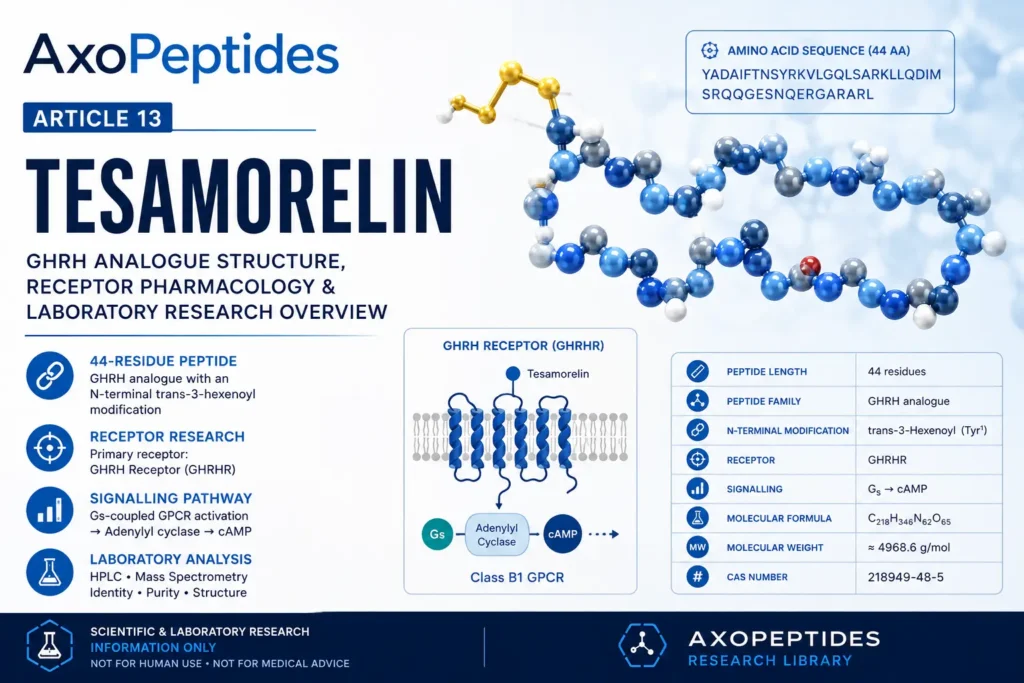
A scientific overview of tesamorelin covering its 44-residue GHRH-derived peptide architecture, N-terminal modification, GHRH receptor signalling and analytical characterisation.
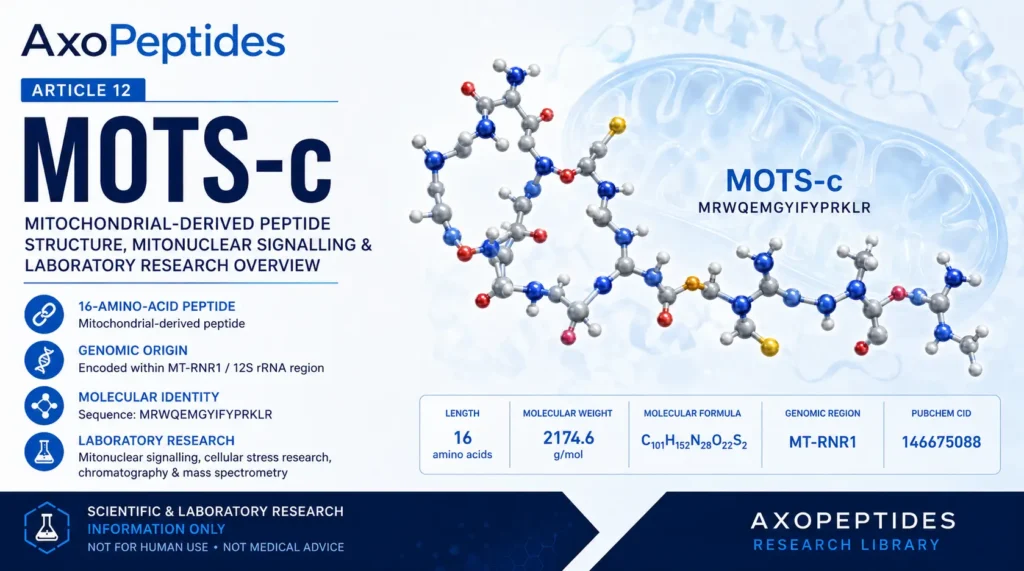
A scientific overview of MOTS-c covering its 16-amino-acid sequence, mitochondrial genomic origin, stress-associated nuclear translocation, mitonuclear signalling and laboratory characterisation.
A scientific overview of AOD-9604 covering its 16-residue hGH-derived peptide architecture, amino-acid sequence, disulphide-constrained structure, experimental research and analytical characterisation.