AxoPeptides Research Library · Article 17
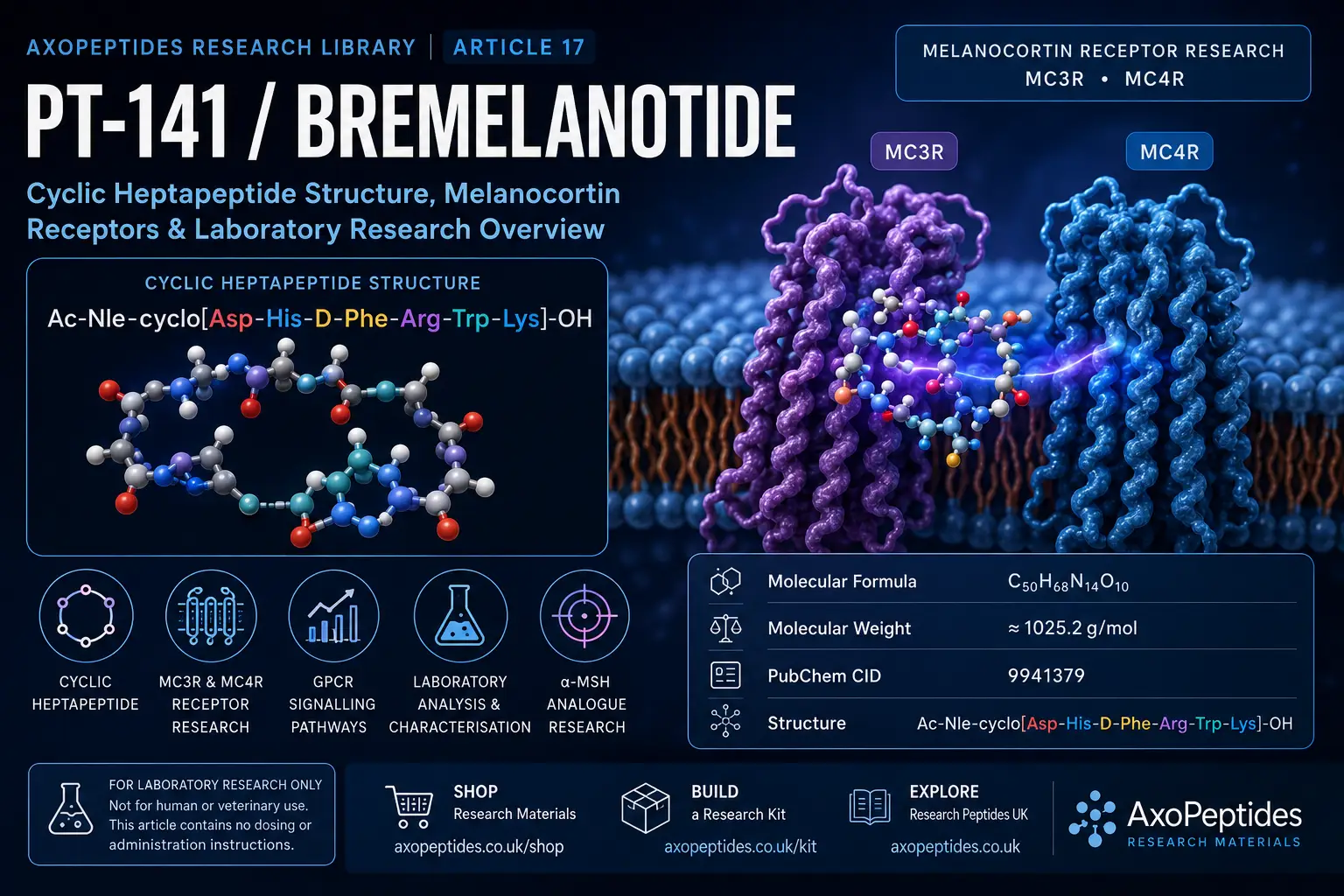
PT-141 / Bremelanotide: Cyclic Heptapeptide Structure, Melanocortin Receptors & Laboratory Research Overview
Cyclic Peptide Structure · Melanocortin Receptors · Analytical Research
PT-141, also known as bremelanotide, is a synthetic cyclic
heptapeptide derived from melanocortin peptide research.
Its molecular architecture incorporates seven residues,
a lactam ring, an N-terminal acetyl group and a
D-phenylalanine residue.
Laboratory research has examined PT-141 in relation to
melanocortin receptor systems, particularly MC3R and MC4R,
as well as peptide structure, receptor signalling and
analytical characterisation.
Researchers exploring related compounds can browse the
Research Peptides UK catalogue
,
visit the
AxoPeptides Shop
or
build a research kit
.
Research information notice:
This article is provided for scientific and educational
reference only. It contains no dosing, reconstitution,
administration, injection, treatment or personal-use instructions.
Research Profile
Compound
Bremelanotide
Research Code
PT-141
Peptide Length
7 Residues
Architecture
Cyclic Lactam Peptide
Molecular Formula
C50H68N14O10
Molecular Weight
≈ 1025.2 g/mol
PubChem CID
9941379
Molecular Overview
What Is PT-141 / Bremelanotide?
PT-141 is the research code historically associated with
bremelanotide. Chemically, bremelanotide is a synthetic
cyclic heptapeptide related to the melanocortin peptide family.
The molecule contains a combination of standard and modified
amino-acid features and is constrained by a cyclic lactam
architecture rather than existing purely as a linear
seven-residue chain.
Structural Representation
Ac-Nle-cyclo[Asp-His-D-Phe-Arg-Trp-Lys]-OH
Cyclic heptapeptide with N-terminal acetylation
Peptide Architecture
Seven-Residue Structure
The bremelanotide backbone contains seven residues.
The D-phenylalanine configuration and cyclic constraint are
particularly important when describing the molecule accurately.
Peptide Chemistry
Why Is Bremelanotide a Cyclic Peptide?
Bremelanotide is not simply a linear chain of seven residues.
A lactam linkage constrains part of its structure into a ring.
Cyclic constraints are widely studied in peptide chemistry because
they alter the conformational possibilities available to a molecule.
This can influence receptor recognition and other measurable
biochemical properties.
01
Linear Sequence
Defines the order of peptide residues.
02
Lactam Linkage
Introduces a covalent cyclic constraint.
03
Conformational Research
Researchers can investigate how cyclic constraint influences molecular recognition.
Melanocortin Peptide Research
Relationship to α-MSH Research
Bremelanotide belongs to a research lineage based on
melanocortin peptides and is commonly described as a synthetic
analogue related to α-melanocyte-stimulating hormone,
abbreviated α-MSH.
Analogue research allows investigators to compare how selected
residue substitutions, stereochemistry and conformational
constraints affect interactions with melanocortin receptors.
Receptor Pharmacology
PT-141 & Melanocortin Receptor Research
Melanocortin receptors are G-protein-coupled receptors that
interact with endogenous melanocortin peptides and synthetic
peptide analogues.
Published PT-141 research has specifically identified agonist
activity at melanocortin receptors including MC3R and MC4R.
These systems can be studied through receptor-binding and
cellular signalling assays.
MC3R
Melanocortin 3 Receptor
One receptor system investigated in PT-141 pharmacology.
MC4R
Melanocortin 4 Receptor
A prominent receptor target in melanocortin peptide research.
Cellular Signalling
Receptor Activation & GPCR Signalling
Melanocortin receptors belong to the G-protein-coupled receptor
family. Receptor activation can therefore be investigated using
controlled cellular signalling experiments.
04
Signalling Measurement
Scientific interpretation:
receptor activation is a molecular pharmacology observation and
should not automatically be converted into claims about outcomes
outside the experimental system.
Experimental Science
How Can PT-141 Be Studied Experimentally?
Different experimental systems address different scientific questions.
01
Chemical
Structure & molecular identity
02
Receptor
MC3R & MC4R interaction
03
Cellular
GPCR signalling assays
04
Preclinical
Controlled experimental models
Analytical Science
Laboratory Characterisation of PT-141
Complete analytical characterisation requires consideration of
peptide sequence, cyclic structure, stereochemistry and molecular mass.
Available analytical records for AxoPeptides research materials
can also be reviewed through the
COA Library
.
01
Structure Reference
Sequence, cyclic linkage and stereochemical features should be defined.
02
HPLC
Chromatography can investigate relative sample composition.
03
Mass Spectrometry
Molecular mass-related data can contribute to identity assessment.
Chemical Representation
Bremelanotide Free Base & Acetate Representation
Chemical records may refer either to the bremelanotide free base
or to an acetate-associated representation. Those forms should
be distinguished when comparing formulas and analytical records.
Free Base
Bremelanotide
C50H68N14O10 · approximately 1025.2 g/mol
Salt Representation
Bremelanotide Acetate
Includes acetate associated with the peptide compound.
Analytical Interpretation
Purity, Identity & Quantity Are Different Questions
PURITY
Sample Composition
Relative chromatographic composition under the analytical method used.
IDENTITY
Which Molecule?
Addresses whether analytical evidence is consistent with PT-141.
QUANTITY
How Much Material?
Requires an appropriate quantitative analytical method.
Scientific Caution
Important Limitations When Reading PT-141 Research
✓ PT-141 is a cyclic peptide and should not be represented simply as an unconstrained linear heptapeptide.
✓ D-phenylalanine stereochemistry forms part of the molecular identity.
✓ Receptor-binding and receptor-signalling assays measure different experimental endpoints.
✓ MC3R and MC4R observations should remain tied to the experimental system used.
✓ Cellular experiments and animal-model studies represent different evidence levels.
✓ Parent-compound and acetate representations should be distinguished analytically.
✓ HPLC purity alone does not establish complete molecular identity.
United Kingdom
PT-141 in the UK Research Context
Scientific discussion of research compounds should remain clearly
separated from medicinal presentation and personal-use instructions.
MHRA guidance explains that assessment of borderline products can
consider explicit and implicit claims, pharmacological properties,
intended purpose and overall presentation.
Research terminology should therefore remain consistent across
website content, product presentation, advertising and other
surrounding material.
This article intentionally provides no:
Dosing
Reconstitution
Injection Guidance
Administration
Treatment Claims
Personal-Use Guidance
Performance Claims
Testimonials
AxoPeptides Research Catalogue
Explore Research Materials
Browse research materials individually or select multiple
items through the AxoPeptides Research Kit Builder.
Scientific FAQ
Frequently Asked Research Questions About PT-141
What is PT-141?
PT-141 is the research code associated with the cyclic
heptapeptide bremelanotide.
Is PT-141 the same compound as bremelanotide?
PT-141 is the developmental or research name commonly
associated with bremelanotide.
How many residues are in bremelanotide?
Bremelanotide contains seven residues and is classified
as a cyclic heptapeptide.
What is the PT-141 structural sequence?
It is commonly represented as
Ac-Nle-cyclo[Asp-His-D-Phe-Arg-Trp-Lys]-OH.
What type of peptide is PT-141?
It is a synthetic cyclic lactam heptapeptide related
to melanocortin peptide research.
Which receptor systems are associated with PT-141 research?
Published research has examined melanocortin receptors
including MC3R and MC4R.
What is the molecular formula of bremelanotide?
PubChem lists C50H68N14O10 for the parent bremelanotide compound.
Does HPLC purity prove PT-141 identity?
No. Chromatographic purity and molecular identity are
separate analytical measurements.
Scientific Sources
References & Further Reading
Primary scientific and official chemical sources should be
reviewed in their original context when evaluating PT-141 research.
PubChem — Bremelanotide
Molecular formula, molecular weight and compound identifiers.
View PubChem ↗
FDA Chemistry Review — Bremelanotide
Official chemistry information describing bremelanotide
acetate as a synthetic cyclic heptapeptide.
View FDA Chemistry Review ↗
Molinoff PB, et al. — 2003
Early PT-141 research describing its relationship to
α-MSH and melanocortin receptor agonism including MC3R and MC4R.
View PubMed ↗
MHRA — Borderline Products Guidance
UK guidance concerning claims, intended purpose and
medicinal-product classification.
View GOV.UK Guidance ↗
Continue Exploring
Explore AxoPeptides Research Resources
Browse research materials, build a multi-product research kit,
explore the peptide catalogue or review available analytical documentation.
Research Catalogue
Shop Research Materials
Browse the complete AxoPeptides research catalogue.
Visit Shop →
Research Kit Builder
Build a Research Kit
Select multiple research materials in one kit.
Build a Research Kit →
Analytical Records
COA Library
Review available laboratory and analytical documentation.
View COA Library →
Scientific & Laboratory Research Information
This page is intended for scientific, laboratory and educational
information. It provides no dosing, reconstitution, administration,
injection, treatment or personal-use guidance.