Tesamorelin: GHRH Analogue Structure,
Receptor Pharmacology & Laboratory Research Overview
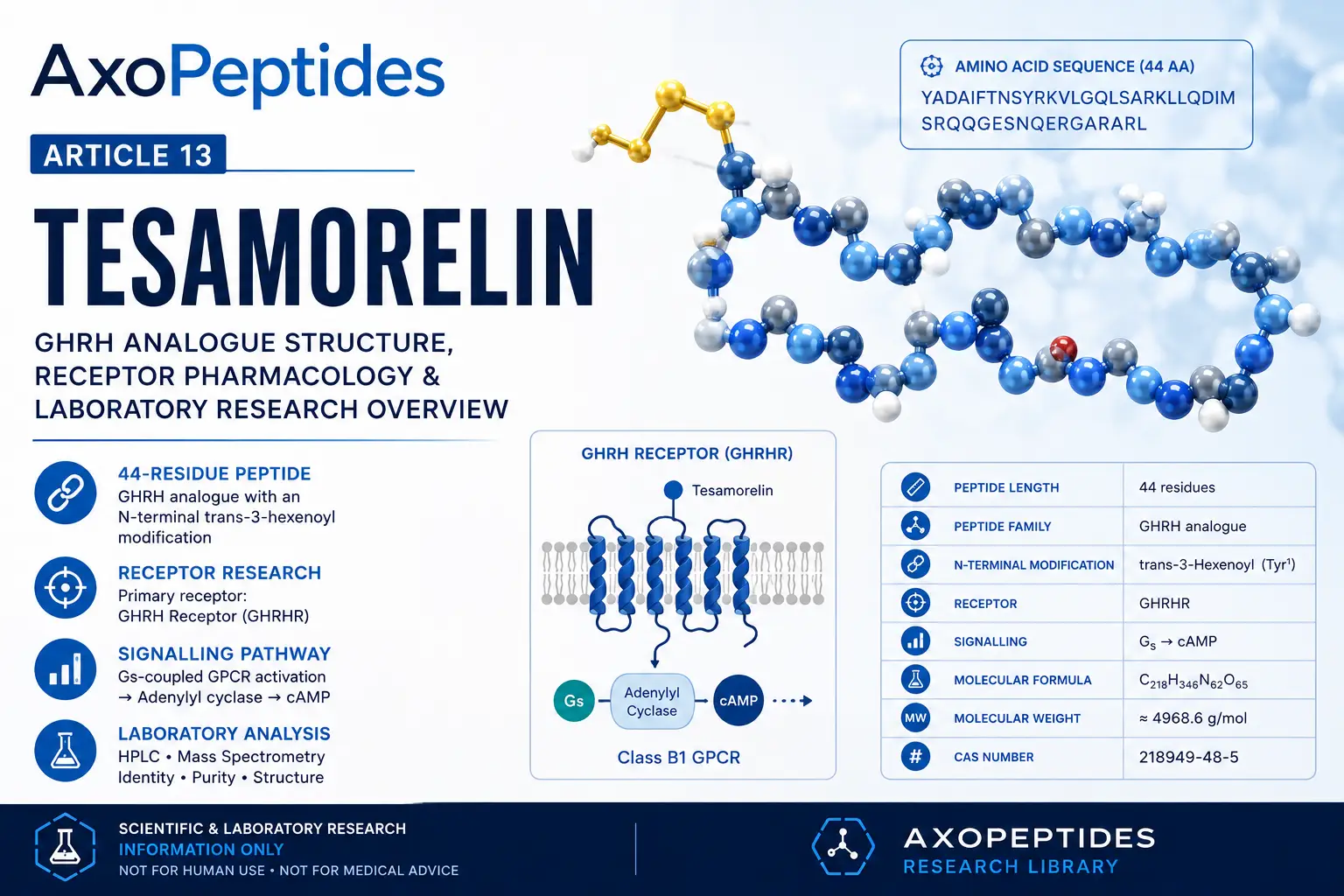
Tesamorelin is a synthetic 44-residue peptide analogue related
to human growth hormone-releasing hormone, commonly abbreviated
GHRH. This scientific overview examines its peptide architecture,
N-terminal modification, relationship to native GHRH, interaction
with the GHRH receptor, intracellular signalling research and
laboratory characterisation.
R
Scientific & Laboratory Research Information
This article is intended for scientific and educational
information only. It contains no dosing, reconstitution,
administration, injection, treatment or personal-use
instructions.
COMPOUNDTesamorelin
PEPTIDE LENGTH44 residues
PEPTIDE FAMILYGHRH analogue
RECEPTOR RESEARCHGHRHR
MOLECULAR OVERVIEW
What Is Tesamorelin?
Tesamorelin is a synthetic peptide analogue based on the
44-amino-acid sequence of human growth hormone-releasing hormone.
The molecule therefore belongs to a different research category
from growth hormone itself. Tesamorelin is structurally related
to the peptide signal upstream of the growth-hormone receptor
system rather than being growth hormone.
Its design preserves the GHRH-related peptide backbone while
incorporating an additional chemical modification at the
N-terminal end of the molecule.
SYNTHETIC PEPTIDE ANALOGUE
Tesamorelin
44-residue GHRH-related peptide with an N-terminal
chemical modification
PEPTIDE FAMILY
What Is Growth Hormone-Releasing Hormone?
Growth hormone-releasing hormone, abbreviated
GHRH, is a peptide signalling molecule.
The mature human GHRH peptide commonly used as a molecular
reference contains 44 amino-acid residues.
In receptor biology, GHRH acts as the endogenous ligand for
the growth hormone-releasing hormone receptor,
abbreviated GHRHR.
ENDOGENOUS PEPTIDE
GHRH
→
MOLECULAR ENGINEERING
Modified analogue
→
SYNTHETIC PEPTIDE
Tesamorelin
PEPTIDE ENGINEERING
What Is a GHRH Analogue?
A peptide analogue is a molecule designed to retain important
structural features of a reference peptide while incorporating
deliberate chemical changes.
These modifications allow researchers to investigate how
molecular structure influences properties such as receptor
interaction, enzymatic susceptibility and signalling behaviour.
01Reference Sequence
A naturally occurring peptide provides the molecular
framework.
02Chemical Modification
Selected structural changes are incorporated into the
peptide.
03Experimental Comparison
Molecular and receptor behaviour can then be studied
relative to the parent peptide.
AMINO-ACID SEQUENCE
Tesamorelin Peptide Sequence
The peptide backbone of tesamorelin corresponds to the
44-residue human GHRH sequence.
YADAIFTNSYRKVLGQLSARKLLQDIMSRQQGESNQERGARARL
Sequence information is one of the primary identifiers used
when defining a synthetic research peptide.
Sequence is only one part of molecular identity.
Tesamorelin also contains an N-terminal chemical
modification, meaning that confirming the amino-acid
sequence alone does not describe the complete molecule.
MOLECULAR ARCHITECTURE
Tesamorelin Molecular Structure
Tesamorelin combines a 44-residue peptide backbone with an
additional N-terminal chemical group.
0144-residue peptide
+
02N-terminal modification
=
ENGINEERED ANALOGUETesamorelin
This distinction is important when comparing tesamorelin with
unmodified human GHRH.
CHEMICAL MODIFICATION
The N-Terminal Modification of Tesamorelin
Tesamorelin contains a
trans-3-hexenoyl group attached to the
N-terminal tyrosine of the GHRH-related peptide sequence.
This makes tesamorelin chemically distinct from an unmodified
GHRH peptide even though the underlying amino-acid sequence is
closely related.
CHEMICAL GROUP
trans-3-hexenoyl
+
N-TERMINAL RESIDUE
Tyr¹
+
PEPTIDE BACKBONE
GHRH-related 44-mer
Simplified molecular representation for educational purposes,
not a synthesis procedure.
MOLECULAR COMPARISON
Tesamorelin vs Native GHRH
Tesamorelin and native GHRH are closely related but should not
be treated as chemically identical molecules.
NATIVE GHRH
Reference peptide
Natural peptide sequence recognised by the GHRH
receptor system.
TESAMORELIN
Modified analogue
GHRH-related peptide backbone containing an additional
N-terminal chemical modification.
Analogue does not mean identical.
A structural modification can influence biochemical
properties even where the core peptide sequence remains
closely related to the reference molecule.
RECEPTOR PHARMACOLOGY
Tesamorelin & GHRH Receptor Research
The primary receptor system associated with GHRH-family
peptide research is the
growth hormone-releasing hormone receptor,
or GHRHR.
GHRHR is a membrane receptor belonging to the class B1 family
of G-protein-coupled receptors.
PEPTIDE LIGAND
Tesamorelin
→
RECEPTOR
GHRHR
→
RECEPTOR FAMILY
Class B1 GPCR
Laboratory pharmacology can investigate ligand binding,
receptor activation and downstream signalling within
controlled experimental systems.
RECEPTOR BIOLOGY
GHRHR as a Class B1 GPCR
G-protein-coupled receptors are membrane proteins that translate
extracellular ligand interactions into intracellular signalling.
The GHRH receptor belongs to the class B1 GPCR family, which
contains several receptors activated by peptide ligands.
Extracellular Domain
Contributes to peptide recognition and ligand-receptor
interactions.
Seven-Transmembrane Core
Characteristic GPCR architecture spanning the cellular
membrane.
G-Protein Coupling
Receptor activation can engage intracellular
heterotrimeric G proteins.
Second Messengers
Downstream biochemical signals can be measured using
cellular assays.
CELLULAR SIGNALLING
GHRHR & cAMP Signalling Research
A major signalling pathway associated with GHRHR involves
coupling to stimulatory G proteins and activation of
adenylyl cyclase.
Pathway involvement is not a personal-benefit claim.
Describing receptor and cAMP signalling explains molecular
pharmacology. It should not be converted into claims about
outcomes in an individual.
PEPTIDE BIOCHEMISTRY
Peptide Modification & Proteolytic Susceptibility
Peptides can be susceptible to cleavage by proteolytic enzymes.
The N-terminal region of native GHRH is particularly important
to its molecular activity.
Dipeptidyl peptidase-4, commonly abbreviated
DPP-4, can cleave certain peptides at their
N-terminal region.
The structural modification incorporated into tesamorelin has
therefore been investigated in relation to altered susceptibility
to enzymatic cleavage compared with unmodified GHRH.
This is biochemical stability, not storage guidance.
Proteolytic susceptibility describes molecular behaviour
in an enzymatic system. It does not provide instructions
concerning preparation, storage or use.
EXPERIMENTAL SCIENCE
How Can Tesamorelin Be Studied Experimentally?
Different experimental models address different scientific
questions.
01Chemical
Sequence & structure
02Receptor
Ligand interaction
03Cellular
cAMP signalling
04Analytical
Identity & purity
Results obtained using one experimental level should not
automatically be generalised to another.
ANALYTICAL SCIENCE
Laboratory Characterisation of Tesamorelin
Complete characterisation of a modified synthetic peptide can
require several complementary analytical techniques.
01Sequence Analysis
Confirms information relating to the peptide backbone.
02Chromatography
Can investigate relative sample composition under
specified analytical conditions.
03Mass Spectrometry
Molecular mass-related data can contribute to
assessment of identity.
04Modification Confirmation
The N-terminal chemical group forms part of the complete
molecular identity.
CHROMATOGRAPHY
HPLC in Tesamorelin Research
High-performance liquid chromatography can separate components
within a peptide sample according to their interaction with the
chromatographic system.
The resulting chromatogram can provide information about relative
composition under the specific conditions used.
Simplified chromatographic illustration — not laboratory data.
Purity is method-dependent.
An HPLC percentage should be interpreted together with the
analytical method and other identity-related evidence.
MASS SPECTROMETRY
Mass Spectrometry & Molecular Identity
Mass spectrometry provides information about ions according
to their mass-to-charge ratio.
For modified peptides such as tesamorelin, molecular-mass data
can help assess whether analysed material is consistent with
the expected peptide plus its chemical modification.
EXPECTED MOLECULE
Tesamorelin
→
ANALYSIS
Mass spectrometry
→
DATA
m/z information
→
QUESTION
Identity evidence
ANALYTICAL INTERPRETATION
Purity, Identity & Quantity Are Different Measurements
PURITY
Sample composition
Describes relative chromatographic composition under
the stated method.
IDENTITY
Which molecule?
Addresses whether analytical evidence is consistent
with tesamorelin.
QUANTITY
How much material?
Requires an appropriate quantitative analytical
measurement.
HPLC purity alone is not full characterisation.
A chromatographic percentage does not independently prove
the amino-acid sequence, N-terminal modification, molecular
mass and absolute quantity.
SCIENTIFIC CAUTION
Important Limitations When Reading Tesamorelin Research
Tesamorelin is a modified analogue and should not be treated
as chemically identical to native GHRH.
GHRH and growth hormone are different molecules with
different receptor systems.
Receptor-binding observations and intracellular signalling
measurements answer different experimental questions.
cAMP signalling should remain described as a molecular or
cellular observation.
Class B GPCR pathway involvement does not establish a
personal outcome.
Findings from cellular models should remain identified
as cellular evidence.
Structural similarity does not establish identical
pharmacological behaviour.
HPLC purity alone does not establish complete molecular identity.
Scientific evidence should remain tied to the models and
endpoints that were actually investigated.
UNITED KINGDOM
Tesamorelin in the UK Research Context
Research-focused scientific discussion should remain clearly
separated from medicinal presentation and personal-use guidance.
MHRA guidance explains that whether a product may be considered
medicinal can depend on factors including explicit and implicit
claims, pharmacological properties, intended purpose and the
overall way in which it is presented.
Website content, product descriptions, advertising, packaging,
social-media material and testimonials can contribute to that
overall presentation.
A research-only statement should therefore not be contradicted
elsewhere by instructions for use or claims directed at personal
outcomes.
Frequently Asked Research Questions About Tesamorelin
What is tesamorelin?
Tesamorelin is a synthetic 44-residue peptide analogue
related to human growth hormone-releasing hormone.
Is tesamorelin a peptide?
Yes. Its molecular structure contains a 44-amino-acid
peptide backbone with an additional N-terminal modification.
How many amino acids are in tesamorelin?
The peptide backbone contains 44 amino-acid residues.
Is tesamorelin the same as GHRH?
No. Tesamorelin is structurally related to human GHRH but
contains an additional N-terminal chemical modification.
Is tesamorelin growth hormone?
No. Tesamorelin is a GHRH-related peptide analogue.
Growth hormone is a separate protein molecule.
Which receptor is associated with tesamorelin research?
Its primary receptor research concerns the growth
hormone-releasing hormone receptor, or GHRHR.
What type of receptor is GHRHR?
GHRHR belongs to the class B1 family of
G-protein-coupled receptors.
What signalling pathway is associated with GHRHR?
Experimental receptor research commonly examines
Gs-linked adenylyl-cyclase and cAMP signalling.
What modification does tesamorelin contain?
Tesamorelin contains a trans-3-hexenoyl modification
associated with the N-terminal region of the peptide.
Why are peptide analogues chemically modified?
Peptide modifications allow researchers to investigate
how structural changes influence properties including
receptor interaction and enzymatic susceptibility.
How can tesamorelin be characterised in a laboratory?
Characterisation can include peptide-sequence information,
chromatography, mass spectrometry and analytical confirmation
of relevant chemical modifications.
Does HPLC purity prove tesamorelin identity?
No. Chromatographic purity and molecular identity are
separate analytical questions.
SCIENTIFIC & REGULATORY SOURCES
References & Further Reading
PubChem — Tesamorelin
Chemical structure, molecular identifiers and compound
information for tesamorelin.
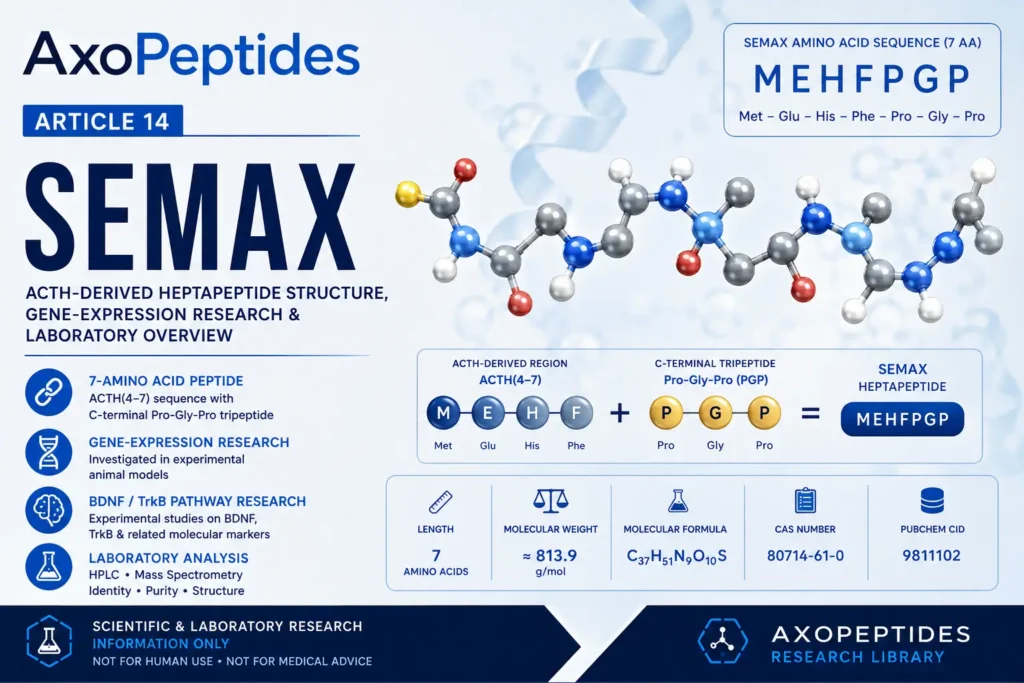
A scientific overview of Semax covering its seven-residue ACTH-derived peptide structure, MEHFPGP sequence, Pro-Gly-Pro component, experimental gene-expression research and analytical characterisation.
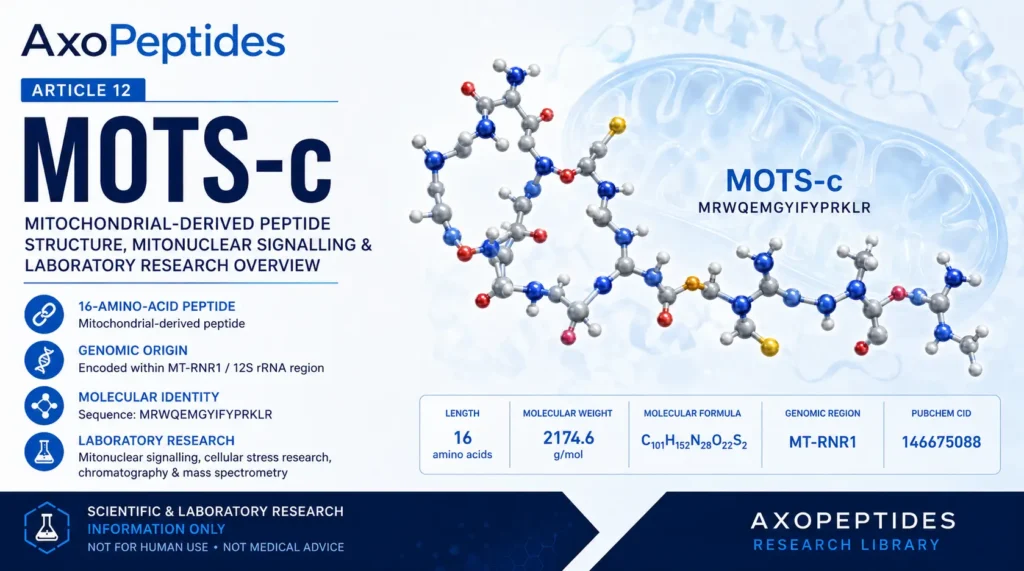
A scientific overview of MOTS-c covering its 16-amino-acid sequence, mitochondrial genomic origin, stress-associated nuclear translocation, mitonuclear signalling and laboratory characterisation.
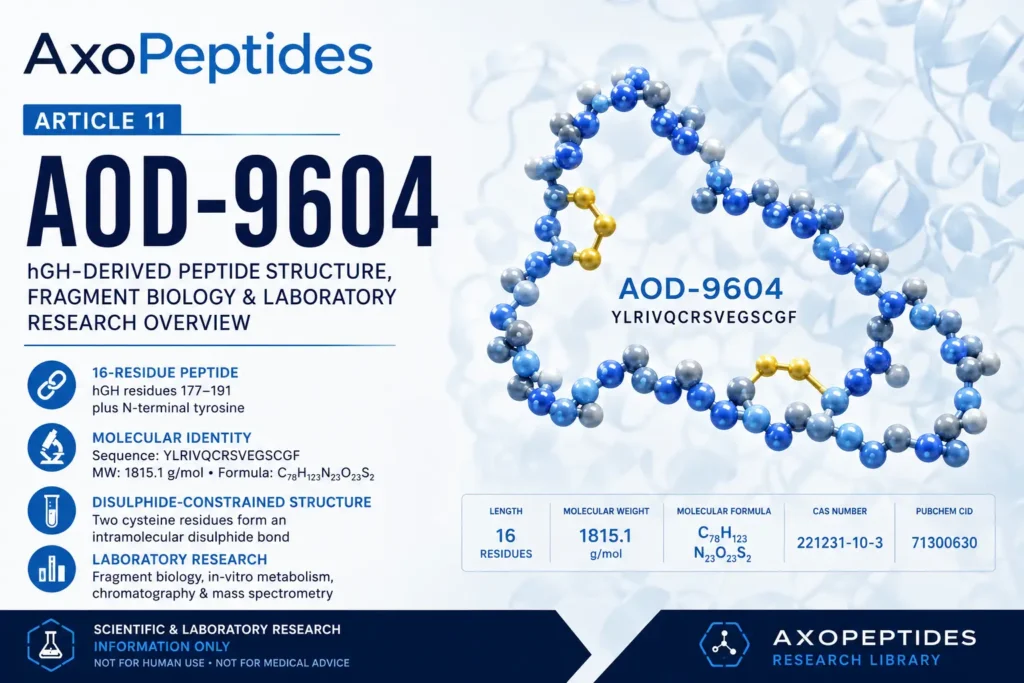
A scientific overview of AOD-9604 covering its 16-residue hGH-derived peptide architecture, amino-acid sequence, disulphide-constrained structure, experimental research and analytical characterisation.